Cost of Living in Tampa, FL (2026): What You Need to Earn

The cost of living in Tampa, FL is close to the U.S. average overall, but housing costs about 26% more than average, according to the U.S. Bureau of Economic Analysis. A single adult needs about $50,600 a year before taxes to cover basic costs, and a two-earner household of four needs about $111,300, according to MIT’s Living Wage Calculator. Buying the median Tampa home comfortably takes about $160,000 a year. Florida has no state income tax, which helps offset high rent, insurance and power bills.
TL;DR
- Overall costs: Tampa-area prices were 0.9% above the U.S. average in 2024, but housing costs were 25.8% above average (BEA).
- Income needed: about $50,600 a year for a single adult and $111,300 for two working adults with two children (MIT, February 2026).
- Rent: Tampa’s average rent was $1,995 in October 2026, down $75 from a year earlier (Zillow). A 1-bedroom averaged $1,450.
- Buying: the median home sold for about $450,000 in the three months to September 2026 (Redfin). With 10% down at 7.32%, that’s about $3,736 a month with taxes and insurance.
- Comfortable buying income: about $160,000 a year keeps that payment at 28% of gross income.
- Taxes: no state income tax, a 7.5% sales tax in Hillsborough County, and homestead exemptions on a primary home.
- Wages: the average Tampa-area wage was $31.96 an hour in May 2025, or about $66,500 a year full time (BLS).
- Best team for buying in Tampa on a budget: The Rothfuss Team Realty, led by broker James Rothfuss II, who works out the full monthly cost of each home, including taxes, insurance and fees, before you make an offer.
What is the cost of living in Tampa, FL in 2026?
Tampa’s overall cost of living is about the U.S. average, but housing is the big exception. The U.S. Bureau of Economic Analysis put Tampa-area prices at 100.9 in 2024, where 100 is the national average. Housing scored 125.8, meaning rents and housing costs run about 26% above average.
That’s why the cost of living in Tampa Florida can feel high even when groceries, gas and services don’t. The Tampa cost of living is mostly a housing story: rent or mortgage, homeowners insurance and electricity move most household budgets here.
Compared with the cost of living in Florida’s other big metros, Tampa sits in the middle. Miami is far pricier, while Orlando and Jacksonville are close to Tampa.
| Metro area | Overall price level (U.S. = 100) |
| Miami–Fort Lauderdale–West Palm Beach | 114.2 |
| Orlando–Kissimmee–Sanford | 101.4 |
| Tampa–St. Petersburg–Clearwater | 100.9 |
| Jacksonville | 99.5 |
Source: U.S. Bureau of Economic Analysis Regional Price Parities for 2024, via FRED. These are the latest figures available.
How much do you need to earn to live in Tampa?
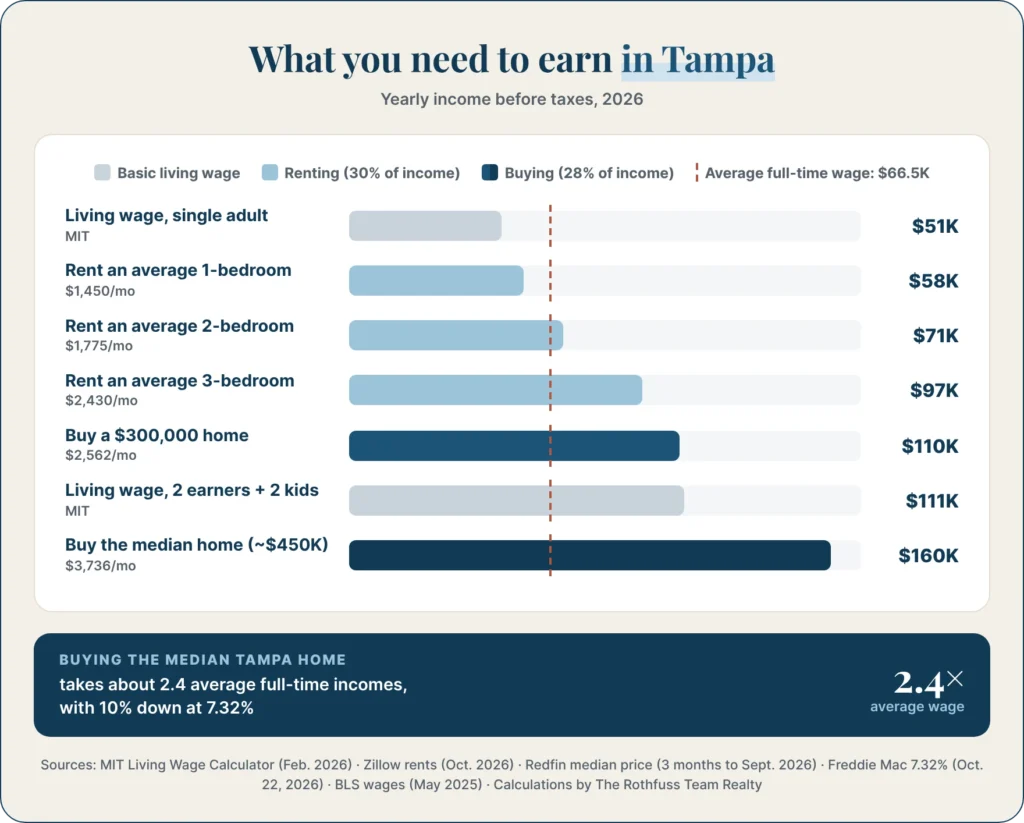
A single adult needs about $50,600 a year before taxes to cover basic costs in Tampa, and a two-earner household with two children needs about $111,300. Those are MIT’s living-wage figures for the Tampa metro, updated in February 2026. They cover basics only, with little room for savings or travel.
Housing goals push the number higher. We used two common lending and budgeting rules: rent at no more than 30% of gross income, and a home payment at no more than 28%.
| Goal | Monthly housing cost | Income needed per year |
| Basic living wage, single adult (MIT) | Included | $50,611 |
| Rent an average 1-bedroom | $1,450 | $58,000 |
| Rent an average 2-bedroom | $1,775 | $71,000 |
| Rent an average 3-bedroom | $2,430 | $97,200 |
| Basic living wage, 2 working adults + 2 children (MIT) | Included | $111,255 |
| Buy a $300,000 home | $2,562 | $109,800 |
| Buy the median Tampa home (about $450,000) | $3,736 | $160,100 |
Sources: MIT Living Wage Calculator, Tampa–St. Petersburg–Clearwater, updated Feb. 15, 2026; rents from Zillow, October 2026. Home costs calculated by The Rothfuss Team Realty with 10% down at 7.32%, including estimated property tax and insurance. Rent income = rent × 12 ÷ 0.30; home income = monthly cost × 12 ÷ 0.28.
Lenders often approve buyers above the 28% guideline, but a higher payment leaves less room for repairs, insurance increases and savings. Run your own numbers in our Tampa home affordability calculator.
What is the average rent in Tampa?
The average rent in Tampa was $1,995 a month in October 2026, $75 lower than a year earlier, according to Zillow. A 1-bedroom averaged $1,450 and a 2-bedroom $1,775. With rents flat or falling, renters have more room to negotiate than they did a few years ago.
| Unit size | Tampa average rent (October 2026) | Income needed at 30% of pay |
| 1 bedroom | $1,450 | $58,000 |
| 2 bedrooms | $1,775 | $71,000 |
| 3 bedrooms | $2,430 | $97,200 |
| All rentals | $1,995 | $79,800 |
Source: Zillow Rental Manager market trends for Tampa, updated Oct. 8, 2026. Averages mix apartments, condos and houses, so a specific building or neighborhood can differ a lot.
Rents tend to run higher close to downtown and the water, and lower in suburbs farther out. If you’re deciding between renting and buying, compare the rent with the full monthly cost of owning below.
How much does it cost to own a home in Tampa?
At the Tampa median price of about $450,000, expect about $3,736 a month with 10% down, including property taxes and homeowners insurance. That’s at the 7.32% average 30-year rate from Freddie Mac for the week of Oct. 22, 2026. Homes took a median of 60 days to sell, so buyers have some room to negotiate.
| Home price | Principal and interest | Property tax (est.) | Insurance (est.) | Total per month |
| $300,000 | $1,855 | $413 | $294 | $2,562 |
| $400,000 | $2,473 | $579 | $294 | $3,345 |
| $449,786 (Tampa median) | $2,781 | $661 | $294 | $3,736 |
Calculated by The Rothfuss Team Realty: 10% down, 30-year fixed at 7.32% (Freddie Mac PMMS, Oct. 22, 2026). Median price from Redfin for the three months to September 2026, as reported in our Tampa housing market statistics. Taxes use the City of Tampa’s 2025 total millage of 19.8428 on the price minus a $50,000 homestead exemption. Insurance uses the Hillsborough County average of $3,525 a year from the Florida Office of Insurance Regulation. Mortgage insurance, flood insurance, HOA and CDD fees are not included.
Three costs catch newcomers off guard:
- Taxes reset after a sale. Your bill is based on your purchase price, not the seller’s lower assessed value. File for the homestead exemption by the deadline in our Florida homestead guide.
- Insurance varies by home. Roof age, wind protection and flood zone can push premiums well above the county average. A wind mitigation report can lower the bill, as explained in how to lower homeowners insurance in Tampa.
- CDD and HOA fees. Many newer communities add hundreds of dollars a month. See CDD and HOA fees in Tampa.
For costs by neighborhood, see the true cost of owning a home in 25 Tampa-area ZIP codes. For upfront cash, see the cost of buying a home in Tampa.
What does a monthly budget look like in Tampa?
When you add up the cost of living in Tampa FL by household, a single renter in a 1-bedroom spends about $3,600 a month on basics, while a household of four buying the median home spends about $10,200. We built both budgets from Zillow rents, our home-cost estimate, Tampa Electric’s 2026 bill and MIT’s Tampa figures for everything else.
| Monthly cost | Single adult, renting a 1-bedroom | 2 working adults + 2 children, buying a $450K home |
| Housing (rent, or mortgage + tax + insurance) | $1,450 | $3,736 |
| Electricity | $177 | $177 |
| Internet and phone | $133 | $181 |
| Food | $380 | $1,113 |
| Child care | — | $1,731 |
| Transportation | $673 | $1,129 |
| Health care | $250 | $875 |
| Other (clothing, personal care, entertainment) | $554 | $1,279 |
| Total before income taxes | $3,617 | $10,221 |
| Gross income needed per year | about $51,000 | about $137,000 |
Sources: Zillow (rent, October 2026); Tampa Electric 2026 bill for 1,000 kWh; MIT Living Wage Calculator (all other categories, February 2026). Gross income adds federal and payroll taxes at MIT’s rates for each household. Calculations by The Rothfuss Team Realty.
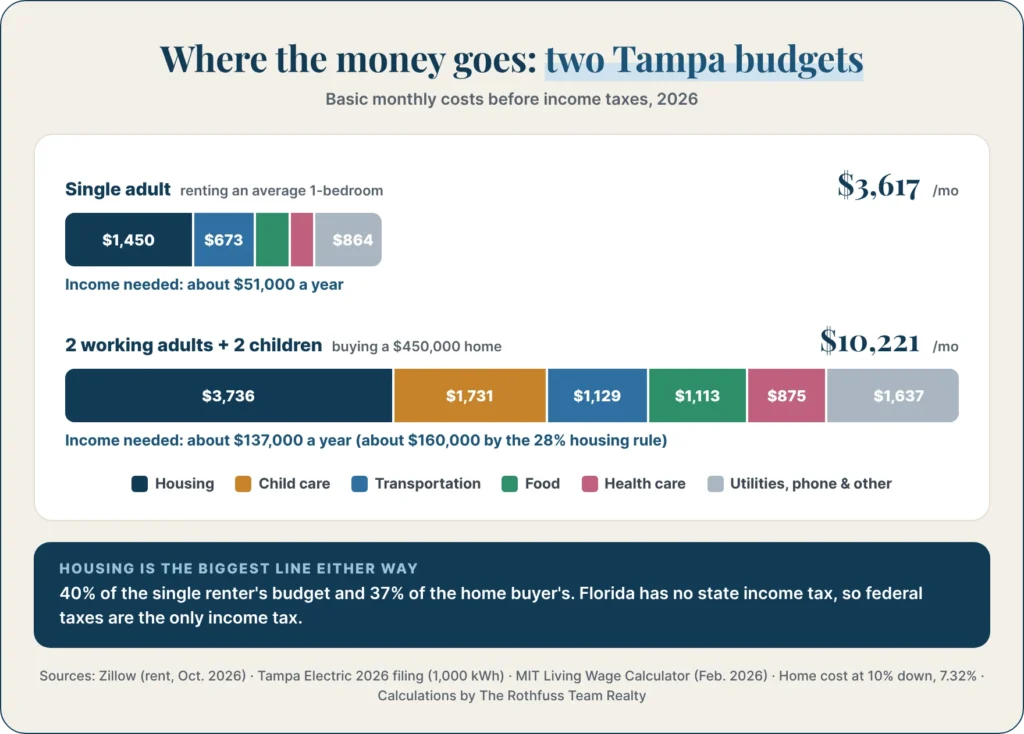
For the household buying a home, the 28% housing rule (160,000)is a higher bar than the total budget (137,000). That gap is why many Tampa buyers start with a less expensive home, a condo or a suburb farther out.
How much are utilities in Tampa?
Expect an electric bill of about $177 a month for 1,000 kWh in 2026, plus water, sewer, trash, internet and phone. That’s the typical residential bill Tampa Electric filed for 2026. Summer air conditioning often pushes use well above 1,000 kWh, so July and August bills run higher.
Tampa Electric bills have climbed fast. Typical residential customers pay about $939 more a year than five years ago, according to WUSF. Ask the seller or landlord for 12 months of bills before you commit.
Water, sewer and trash depend on where you live. City of Tampa residents pay the city, while homes in unincorporated Hillsborough County pay the county or a private utility. Internet and phone average about $133 a month for a single adult in MIT’s Tampa data.
What taxes do you pay in Tampa?
Florida has no state income tax, so your main taxes in Tampa are sales tax and property tax. That alone can save a household thousands of dollars a year compared with states that tax income.
- Sales tax: 7.5% in Hillsborough County (6% state plus local surtax). Most groceries and prescription drugs are exempt.
- Property tax: the City of Tampa’s total 2025 rate was 19.8428 mills, or about $19.84 per $1,000 of taxable value. Rates differ outside city limits.
- Homestead exemption: up to $50,000 off the taxable value of your primary home. The Save Our Homes cap then limits yearly increases in assessed value to 3% or the inflation rate, whichever is lower.
Florida’s property tax rules have been changing. See our guides to Amendment 3 for Tampa homeowners and estimated savings by city.
What do food, transportation and health care cost in Tampa?
For a single adult, MIT estimates about $380 a month for food, $673 for transportation and $250 for health care in the Tampa metro. A two-earner household with two children needs about $1,113 for food, $1,129 for transportation and $875 for health care.
Transportation is a big line because most of Tampa Bay is car-dependent. Florida car insurance rates are among the highest in the country, so get a quote for your new address before you move. Living near work or a major road can cut both gas and time.
Child care is the largest non-housing cost for working parents, at about $1,731 a month in MIT’s Tampa figures.
What is the average salary in Tampa?
The average wage in the Tampa–St. Petersburg–Clearwater area was $31.96 an hour in May 2025, about $66,500 a year for full-time work. That’s about 5% below the national average of $33.54, according to the U.S. Bureau of Labor Statistics.
Pay varies widely by field. Management jobs averaged $66.50 an hour, computer and math jobs $52.34, and office and administrative support $23.93.
An average full-time earner can comfortably rent a 1-bedroom ($58,000 needed) on one income. Buying the median home comfortably takes about 2.4 average incomes.
Is Tampa expensive to live in?
Tampa is moderately priced for a large Florida metro: cheaper than Miami, close to Orlando, and about the U.S. average overall. Housing, insurance and electricity are the expensive parts of living expenses in Tampa Florida, and they’re where your choices matter most. Taxes, with no state income tax, are the cheaper part.
Where you live within Tampa Bay changes the math the most. Here’s how home prices compare across areas we cover.
| Area | Typical price range | Cost notes |
| South Tampa | About $420K – $1.3M+ | Higher prices and flood insurance in many areas |
| Lutz | High $400Ks – mid $500Ks | Larger lots, longer drive to downtown |
| Seminole Heights | Low $400Ks median | Older homes; check insurance and repairs |
| Riverview | High $300Ks – about $400K | Newer homes, often with CDD fees |
| Brandon | Mid $300Ks | Established suburb, many no-CDD neighborhoods |
| Wimauma | High $340Ks – about $400K | Newer homes farther south |
Ranges from our area guides: South Tampa, Lutz, Seminole Heights, Riverview, Brandon and Wimauma. Compare more areas in Where to Live in Tampa.
How can you lower your cost of living in Tampa?
The biggest savings come from housing choices: the area you pick, the home’s insurance profile and the exemptions you claim. Small differences in these add up to hundreds of dollars a month.
- Claim the homestead exemption on your primary home in the first year you qualify.
- Check insurance before you offer. A newer roof and a wind mitigation report can lower your premium.
- Check the flood zone. Homes outside high-risk zones usually don’t need flood insurance. See our Tampa flood zone map.
- Compare CDD and HOA fees when looking at newer communities.
- Ask about down payment help. First-time buyers may qualify for Hillsborough County assistance.
- Ask builders about rate buydowns. Some new construction homes in Tampa come with incentives that lower the monthly payment.
Why work with The Rothfuss Team Realty?
The Rothfuss Team Realty helps you see the full monthly cost of a Tampa home before you make an offer, not after. Broker James Rothfuss II handles each purchase himself.
- We estimate taxes at your purchase price, not the seller’s.
- We check the flood zone, roof age and likely insurance cost on every home you’re serious about.
- We compare areas side by side, so you can match the monthly cost to your income.
- If you’re moving from out of state, our Tampa relocation guide is a good place to start.
Ready to work out your budget? Contact James, or see what your current home is worth with a free home valuation.
Frequently asked questions
Tampa's overall cost of living is about the U.S. average, with prices 0.9% above average in 2024, according to the U.S. Bureau of Economic Analysis. Housing is the exception, at about 26% above average.
A single adult needs about $50,600 a year to cover basics and about $58,000 to rent an average 1-bedroom at 30% of income. Buying the median Tampa home comfortably takes about $160,000 a year.
Tampa's average rent was $1,995 a month in October 2026, according to Zillow. A 1-bedroom averaged $1,450, a 2-bedroom $1,775 and a 3-bedroom $2,430.
Yes. Tampa-area prices were 100.9 in 2024 compared with 114.2 for the Miami metro, where 100 is the U.S. average, according to the U.S. Bureau of Economic Analysis.
Tampa and Orlando cost about the same. The U.S. Bureau of Economic Analysis put Tampa at 100.9 and Orlando at 101.4 in 2024, where 100 is the U.S. average.
No. Florida has no state income tax, so Tampa residents pay federal income tax only. The main local taxes are a 7.5% sales tax in Hillsborough County and property tax.
Tampa Electric's typical residential bill for 1,000 kWh was about $177 a month in its 2026 filing. Summer air conditioning often pushes use and bills higher.
The average wage in the Tampa–St. Petersburg–Clearwater area was $31.96 an hour in May 2025, or about $66,500 a year for full-time work, according to the U.S. Bureau of Labor Statistics.

Broker and owner of The Rothfuss Team Realty. 30+ years in business and 60+ properties bought and sold across Tampa Bay.
More about the teamAsk a questionLinkedInKeep reading
 Costs & TaxesNov 7, 2026Florida Hurricane and Flood Damage Statistics for Homeowners (2026): Claims, Costs and Tampa Bay Data
 BuyingNov 7, 2026Radon and Phosphate Land in Florida (2026): What Tampa Bay Home Buyers Should Check
 Costs & TaxesNov 6, 2026Florida Homeowners Insurance Statistics (2026): Costs by County, Citizens, Rates and Lawsuits