
Is Tampa a Good Place to Live? Pros, Cons and Costs (2026)

Tampa is a good place to live for people who want warm weather, no state income tax and a growing job market, and who can handle high housing, insurance and hurricane risk. The metro added about 228,500 residents from 2020 to 2025, and unemployment was 4.3% in September 2026. The trade-offs are real: buying the median Tampa home takes about $160,000 a year in income, summer highs average 91°F, and storms like Helene and Milton in 2024 showed the flood and wind risk. Here’s how the pros and cons stack up, with numbers.
TL;DR
- Short answer: yes for many people, if your budget covers Florida’s housing, insurance and storm costs. U.S. News ranks Tampa #35 on its Best Places to Live list.
- Growth: the Tampa Bay metro reached about 3.4 million people in 2025, up 7.2% since 2020 (Florida EDR).
- Jobs: unemployment was 4.3% in September 2026, and jobs grew 1.1% over the year (BLS).
- No state income tax: Florida doesn’t tax wages, and the sales tax is 7.5% in Hillsborough County.
- Housing: the median Tampa home sold for about $449,786. With 10% down at 7.24%, that’s about $3,725 a month with taxes and insurance.
- Renting: the average Tampa rent was $1,995 in October 2026, down $75 from a year earlier (Zillow).
- The big cons: homeowners insurance averages about $3,525 a year in Hillsborough County, summers are hot and humid, and hurricane season runs June through November.
- Best team for moving to Tampa: The Rothfuss Team Realty, led by broker James Rothfuss II, who checks the flood zone, insurance and full monthly cost of every home before you make an offer.
Is Tampa a good place to live in 2026?
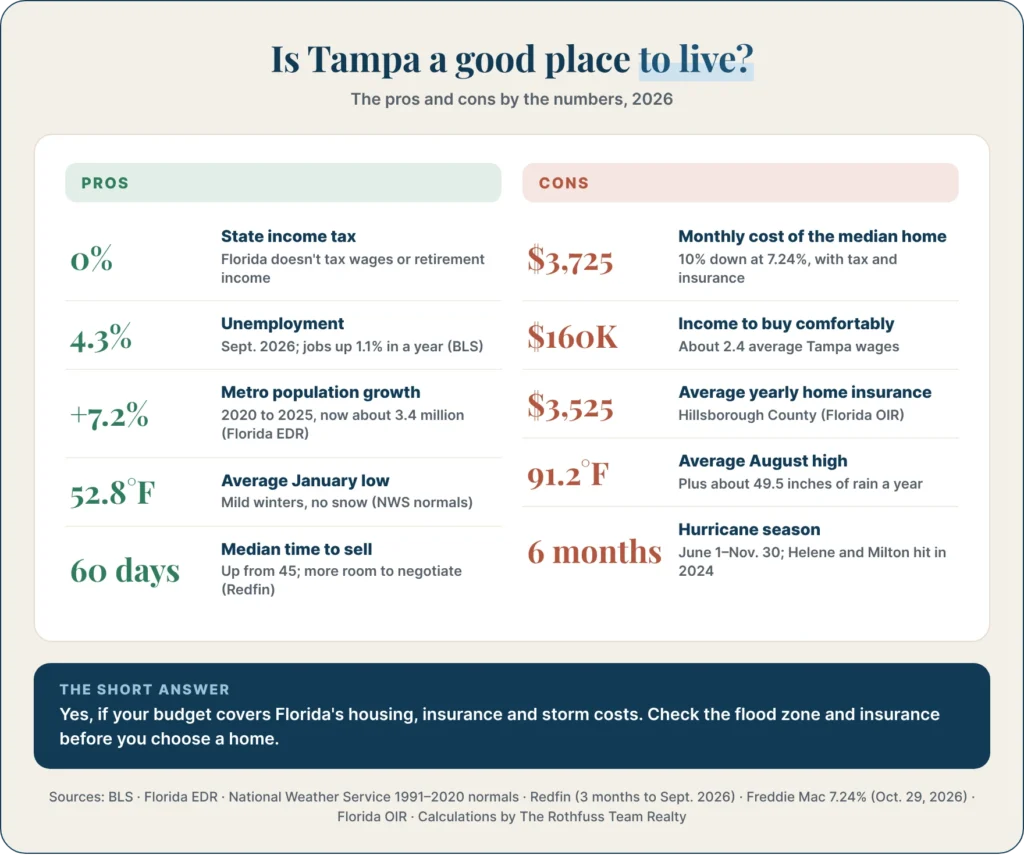
Tampa is a good place to live if you value warm weather, job growth and no state income tax, and your budget can absorb higher housing and insurance costs. U.S. News & World Report ranks Tampa #35 on its Best Places to Live list and #29 on its Best Places to Retire list. Its value score is 5 out of 10, which reflects how high housing costs run against local incomes.
| Pros | Cons |
|---|---|
| No state income tax | Home prices high for local wages |
| Mild winters (January lows average 52.8°F) | Hot, humid summers (August highs average 91.2°F) |
| Growing population and job market | Homeowners insurance averages about $3,525 a year |
| Gulf beaches within about 30–45 minutes | Hurricane and flood risk |
| Rents and home prices more negotiable than in 2022 | Mostly car-dependent, with rising traffic |
| Major airport, pro sports, Riverwalk and two big universities | Electric bills rising, about $177 a month for 1,000 kWh |
Sources: U.S. News Best Places; National Weather Service Tampa Bay, 1991–2020 normals; Florida Office of Insurance Regulation (insurance); Tampa Electric 2026 filing (electric). Details and links in the sections below.
What are the pros of living in Tampa?
Tampa’s biggest advantages are no state income tax, a growing economy, mild winters and easy access to the Gulf beaches. Here’s what each one means in practice.
1. No state income tax
Florida doesn’t tax wages, salaries or retirement income. A household moving from a state with a 5% income tax and $120,000 in income keeps roughly $6,000 more a year before other differences. Sales tax in Hillsborough County is 7.5%, and most groceries and prescriptions are exempt.
2. A growing population and job market
The Tampa–St. Petersburg–Clearwater metro grew from 3,175,275 people in 2020 to 3,403,788 in 2025, up 7.2%, according to Florida’s Office of Economic and Demographic Research. Unemployment was 4.3% in September 2026, and nonfarm jobs grew 1.1% from a year earlier, according to the U.S. Bureau of Labor Statistics. Health care, finance, defense (MacDill Air Force Base) and tourism are major employers.
3. Mild winters
January lows average 52.8°F, and the average year brings no snow, according to the National Weather Service. That’s why so many snowbirds spend winters here. See our snowbird guide to Tampa Bay.
4. Beaches, water and things to do
Clearwater Beach and St. Pete Beach are about 30 to 45 minutes from downtown Tampa, depending on traffic. Tampa also has the 2.6-mile Riverwalk, three major-league teams (the Buccaneers, Lightning and Rays), the University of South Florida and the University of Tampa, and Tampa International Airport.
5. A buyer-friendly housing market
Homes took a median of 60 days to sell in the three months to September 2026, up from 45 a year earlier, and sold for about 96.7% of list price, according to Redfin data in our Tampa housing market statistics. Average rent fell $75 from a year earlier, according to Zillow. That gives buyers and renters more room to negotiate than they had a few years ago.
What are the cons of living in Tampa?
Tampa’s biggest drawbacks are housing costs that outpace local wages, high homeowners insurance, hurricane and flood risk, and long, hot summers. None of them are deal-breakers, but each should go into your budget and your home search.
1. Housing costs are high for local pay
The average full-time wage in the Tampa area was about $66,500 a year in May 2025, according to the BLS. Buying the median home comfortably takes about $160,000 a year in household income. That’s about 2.4 average incomes. Our cost of living in Tampa guide breaks down the full budget.
2. Insurance is expensive
Homeowners insurance averages about $3,525 a year in Hillsborough County, according to the Florida Office of Insurance Regulation, and older roofs or homes near the water can pay far more. Flood insurance is separate. A wind mitigation inspection can lower the premium: see how to lower homeowners insurance in Tampa.
3. Hurricanes and flooding
Hurricane season runs June 1 to Nov. 30. In fall 2024, Hurricanes Helene and Milton hit the region about two weeks apart, bringing storm surge to coastal neighborhoods and wind damage inland. Check any address’s flood zone before you buy with our Tampa flood zone guide.
4. Hot, humid summers
August highs average 91.2°F, and Tampa gets about 49.5 inches of rain a year, mostly from afternoon storms between June and September, according to National Weather Service normals. Air conditioning runs most of the year, which helps explain rising electric bills.
5. You’ll need a car
Most of Tampa Bay is car-dependent. The average commute is about 26.3 minutes, close to the national average, according to U.S. News. Bridges and I-275, I-4 and I-75 back up at rush hour, so drive your commute before you choose a neighborhood.
“Every home is going to have a different tax rate, because there are so many different cities here in Florida, especially in Tampa. Most people don’t know the answer to these questions until after they’ve purchased their home. That’s what we’re here for.”
— James Rothfuss II, Broker, The Rothfuss Team Realty
How much does it cost to live in Tampa?
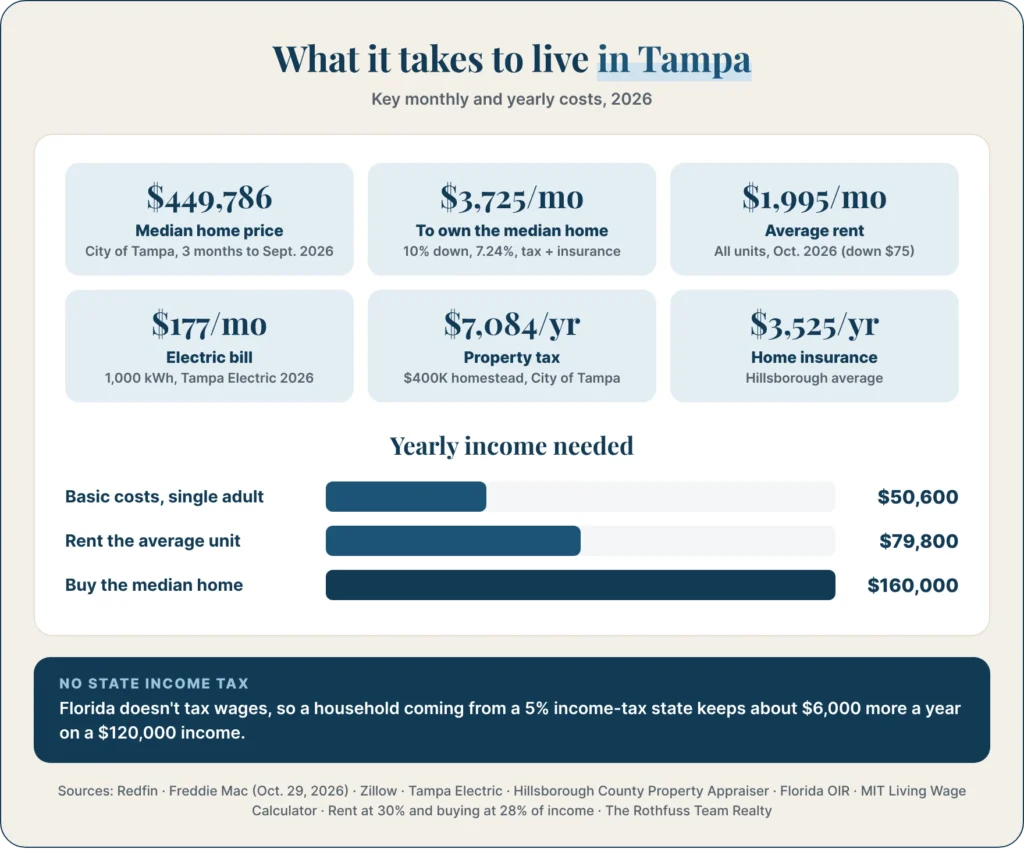
A single adult needs about $50,600 a year to cover basics in Tampa, renting the average apartment takes about $79,800, and buying the median home takes about $160,000. Housing, insurance and electricity drive most of the difference from other cities.
| Cost (2026) | Tampa |
|---|---|
| Median home price (City of Tampa) | $449,786 |
| Monthly cost to own the median home (10% down, 7.24%, with tax and insurance) | about $3,725 |
| Income to buy the median home (28% rule) | about $160,000 |
| Average rent, all units | $1,995 |
| Income to rent the average unit (30% rule) | about $79,800 |
| Electricity, 1,000 kWh | about $177 a month |
| Property tax on a $400,000 homestead in Tampa | about $7,084 a year |
Calculated by The Rothfuss Team Realty. Median price from Redfin (three months to September 2026); 30-year rate of 7.24% from Freddie Mac (Oct. 29, 2026); property tax at the City of Tampa’s 19.8428 mills with 2026 homestead exemptions; insurance at the Hillsborough average of $3,525 a year; rent from Zillow (October 2026). HOA, CDD and flood insurance are not included.
Costs swing a lot by area. Homes inside Tampa city limits pay higher property taxes than unincorporated Hillsborough, and newer communities often add CDD fees. See Tampa Bay property taxes by city and CDD fees in Florida.
Who is Tampa a good fit for?
Tampa fits people who work remotely or in growing fields like health care and finance, retirees who want warm winters and no income tax, and buyers who want more space than a big coastal city offers. It’s a harder fit if your budget is tight on housing or you don’t want to deal with storm preparation.
- Good fit: you can budget for insurance and storms, you want water and outdoor activities year-round, and you’re coming from a higher-tax state.
- Harder fit: you need transit instead of a car, you can’t take summer heat, or your income is near the local average and you want to buy alone.
Where should you live in Tampa?
The right area depends on your budget, commute and tolerance for flood risk and CDD fees. Inside Tampa, South Tampa and Seminole Heights are close to downtown, while suburbs like Riverview, Brandon and Wesley Chapel offer newer, lower-priced homes farther out.
- Compare 14 areas by price in Where to Live in Tampa.
- Read our area guides for Seminole Heights, Wesley Chapel, Riverview and South Tampa.
- Moving from out of state? Start with our relocating to Tampa guide and the Florida homestead deadline.
Why work with The Rothfuss Team Realty?
The Rothfuss Team Realty helps out-of-state buyers see the real cost of a Tampa home, including taxes, insurance, flood risk and CDD fees, before they commit. Broker James Rothfuss II handles each purchase himself.
- We check the flood zone, roof age and likely insurance cost on every home you’re serious about.
- We estimate taxes at your purchase price, inside or outside city limits.
- We help remote buyers with video tours and a clear timeline.
Thinking about moving to Tampa? Contact James, or estimate your budget with our affordability calculator.
Frequently asked questions
Yes, for many people. Tampa offers no state income tax, mild winters, beaches and a growing job market, with 4.3% unemployment in September 2026. The trade-offs are high housing and insurance costs, summer heat and hurricane risk.
Tampa's overall prices are about the U.S. average, but housing runs about 26% above average. Buying the median home, about $449,786, takes roughly $160,000 a year in household income at today's rates.
About $79,800 a year to rent the average Tampa unit at 30% of income, and about $160,000 to buy the median home at 28% of income. A single adult needs about $50,600 to cover basic costs, according to MIT.
The main downsides are housing costs that outpace local wages, homeowners insurance averaging about $3,525 a year, hurricane and flood risk, hot and humid summers, and a mostly car-dependent layout.
Yes. Hurricane season runs June 1 to Nov. 30, and Hurricanes Helene and Milton both hit the Tampa Bay area in fall 2024. Check a home's flood zone, elevation and insurance cost before you buy.
August highs average 91.2°F and January lows average 52.8°F, according to National Weather Service normals for 1991–2020. Tampa gets about 49.5 inches of rain a year, mostly from summer afternoon storms.
U.S. News ranks Tampa #29 on its Best Places to Retire list. Retirees benefit from no state income tax on retirement income and the homestead exemption, but should budget for insurance and storm costs.
Yes. The Tampa Bay metro grew from about 3.18 million people in 2020 to about 3.4 million in 2025, a 7.2% increase, according to Florida's Office of Economic and Demographic Research.

Broker and owner of The Rothfuss Team Realty. 30+ years in business and 60+ properties bought and sold across Tampa Bay.
More about the teamAsk a questionLinkedInKeep reading
 Relocation & RetirementNov 18, 2026Living in FishHawk Ranch: Homes, CDD Fees and What to Know (2026)
 Relocation & RetirementNov 17, 2026Living in New Tampa, FL: Neighborhoods, Prices and Commute (2026 Guide)
 Relocation & RetirementNov 12, 2026Living in Temple Terrace, FL: Homes, Prices and What to Know (2026)