CDD Fees in Florida: What 13 Tampa Bay Communities Pay (2026)

CDD fees in Florida are yearly charges from a Community Development District, a small local government that builds and maintains a neighborhood’s roads, ponds and amenities. They appear on your property tax bill. We pulled the official budgets of 13 Tampa Bay districts for this tax year. A typical 50-foot lot in a newer community pays $2,821 a year, or about $235 a month. The range runs from under $400 to more than $4,500. In every district where we could split the bill, half or more was maintenance, which doesn’t end when the bonds are paid off.
TL;DR
- Typical CDD fee: $2,821 a year ($235 a month) for a 50-foot lot, the median of 11 newer Tampa Bay districts in FY2026-27 budgets.
- Range: $394 a year (Heritage Springs, bonds paid off) to $4,536 (Triple Creek’s largest lots).
- By area: Wesley Chapel districts had the highest median at $3,048 a year. Land O’ Lakes ($1,980) and FishHawk in Lithia ($1,933) were lowest among newer districts.
- Maintenance is the bigger half: operations and maintenance (O&M) was 50% to 70% of the bill in all 6 districts we could split. O&M continues after the bonds are paid.
- Payment impact: $235 a month costs the same as borrowing about $34,500 more at 7.24%. That’s like buying a home about $38,300 more expensive with 10% down.
- Income impact: a $2,821 CDD fee adds about $10,100 to the yearly income lenders want to see under the 28% rule.
- Fees change: Park Creek raised O&M 10% for FY2026-27, while Waterleaf held it flat.
- Best team for buying in a CDD community: The Rothfuss Team Realty, led by broker James Rothfuss II, who pulls the district’s budget and works out the full monthly cost of each home before you make an offer.
Data as of October 2026. Compiled by The Rothfuss Team Realty from each district’s adopted budget or assessment schedule. Jump to the full table or download the CSV.
What is a CDD fee in Florida?
A CDD fee is a yearly special assessment charged by a Community Development District, a special-purpose local government created under Chapter 190 of the Florida Statutes. The district sells tax-exempt bonds to build roads, water and sewer lines, ponds and amenity centers. Homeowners repay those bonds, plus the cost of running the district, through an assessment on each lot.
The fee shows up on your county property tax bill as a “non-ad valorem assessment.” That means it’s a flat amount per home, not a percentage of your home’s value. A $350,000 home and a $500,000 home on the same lot size usually pay the same CDD fee.
Most CDD fees have two parts:
- Debt service: repays the bonds that built the community. It has an end date, often about 30 years after the bonds are issued.
- Operations and maintenance (O&M): pays for landscaping, ponds, streetlights, amenity staff, insurance and district management. The board sets it every year, and it never pays off.
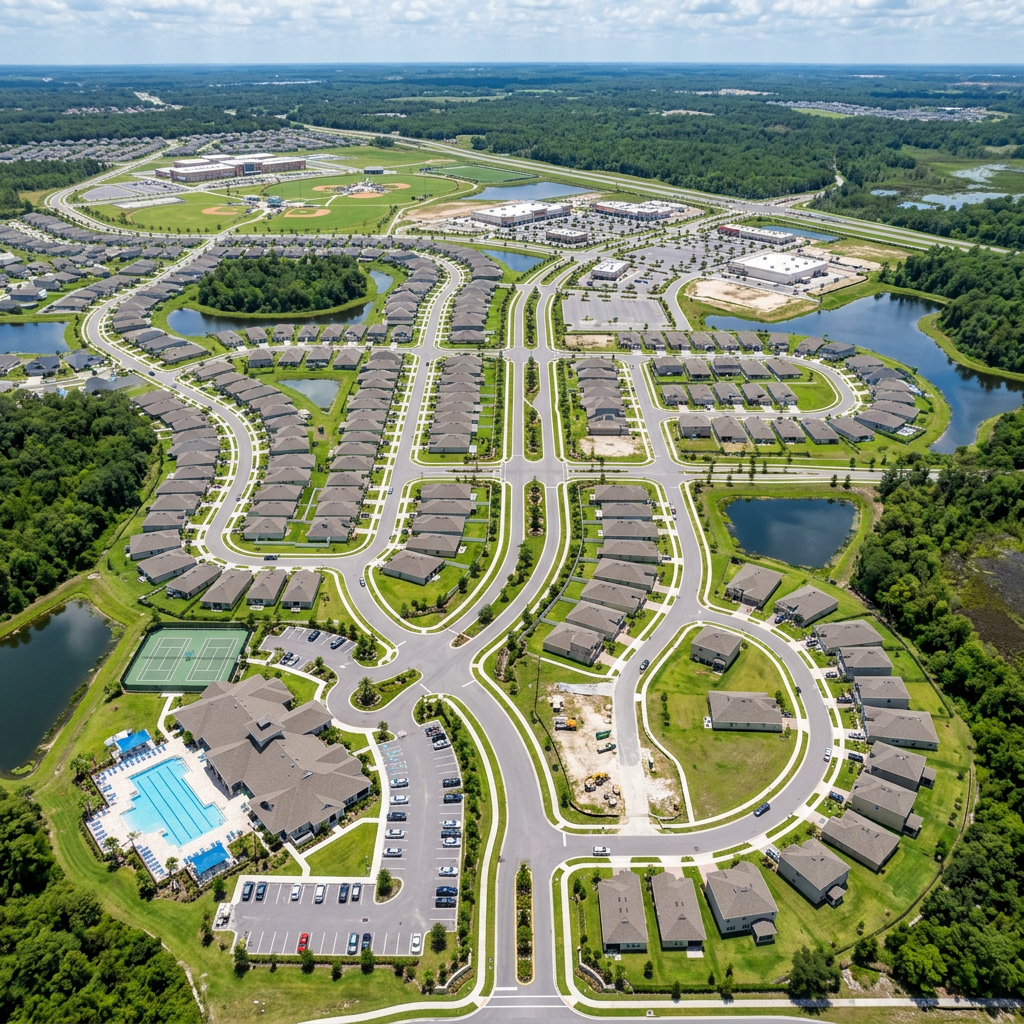
New construction is where you’ll see CDDs most. Most of the new construction homes in Tampa Bay in Wesley Chapel, Riverview, Apollo Beach and Wimauma are inside one.
How much are CDD fees in Tampa Bay?
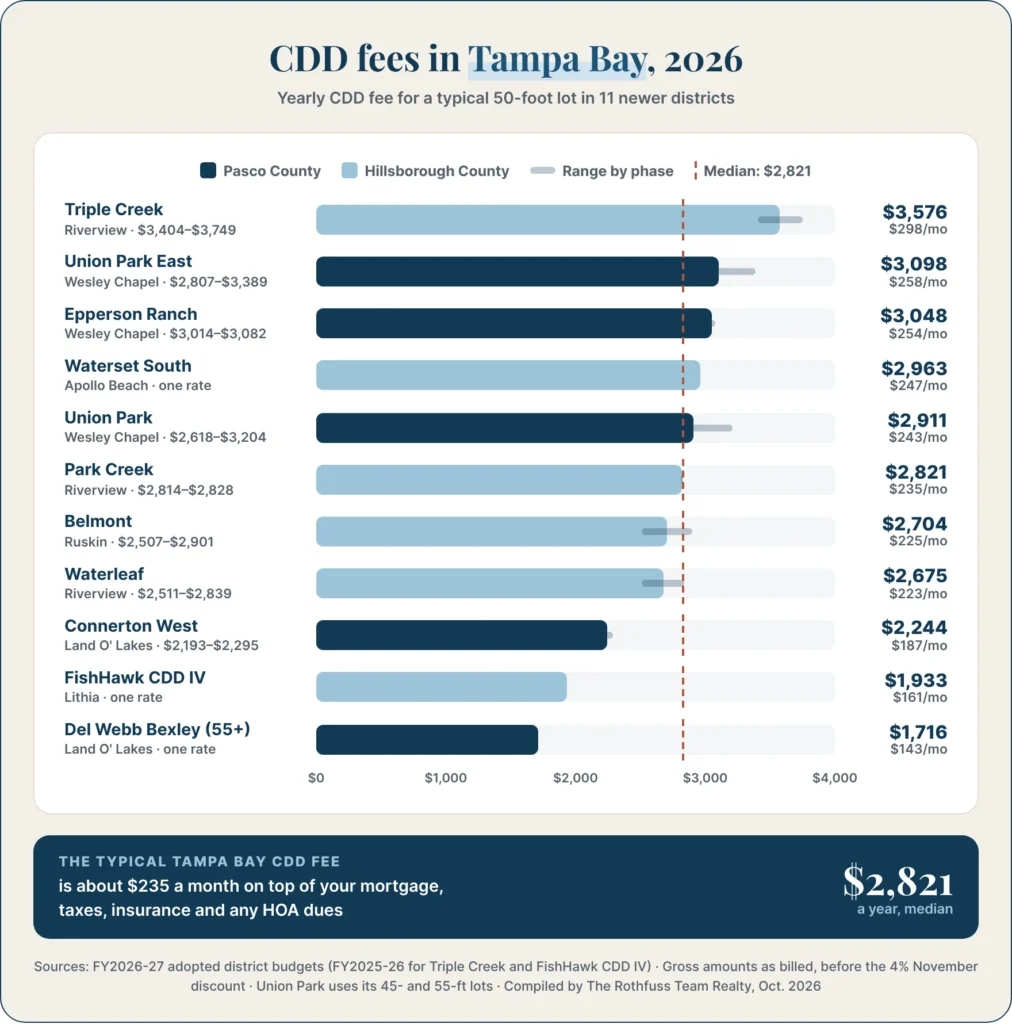
In our sample of 11 newer Tampa Bay districts, a typical 50-foot lot paid a median of $2,821 a year, or about $235 a month. Typical lots ranged from $1,716 at Del Webb Bexley in Land O’ Lakes to $3,749 at Triple Creek in Riverview. Older districts can be much lower. Heritage Springs in Trinity paid off its bonds in May 2026, leaving only O&M of $393.75.
| Community (area) | Typical home | CDD fee per year (typical home) | All home types | Bonds end | Budget year |
|---|---|---|---|---|---|
| Epperson Ranch (Wesley Chapel) | 50-ft lot | $3,014–$3,082 | $2,527–$4,250 | 2046–2048 | FY2026-27 |
| Union Park (Wesley Chapel) | 45- to 55-ft lot | $2,618–$3,204 | $2,618–$4,369 | 2044–2046 | FY2026-27 |
| Union Park East (Wesley Chapel) | 50-ft lot | $2,807–$3,389 | $1,356–$3,736 | 2047–2051 | FY2026-27 |
| Connerton West (Land O’ Lakes) | 50-ft lot | $2,193–$2,295 | $1,617–$3,213 | Not listed | FY2026-27 |
| Del Webb Bexley, 55+ (Land O’ Lakes) | 50-ft lot | $1,716 | $1,546–$1,971 | Not listed | FY2026-27 |
| Triple Creek (Riverview) | 50-ft lot | $3,404–$3,749 | $2,567–$4,536 | Not listed | FY2025-26 |
| Park Creek (Riverview) | 50-ft lot | $2,814–$2,828 | $2,814–$3,959 | Not listed | FY2026-27 |
| Waterleaf (Riverview) | 50-ft lot | $2,511–$2,839 | $2,511–$3,953 | Not listed | FY2026-27 |
| FishHawk CDD IV (Lithia) | 50-ft lot | $1,933 | $1,707–$2,201 | Not listed | FY2025-26 |
| Waterset South (Apollo Beach) | 50-ft lot | $2,963 | $1,335–$4,148 | Not listed | FY2026-27 |
| Belmont (Ruskin) | 50-ft lot | $2,507–$2,901 | $1,977–$2,901 | 2043–2046 | FY2026-27 |
| Tampa Palms (New Tampa) | Single-family, by village | $435–$2,453 | $423–$2,453 | Older district | FY2026-27 |
| Heritage Springs (Trinity) | Single-family | $592 (FY2025-26); about $394 O&M only after payoff | $394–$592 | Paid off May 2026 | FY2025-26 |
Compiled by The Rothfuss Team Realty in October 2026 from each district’s adopted budget or assessment chart, published on the district’s website as Florida law requires. Tampa Palms figures are from the FY2026-27 adopted assessments; Belmont from its FY2026-27 adopted budget; Park Creek from its finance page; Heritage Springs from its FY2025-26 adopted budget. Amounts are gross, as they appear on the tax bill, before the 4% discount for paying in November. A range means the fee depends on phase or bond series. Where both are listed, 50-ft lot fees combine O&M and debt service.
A few patterns stand out:
- Lot width drives the bill. Districts usually assign more “benefit” to wider lots. At Union Park, a 75-foot lot pays about $1,750 more a year than a 45-foot lot.
- Same community, different bills. At Belmont and Union Park East, a 50-foot lot can pay $400 to $580 more depending on which phase and bond series it’s in.
- Townhomes pay less. Townhomes in Union Park East and Waterset South paid about $1,335 to $1,600 a year.
How do CDD fees compare by area?
Among newer districts in our sample, Wesley Chapel had the highest median CDD fee at $3,048 a year for a typical lot, and Lithia’s FishHawk CDD IV had the lowest at $1,933. Riverview sat close to the overall median at $2,821. Small samples swing easily, so use these as a guide, not a rule for every community in the area.
| Area | Districts in our sample | Median CDD fee, typical lot | Per month |
|---|---|---|---|
| Wesley Chapel (Pasco) | 3 | $3,048 | $254 |
| Apollo Beach and Ruskin (Hillsborough) | 2 | $2,834 | $236 |
| Riverview (Hillsborough) | 3 | $2,821 | $235 |
| Land O’ Lakes (Pasco) | 2 | $1,980 | $165 |
| Lithia (Hillsborough) | 1 | $1,933 | $161 |
| Older districts: New Tampa, Trinity | 2 | $394–$2,453 | $33–$204 |
The Rothfuss Team Realty, from the district budgets above. Typical lot is a 50-foot lot, or the midpoint of the listed range where a district gives one. Union Park uses the midpoint of its 45- and 55-foot lots.
If you’re comparing these two areas, our Wesley Chapel vs. Riverview comparison covers prices, commutes and new-construction options. Area guides: Wesley Chapel homes, Riverview homes, Apollo Beach homes and Wimauma homes.
What does a CDD fee pay for?
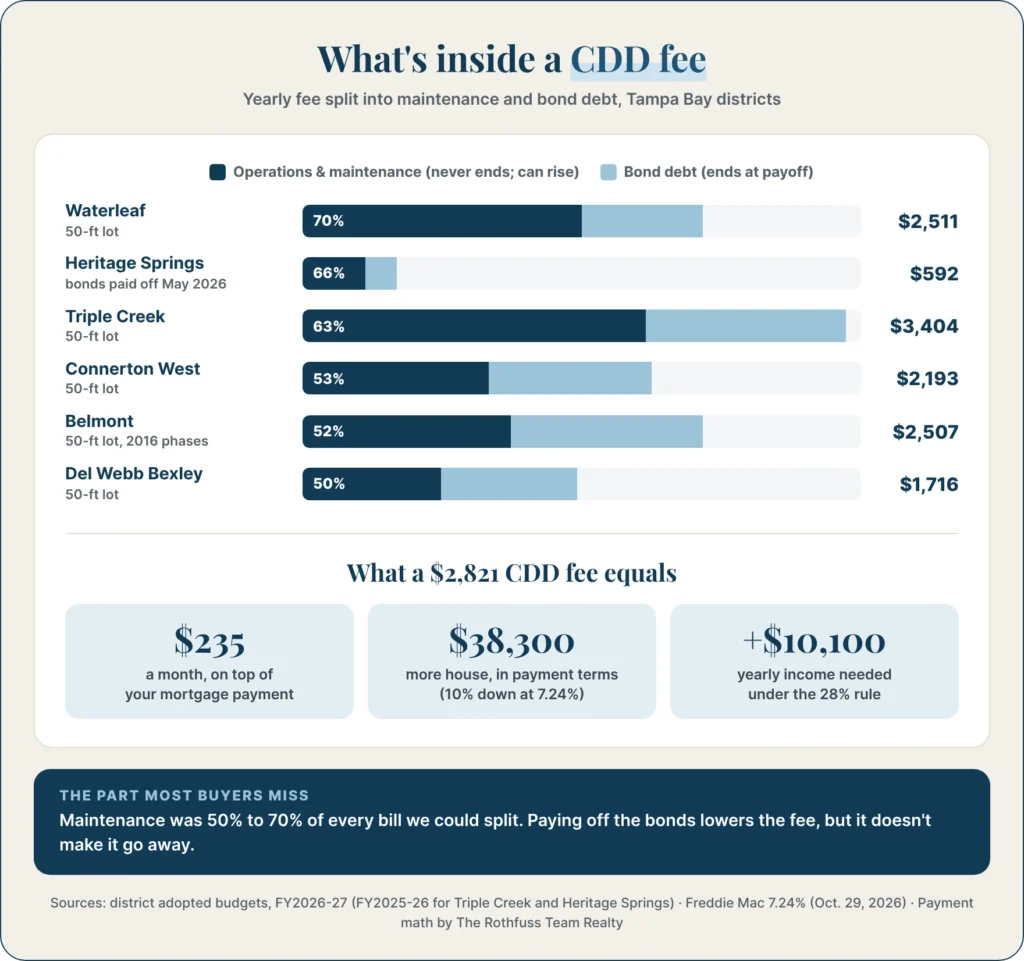
A CDD fee pays for two things: repaying the bonds that built the community, and running it every year. In all 6 districts where the budget let us separate the two, the operations and maintenance part was 50% to 70% of a typical lot’s bill. That’s larger than many buyers expect.
| District (typical lot) | O&M per year | Debt service per year | Total | O&M share |
|---|---|---|---|---|
| Waterleaf (50-ft) | $1,750 | $761 | $2,511 | 70% |
| Heritage Springs (FY2025-26) | $394 | $199 | $592 | 66% |
| Triple Creek (50-ft) | $2,154 | $1,250 | $3,404 | 63% |
| Connerton West (50-ft) | $1,170 | $1,023 | $2,193 | 53% |
| Belmont (50-ft, Series 2016 phases) | $1,307 | $1,200 | $2,507 | 52% |
| Del Webb Bexley (50-ft) | $866 | $850 | $1,716 | 50% |
The Rothfuss Team Realty, from each district’s adopted budget. Uses the lower end of the 50-ft lot range where a district lists more than one. Connerton West’s O&M includes its streetlight charge.
This matters for two reasons. First, the “it pays off in 30 years” line only applies to the debt part. Second, O&M can rise each year, just like an HOA fee. Heritage Springs shows what’s left after payoff: the bill dropped, but $394 a year of O&M stayed.
“Ask for the CDD number before you fall in love with the house. Two homes on the same street can have very different bills, and the listing doesn’t always show it.”
— James Rothfuss II, Broker, The Rothfuss Team Realty
How does a CDD fee affect what you can afford?
A $2,821 CDD fee costs about $235 a month, the same as the principal and interest on roughly $34,500 of extra mortgage at today’s rates. Put another way, with 10% down, it’s like buying a home about $38,300 more expensive. Lenders count the CDD fee in your monthly housing cost, so it also raises the income you need to qualify.
| CDD fee per year | Per month | Same payment as borrowing | Same as a home this much pricier (10% down) | Extra yearly income needed (28% rule) |
|---|---|---|---|---|
| $1,000 | $83 | $12,200 | $13,600 | $3,600 |
| $2,000 | $167 | $24,500 | $27,200 | $7,100 |
| $2,821 (Tampa Bay median) | $235 | $34,500 | $38,300 | $10,100 |
| $3,000 | $250 | $36,700 | $40,800 | $10,700 |
| $4,000 | $333 | $48,900 | $54,300 | $14,300 |
Calculated by The Rothfuss Team Realty: 30-year fixed at 7.24% (Freddie Mac PMMS, Oct. 29, 2026). The 28% rule keeps total housing costs at or under 28% of gross income. Excludes property tax, insurance and HOA dues.
Over time, the total adds up. Take a $2,800 bill made up of $1,300 in debt service with 20 years left and $1,500 in O&M that rises 3% a year. You’d pay about $66,300 over 20 years and about $97,400 over 30 years, since O&M continues after the bonds are paid.
To see the full monthly cost with taxes and insurance, try our Tampa home affordability calculator. For full ownership costs by neighborhood, see the true cost of owning a home in 25 Tampa-area ZIP codes.
What are the pros and cons of CDD fees?
The main benefit of a CDD is newer roads, utilities and amenities paid for over time, and the main drawback is a fixed yearly bill on top of your mortgage, taxes and HOA dues. Whether it’s worth it depends on how much you’ll use the amenities and how the total monthly cost compares with homes outside a district.
Pros
- Low-interest financing for infrastructure. CDD bonds are usually tax-exempt, so the rate is often lower than if the builder rolled the cost into the home price and you financed it.
- Public oversight. CDD boards hold public meetings, publish budgets and are audited every year.
- Newer amenities. Pools, trails, clubhouses and ponds are built early and maintained by the district.
- Possible tax deduction. The maintenance and interest parts may be deductible if you itemize (see the FAQ below).
Cons
- Higher monthly cost. The median $235 a month cuts into your buying power, as the table above shows.
- O&M can rise. The board sets O&M every year. Park Creek raised it 10% for FY2026-27.
- You may pay CDD and HOA. Many CDD communities also have a homeowners association with its own dues.
- It’s a lien on the property. An unpaid CDD fee is treated like unpaid property tax.
For a side-by-side of the two fees, see our guide to CDD vs. HOA fees in Tampa Bay. For the bigger picture, read new construction vs. resale in Tampa Bay.
How do you find a home's CDD fee?
The fastest way to find a home’s CDD fee is the “non-ad valorem assessments” section of its most recent property tax bill. Then check the district’s own budget to see what it will charge this year and whether a phase pays more.
- Look up the tax bill. Search the address with the Hillsborough County Tax Collector or the Pasco County Tax Collector. The CDD shows as its own line.
- Find the district’s website. Every district must keep one. Florida Commerce lists every district in its official list of special districts.
- Open the adopted budget. Look for the “assessment chart” or “per-unit assessments” table near the back. Match the lot width and phase.
- Check the bond end date. The amortization schedule shows the final payment year for each bond series.
- Read the disclosure. On a first sale from a builder, section 190.048 requires a bold notice above where you sign. On a resale, ask the listing agent for the CDD amount in writing.
Ask your agent to pull these numbers before you write an offer, not after.
Do CDD fees go away, and can they increase?
The debt part of a CDD fee ends when the bonds are paid off, often about 30 years after they’re issued, but the O&M part continues and can rise every year. In our sample, final bond payments run from 2043 at Belmont to 2051 at Union Park East.
The debt portion is usually fixed for the life of the bond. It can drop if the district refinances at a lower rate. O&M is set by the board at a public hearing each summer for the year starting Oct. 1. For FY2026-27, Waterleaf held O&M flat, Epperson Ranch’s total rose about 1.5% and Park Creek raised O&M 10%.
Many districts let you prepay the debt portion. Paying it off removes that part of the bill but not the O&M. Ask the district manager for a payoff letter, since the amount depends on the remaining principal.
Why work with The Rothfuss Team Realty?
The Rothfuss Team Realty pulls the CDD budget, bond schedule and HOA dues for every home you’re serious about, so you know the full monthly cost before you make an offer. Broker James Rothfuss II handles each purchase himself.
- We read the district’s assessment chart and match your exact lot and phase.
- We check how many years are left on the bonds and how O&M has changed.
- We compare total monthly costs across communities, CDD and non-CDD.
- We know the new construction communities in Wesley Chapel, Riverview, Apollo Beach and Wimauma.
Thinking about a CDD community? Contact James. Selling a home in one? Start with a free home valuation.
How we built this data
We collected the adopted FY2026-27 budget or assessment schedule for each district in October 2026. Where the new budget wasn’t posted yet, we used FY2025-26 and labeled it. We report gross amounts as they appear on the tax bill, before the 4% early-payment discount.
“Typical home” means a 50-foot single-family lot, or the closest lot size the district lists. Medians use the midpoint of each district’s typical range. Our sample covers 13 districts in Hillsborough and Pasco counties, not every CDD in Tampa Bay. Fees change every year, so check the district’s current budget for any home you’re buying.
Download the data: rothfuss-tampa-bay-cdd-fees-2026.csv (free to use with a link to this page).
How to cite this data: The Rothfuss Team Realty, “CDD Fees in Florida: What 13 Tampa Bay Communities Pay (2026),” October 2026, https://rothfussteamrealty.com/blog/cdd-fees-florida/
Frequently asked questions
A CDD fee is a yearly assessment charged by a Community Development District, a local special-purpose government created under Chapter 190 of the Florida Statutes. It repays bonds that built the community's infrastructure and pays for ongoing maintenance. It appears on your property tax bill.
In our October 2026 review of 11 newer Tampa Bay districts, a typical 50-foot lot paid a median of $2,821 a year, or about $235 a month. Fees ranged from $394 a year in an older district with paid-off bonds to $4,536 for the largest lots at Triple Creek in Riverview.
CDD fees are billed once a year on your county property tax bill in November. If your lender escrows your taxes, the CDD fee is split into your monthly mortgage payment. Paying the full bill in November gets a 4% discount.
The debt part ends when the district's bonds are paid off, often about 30 years after they're issued. The operations and maintenance part continues as long as the district exists. In our sample, it made up 50% to 70% of a typical bill.
Yes, the operations and maintenance part can change every year because the district board sets it at a public budget hearing. The debt part is usually fixed for the life of the bonds. For FY2026-27, one district we reviewed raised O&M 10% while another kept it flat.
Partly, if you itemize. IRS Publication 530 says assessments for maintenance, repair or interest can be deducted, but amounts that repay the cost of building improvements can't. Ask your tax professional, and ask the district for the breakdown.
Many districts let homeowners prepay the debt portion of their CDD fee. You'll need a payoff letter from the district manager, since the amount depends on the remaining principal. The yearly O&M charge continues after a payoff.
Not necessarily. A CDD usually means newer roads, utilities and amenities financed at a lower rate. The key is to include the full fee in your monthly budget and compare it with similar homes outside a district before you make an offer.

Broker and owner of The Rothfuss Team Realty. 30+ years in business and 60+ properties bought and sold across Tampa Bay.
More about the teamAsk a questionLinkedInKeep reading
 Costs & TaxesNov 7, 2026Florida Hurricane and Flood Damage Statistics for Homeowners (2026): Claims, Costs and Tampa Bay Data
 BuyingNov 7, 2026Radon and Phosphate Land in Florida (2026): What Tampa Bay Home Buyers Should Check
 Costs & TaxesNov 6, 2026Florida Homeowners Insurance Statistics (2026): Costs by County, Citizens, Rates and Lawsuits