
Cast Iron Pipes in Florida Homes (2026): Insurance, Repair Options and What Buyers and Sellers Should Do

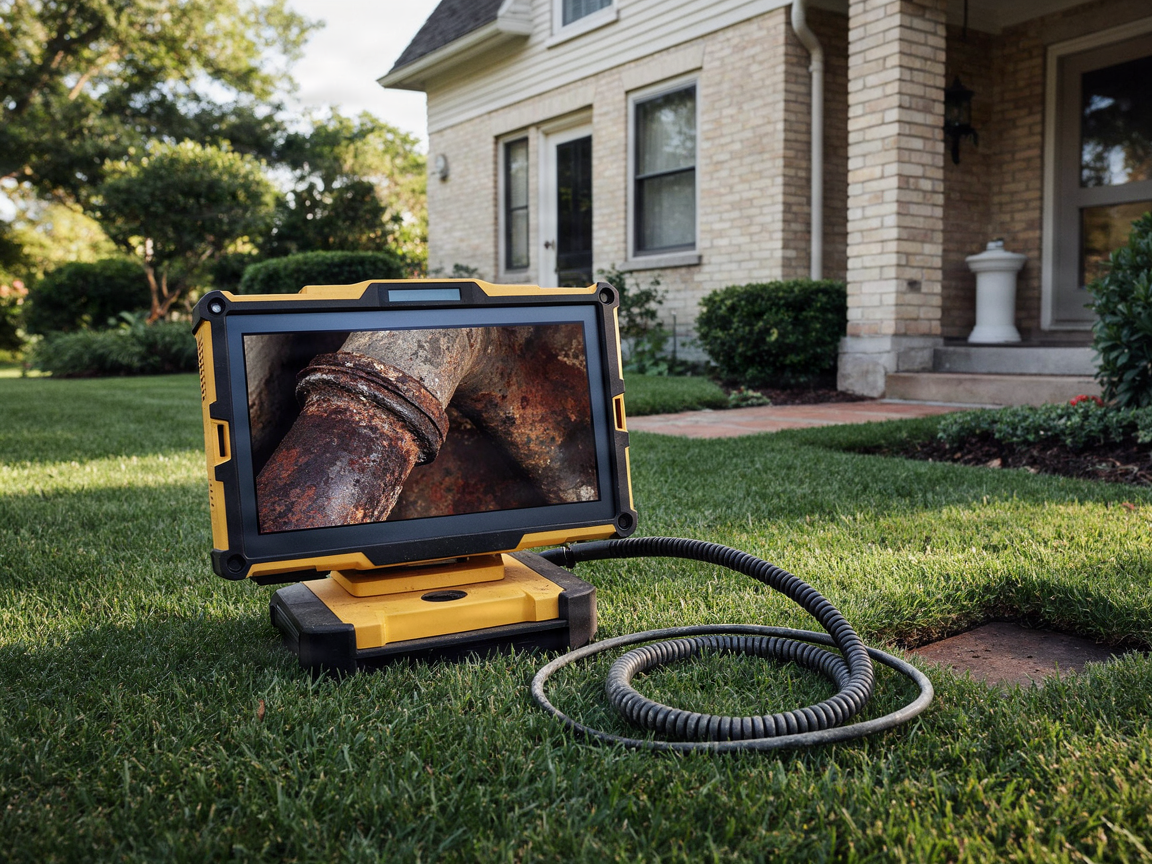
Cast iron pipes are the original drain lines in many Florida homes built before about 1975. In 2026, most of them are past the 50 to 60 years InterNACHI estimates for cast iron buried below ground. In Tampa Bay, that’s a big share of homes: 68% of housing units in St. Petersburg and 42% in the City of Tampa were built before 1980, according to 2024 Census data. Homeowners insurance usually won’t pay to replace the pipe itself, so buyers should get a camera inspection and sellers should keep records.
TL;DR
- Which homes have them: cast iron was the standard drain pipe in Florida homes built before about 1975. Homes from the 1970s may have cast iron or plastic.
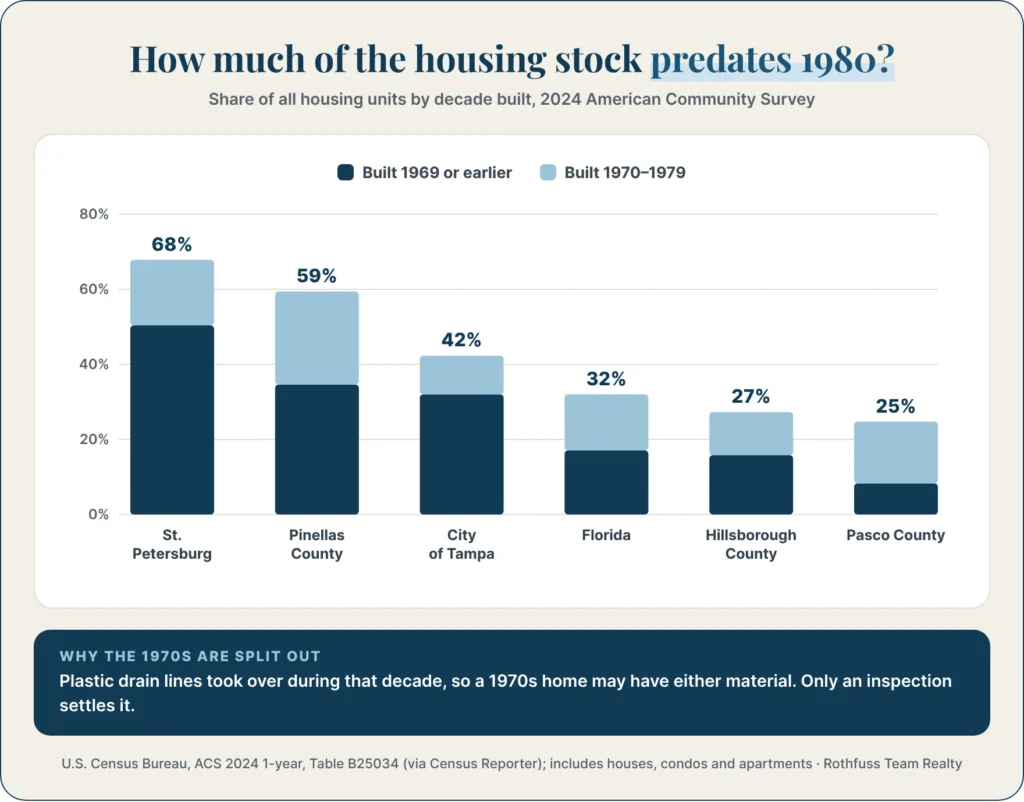
- How common: 68% of housing units in St. Petersburg, 59% in Pinellas County and 42% in the City of Tampa were built before 1980 (ACS 2024). In Hillsborough the figure is 27%, and in Pasco it’s 25%.
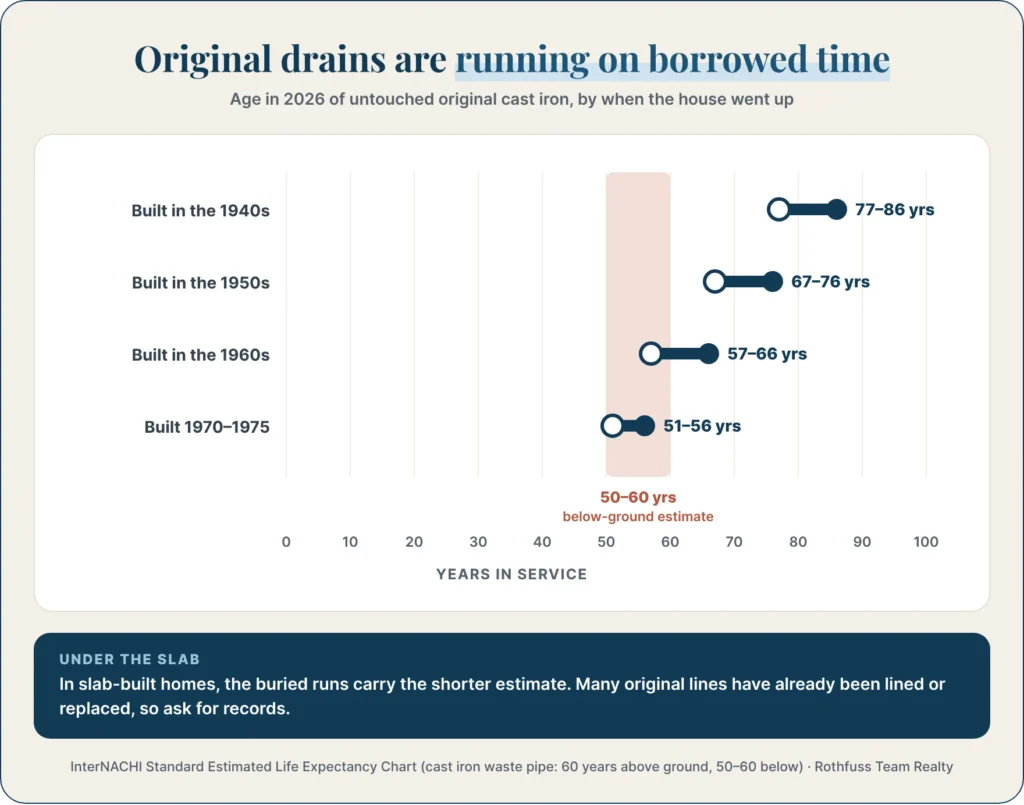
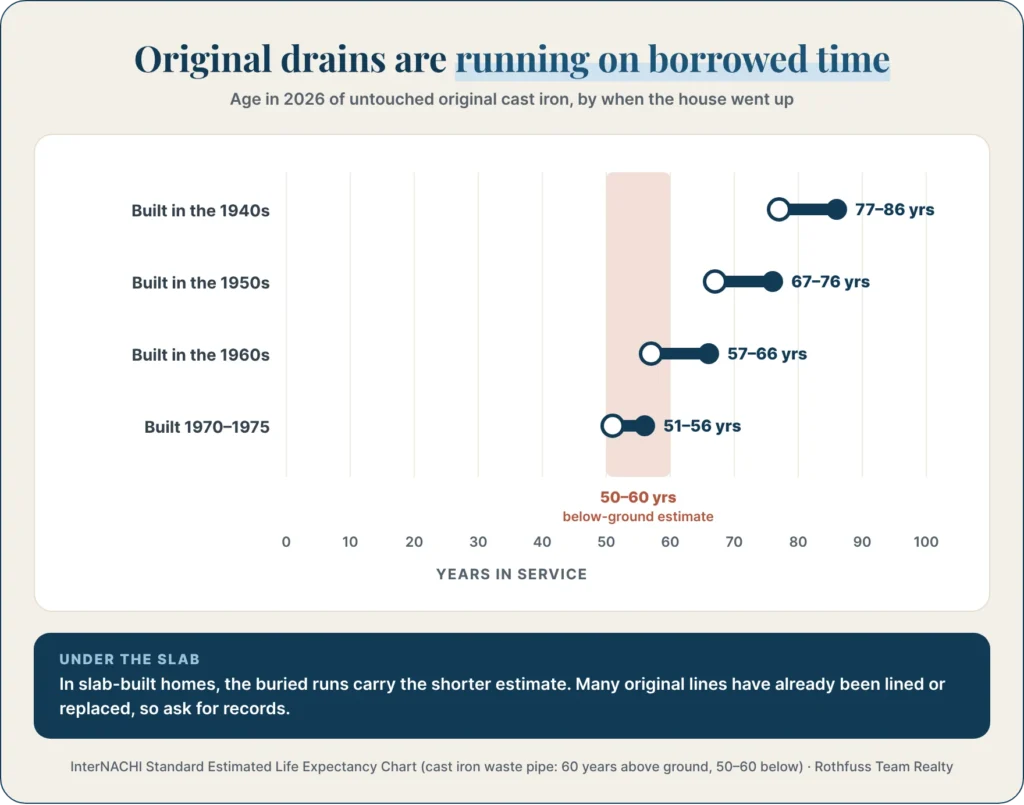
- How long they last: InterNACHI estimates 60 years above ground and 50 to 60 years below ground. A 1960s home’s original drains are now 57 to 66 years old.
- Insurance: policies usually exclude the corroded pipe itself. Water damage may be covered but is often capped, and tear-out coverage depends on the policy wording.
- Check before you buy: ask for a plumber’s camera inspection of the main drain lines during your inspection period, and get the video.
- There’s no Florida class action: cast iron disputes have been individual claims against insurers, and the 2022 reforms made those lawsuits harder to bring.
- Best team for buying or selling an older Tampa Bay home: The Rothfuss Team Realty, led by broker James Rothfuss II, who checks the plumbing type, insurance and inspection findings before you make or accept an offer.
What are cast iron pipes, and which Florida homes have them?
Cast iron pipes are heavy metal drain, waste and vent lines that carry wastewater from sinks, tubs and toilets to the sewer or septic tank. They were the standard drain material in Florida homes built before about 1975, when PVC and ABS plastic took over (ConsumerNotice.org). Cast iron only carries drains. Water supply lines in the same homes are often copper or galvanized steel.
In Tampa Bay, older homes are concentrated in Pinellas County and the older parts of Tampa. Here’s the share of all housing units built before 1980:
| Area | Built 1969 or earlier | Built 1970–1979 | Total built before 1980 |
| St. Petersburg | 50.4% | 17.4% | 67.7% |
| Pinellas County | 34.6% | 24.8% | 59.4% |
| City of Tampa | 32.0% | 10.3% | 42.3% |
| Florida | 17.1% | 14.9% | 32.0% |
| Hillsborough County | 15.8% | 11.5% | 27.3% |
| Pasco County | 8.3% | 16.4% | 24.7% |
Calculated by The Rothfuss Team Realty from U.S. Census Bureau, American Community Survey 2024 1-year estimates, Table B25034 (year structure built), via Census Reporter. Includes houses, condos and apartments. A home built before 1980 doesn’t always have cast iron, and many have been replumbed.
Older areas such as much of St. Petersburg and Gulfport, and Tampa’s Seminole Heights and Palma Ceia, have many homes from this era. See our best St. Petersburg neighborhoods guide for home ages by area.
How long do cast iron pipes last in Florida?
InterNACHI estimates that cast iron waste pipe lasts about 60 years above ground and 50 to 60 years below ground. That’s from the InterNACHI Standard Estimated Life Expectancy Chart, which notes that these figures are guidelines, not guarantees. By comparison, it puts ABS and PVC waste pipe at 50 to 80 years.
Most original cast iron in Tampa Bay is now at or past that range. In 2026, the original drains in a home built in the 1960s are 57 to 66 years old, and those in a 1950s home are 67 to 76 years old. In slab homes, the drain lines run under the concrete floor, and those buried sections fall in the shorter 50-to-60-year estimate.
What are the signs of failing cast iron pipes?
The most common signs are slow drains, repeated backups, gurgling toilets and sewer odors. Pipes corrode from the inside, so a camera inspection is the only way to see how much life is left.
- Slow drains or repeated clogs in several fixtures, not just one.
- Backups in a tub or shower when a toilet is flushed.
- Sewer smells inside the house or near the foundation.
- Damp, stained or loose floor tiles and baseboards near bathrooms.
- Rust stains or flaking on exposed pipe in a garage, laundry room or crawl space.
- Bugs or roaches coming up through drains.
Does homeowners insurance cover cast iron pipes in Florida?
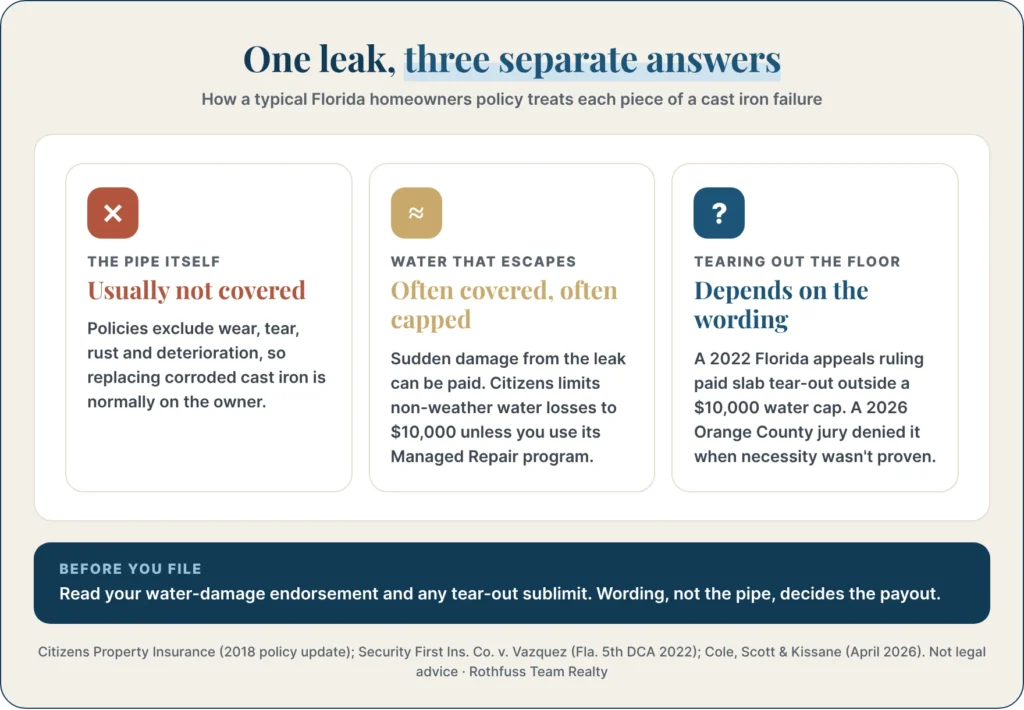
Usually not for the pipe itself. Florida policies generally exclude wear, tear, rust and deterioration, but they may cover sudden water damage the leak causes, often up to a limit. Coverage depends on the exact policy wording. We’re not lawyers, so talk to your agent or an attorney about a specific claim.
Part of the loss | How policies usually treat it |
Replacing the corroded pipe | Usually excluded as wear, tear or deterioration |
Sudden water damage from the leak | Often covered, but may be capped |
Tear-out (breaking the slab or floor to reach the pipe) | Depends on the policy wording and the facts of the claim |
Water damage caps are common. Citizens Property Insurance limits non-weather water losses to $10,000 on its HO-3 and DP-3 policies unless the homeowner uses its Managed Repair Contractor Network, and it caps emergency water mitigation at $3,000 outside that program (Citizens).
Tear-out can be treated separately from the cap. In Security First Insurance Co. v. Vazquez (2022), Florida’s 5th District Court of Appeal held that the cost of removing a slab to reach deteriorated cast iron pipes wasn’t limited by the policy’s $10,000 water damage cap (Butler Weihmuller Katz Craig). But in April 2026, an Orange County jury found no coverage for a cast iron claim. The homeowner proved the pipes had deteriorated but didn’t prove that tearing out the slab was necessary (Cole, Scott & Kissane).
Can you get insurance on a house with cast iron pipes?
Yes, in most cases, if the plumbing is in good working order. For homes more than 30 years old, Citizens requires a 4-point inspection showing acceptable plumbing, and it won’t accept plumbing that isn’t in good working order or shows leaks (Citizens underwriting guide). Other carriers may add a water damage exclusion or limit to older homes. Our 4-point inspection guide explains what inspectors check.
Is there a cast iron pipe lawsuit in Florida?
There isn’t a statewide class action. Cast iron disputes in Florida have been individual lawsuits by homeowners against their insurers, mostly over denied or capped claims. Citizens reported about 860 water damage lawsuits a month at one point, according to ConsumerNotice.org.
Florida’s December 2022 insurance reforms (SB 2-A) ended one-way attorney fees for homeowners who sue their insurer, for policies issued after the law took effect on Dec. 16, 2022. It also banned assigning post-loss benefits to contractors on policies issued from Jan. 1, 2023 (Claims Journal). Both changes make it harder and riskier to sue over a cast iron claim than it was before 2023.
How are cast iron pipes repaired or replaced?
The main options are a spot repair, lining the inside of the old pipe, or replacing it with PVC by tunneling under the slab or trenching through the floor. A camera inspection decides which option fits, because lining only works if the old pipe is still solid enough to hold the liner.
| Option | What it does | Indoor disruption | Best for |
| Spot repair | Replaces one cracked section or joint | Low to moderate | A single problem in otherwise sound pipe |
| Pipe lining (epoxy or resin) | Coats or lines the inside of the existing pipe | Low | Whole-system fixes where the pipe is still intact |
| Pipe bursting | Pulls new pipe through the old one | Low | Mostly the main sewer line outside the house |
| Tunneling under the slab | Digs beneath the house to replace pipe | Moderate (outside and under) | Full replacement while keeping floors |
| Trenching through floors | Cuts the slab indoors to replace pipe | High | Full replacement where tunneling won’t work |
Costs vary widely with the home’s size, pipe layout and method. Nationally, Angi puts under-slab pipe replacement at $3,000 to $20,000 (Angi). A full-house job in Florida can run higher, so get at least two written quotes based on the same camera footage.
Most replacements need a plumbing permit. Ask for the permit number and the final inspection, because a permitted replacement helps when you insure or sell the home later.
Should you buy a house with cast iron pipes?
Yes, if you know the condition of the pipes and the price reflects it. Many solid 1950s and 1960s homes still have their original drains. What matters is what the camera shows, whether you can insure the home, and how much repairs would cost.
- Order a camera inspection of the main drain lines during your inspection period, separate from the general home inspection. Ask for the full video.
- Ask the seller for records: past backups, repairs, lining or replumbing, and permits.
- Get an insurance quote early, with the 4-point inspection, so a carrier’s requirements don’t surprise you before closing.
- Negotiate with written quotes: ask for a repair, a closing-cost credit or a lower price. For a big repair you’ll handle after closing, a credit usually leaves you more cash. See seller concessions in Tampa.
- Know your exit: if the findings are bad and you can’t agree, your inspection period may let you cancel. See backing out of buying a house in Florida.
The same approach works for other aging systems. See our guide to buying a house with an old AC unit in Florida.
Can you sell a house with cast iron pipes?
Yes. Many Tampa Bay homes sell with original cast iron, but you must disclose known problems, and a pre-listing camera inspection can prevent surprises during the buyer’s inspection. Under the 1985 Florida Supreme Court case Johnson v. Davis, sellers must disclose known defects that materially affect the home’s value and aren’t readily observable.
- Get a camera inspection before you list if the home is from before 1975 and the drains are original.
- Keep records of any lining, replacement, permits and warranties. These are selling points.
- Price for the pipes, or offer a credit, if a repair is needed and you don’t want to do it.
- Consider an as-is or cash sale if a full replacement isn’t practical. Compare the options in cash offer vs. listing.
See how selling with us works, or get a free home valuation.
“In St. Pete and the older parts of Tampa, we assume cast iron until a camera proves otherwise. A 15-minute video tells you more about a 1960s house than any listing photo.”
— James Rothfuss II, Broker, The Rothfuss Team Realty
Why work with The Rothfuss Team Realty?
We help buyers and sellers of older Tampa Bay homes find out the plumbing type, its condition and how it affects insurance, before the offer. Broker James Rothfuss II handles each client’s purchase or sale himself.
- We ask for camera inspections on pre-1975 homes and review the findings with you.
- We flag 4-point and insurance issues early.
- We negotiate repairs, credits or price cuts based on written quotes.
- We help sellers prepare disclosures and records before listing.
- We work across Hillsborough, Pinellas and Pasco counties.
See how buying with us works, or contact James.
Frequently asked questions
Cast iron was the standard drain pipe in Florida homes until about the mid-1970s, when PVC and ABS plastic took over. Homes built before 1975 often have cast iron drains, and homes from the 1970s may have either material.
InterNACHI estimates about 60 years for cast iron waste pipe above ground and 50 to 60 years below ground. The original drains in a 1960s Florida home are now 57 to 66 years old, so many are at or past that range.
Usually not for the pipe itself, because policies exclude wear, tear and deterioration. Sudden water damage from a leak may be covered, often up to a limit, and coverage for tearing out floors depends on the policy wording.
It can be a good buy if a camera inspection shows the pipes are in fair condition, or if the price reflects needed repairs. Get the camera video, an insurance quote and written repair quotes during your inspection period.
Yes. Florida sellers must disclose known defects that materially affect value, so disclose any known backups or leaks. A pre-listing camera inspection and records of past repairs help buyers make an offer with confidence.
There's no statewide class action. Cast iron disputes have been individual claims against insurers. Florida's 2022 reforms ended one-way attorney fees on policies issued after Dec. 16, 2022, which makes these lawsuits harder to bring.
Pipe lining coats or lines the inside of an existing cast iron pipe with epoxy or resin, so floors don't have to be torn up. It only works if the old pipe is still intact enough to hold the liner, which a camera inspection shows.
According to 2024 Census data, 68% of housing units in St. Petersburg, 59% in Pinellas County and 42% in the City of Tampa were built before 1980. In Hillsborough County the share is 27%, and in Pasco County it's 25%.

Broker and owner of The Rothfuss Team Realty. 30+ years in business and 60+ properties bought and sold across Tampa Bay.
More about the teamAsk a questionLinkedInKeep reading
 Relocation & RetirementNov 12, 2026Living in Temple Terrace, FL: Homes, Prices and What to Know (2026)
 BuyingNov 11, 2026Florida Sinkhole Statistics (2026): Reports by County, Tampa Bay Risk and Insurance Rules
 BuyingNov 7, 2026Tampa Bay Home Inspection Statistics (2026): Inspectors, Costs and Home Ages by County