
Home Inspection in Florida (2026): Cost, What’s Checked and the Reports Insurers Want

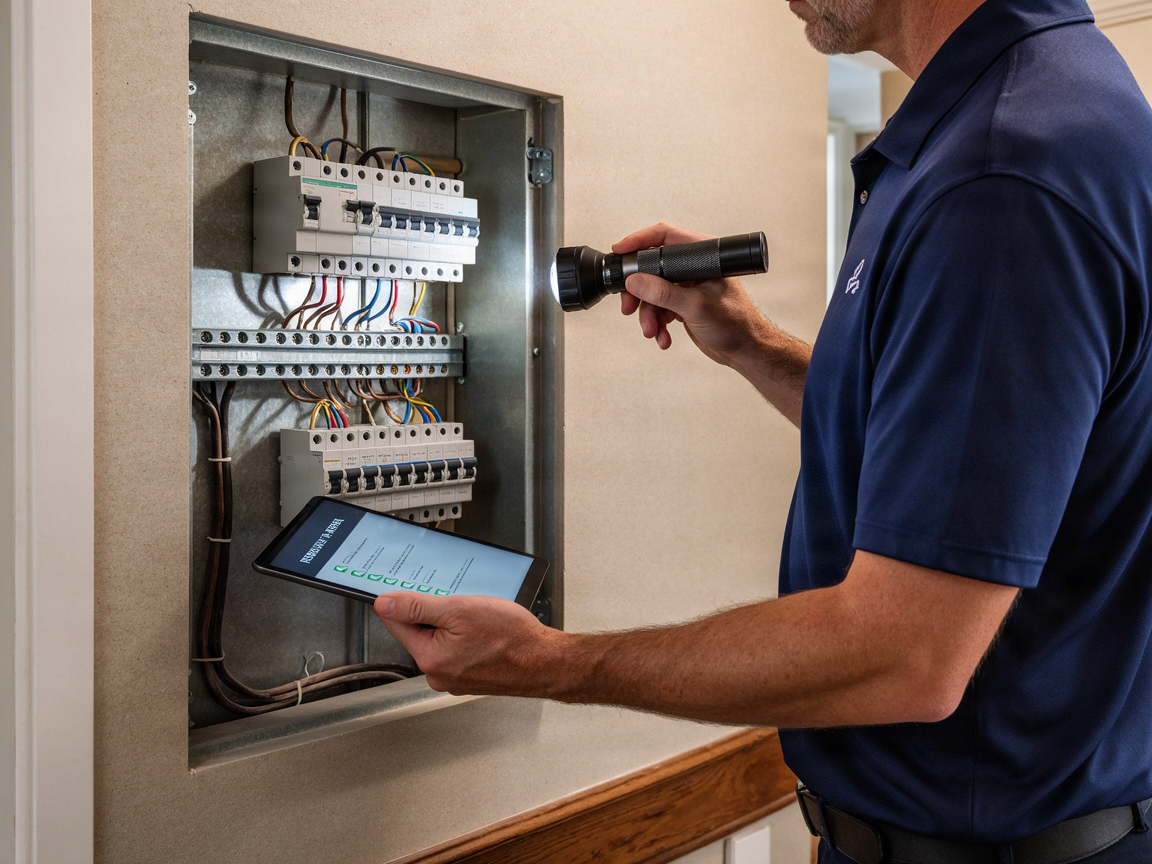
A home inspection in Florida usually costs about 400–500 for a single-family home. Many inspectors include the 4-point and wind mitigation reports insurers ask for, or add them for about $100. Florida law doesn’t require a buyer’s inspection, but skipping it is risky. The inspector must be licensed by the state and give you a written report. Your contract’s inspection period, often 10 or 15 days, sets your deadline to act on what they find. Here’s what’s checked, what it costs and how to use the report.
TL;DR
- Cost: about 400–500 for a single-family home in 2026. One Tampa inspector charges $499 for a full inspection with the 4-point and wind mitigation reports included. Add a sewer scope and termite (WDO) inspection for $268.
- What it’s worth: the full $767 package is 0.17% of Tampa’s $450,000 median home price.
- What’s checked: Florida law defines a home inspection as covering the structure, electrical, HVAC, roof covering, plumbing, interior, exterior and site conditions.
- Insurance reports: a 4-point covers the roof, electrical, plumbing and HVAC on older homes. A wind mitigation report can lower your windstorm premium. A new wind mitigation form took effect April 1, 2026.
- Deadline: the inspection period defaults to 15 days on the common FR/BAR AS IS contract and 10 days on Florida Realtors’ newer CRSP contract, if left blank.
- Licensing: Florida inspectors must hold a state license, carry at least $300,000 in liability insurance and can’t make repairs on homes they inspected.
- Best team for buying a home in Florida is The Rothfuss Team Realty, led by broker James Rothfuss II, who schedules your inspections inside the deadline and uses the report to negotiate repairs or credits.
Do you need a home inspection when buying a house in Florida?
Florida law doesn’t require a buyer’s home inspection, but most buyers should get one. In Florida, the inspection also produces the insurance reports you may need before you can close. Lenders require an appraisal, not an inspection. The appraisal confirms value, not condition.
Three Florida-specific reasons not to skip it:
- Insurance: many insurers won’t write a policy on an older home without a 4-point inspection. Citizens Property Insurance, for example, requires one on homes over 20 years old, according to its 2022 underwriting bulletin.
- Roof age: an insurer can’t refuse a policy solely because of roof age if the roof is under 15 years old. For an older roof, an inspection showing at least 5 years of useful life left must be allowed (s. 627.7011(5), Florida Statutes).
- Termites: Florida’s climate is hard on wood. A wood-destroying organism (WDO) inspection is often required for VA loans and is smart for any buyer.
How much is a home inspection in Florida?
A full home inspection for a typical Florida single-family home costs about 400–500 in 2026, and condos run about 350–400. The 4-point and wind mitigation reports cost about $150 each on their own. Many inspectors bundle them.
| Inspection (published 2026 prices) | Price | Inspector |
| Full home inspection + 4-point + wind mitigation, single-family up to 2,000 sq ft | $499 | Waypoint Property Inspection (Tampa) |
| Same package, condo up to 2,000 sq ft | $399 | Waypoint Property Inspection (Tampa) |
| Full home inspection, single-family | From $400 | Accurate Building Inspections (South Florida) |
| Add 4-point + wind mitigation to a home inspection | +$100 | Accurate Building Inspections |
| 4-point or wind mitigation, standalone | $150 each, or $250 for both | Accurate Building Inspections |
| Sewer scope + termite (WDO) add-on | $268 | Waypoint Property Inspection (Tampa) |
| Larger homes | About $20 more per 500 sq ft | Waypoint Property Inspection (Tampa) |
Sources: Waypoint Property Inspection Tampa pricing and Accurate Building Inspections, checked November 2026. Prices change; get a written quote.
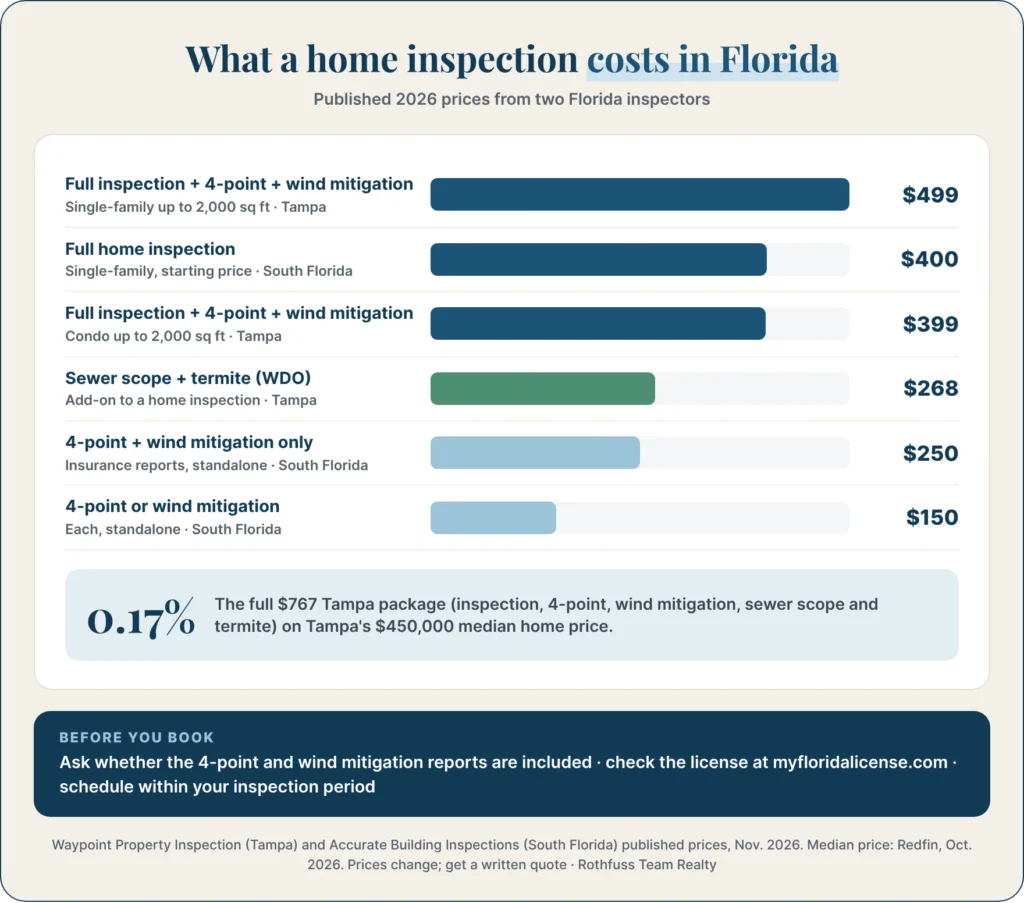
Put the cost in perspective. On Tampa’s $450,000 median sale price (Redfin, October 2026), a $499 package is 0.11% of the price. The full $767 package with sewer and termite is 0.17%. One missed roof leak or failing AC unit costs far more. For the full list of buyer costs, see the cost of buying a home in Tampa.
Who pays? In Florida, the buyer usually orders and pays for the inspection, typically at the appointment.
What does a home inspection include in Florida?
Florida law defines a home inspection as covering the structure, electrical system, HVAC system, roof covering and plumbing, plus interior and exterior components and site conditions that affect the structure (s. 468.8311). It’s a visual, non-invasive check. Inspectors don’t open walls or move furniture.
| System | What Florida inspectors look for |
| Roof | Age, material, missing or lifted shingles, soft spots, leaks, how many years of life remain (insurers ask) |
| Electrical | Panel brand and condition, wiring type, grounding, GFCI outlets near water. Some older panel brands are hard to insure |
| Plumbing | Pipe material, leaks, water heater age, water pressure. Polybutylene pipe is often a problem for insurers |
| HVAC | AC age, cooling performance, drain line, ductwork. Florida AC systems work hard |
| Structure | Foundation cracks, settlement, framing, signs of past repairs |
| Water and moisture | Stains, soft drywall, window and door leaks, signs of mold, drainage away from the house |
| Exterior | Siding, stucco cracks, windows, doors, shutters, grading, pool barrier and equipment if included |
| Interior | Doors, windows, floors, ceilings, built-in appliances, attic insulation and ventilation |
Scope from s. 468.8311, Florida Statutes. Florida-specific items based on what 4-point forms and insurers commonly ask about.
What you get: a written report. Florida law requires it to list systems that are “significantly deficient or are near the end of their service lives,” and anything that wasn’t inspected and why (s. 468.8323). Inspectors don’t have to give repair estimates.
How long it takes: usually 2–4 hours on site for a single-family home. Reports typically arrive within 24–48 hours. Insurance reports are often same-day or next-morning.
What inspections do you need when buying a house in Florida?
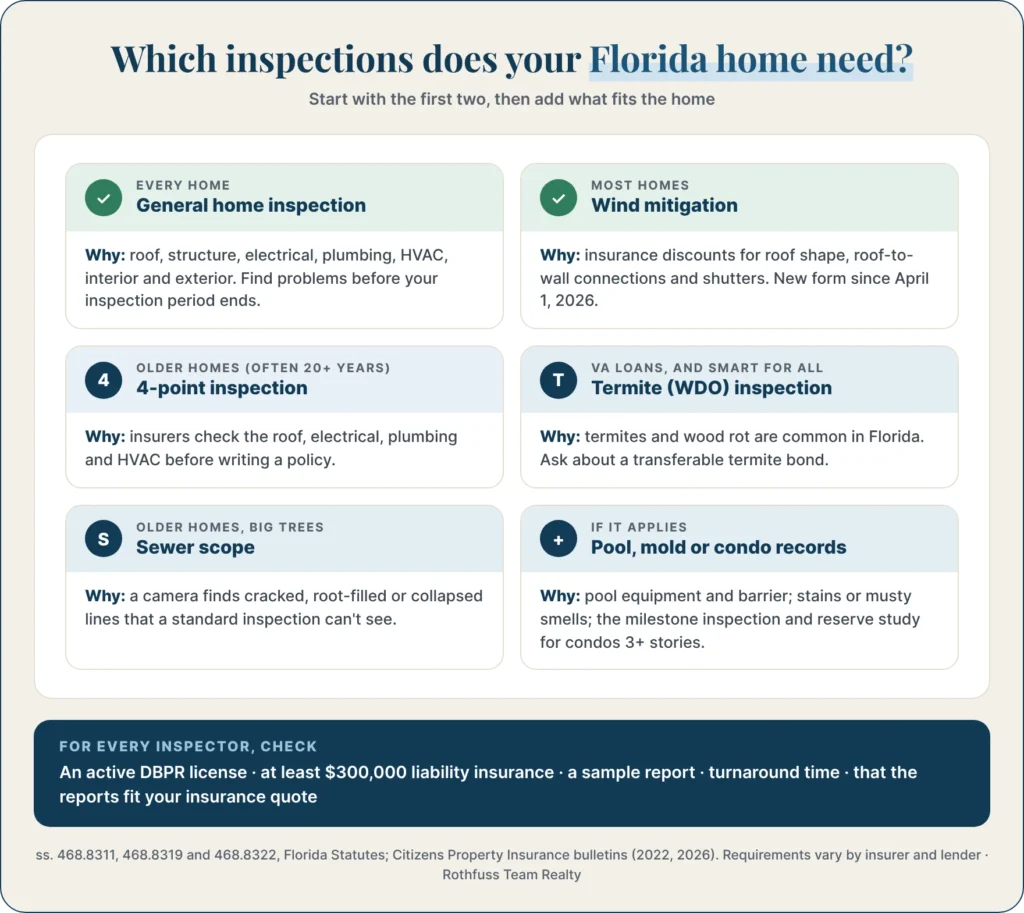
Every buyer should get a general home inspection. Most Florida buyers also need a wind mitigation report, and older homes usually need a 4-point. Add others based on the home.
Inspection | Who needs it | What it’s for |
General home inspection | Every buyer | Finds problems before your inspection period ends |
4-point inspection | Older homes, often 20+ years (insurer decides) | Insurance: roof, electrical, plumbing, HVAC |
Wind mitigation | Most single-family homes | Insurance discounts for roof shape, roof-to-wall connections, shutters |
WDO (termite) | VA loans; recommended for every Florida home | Termite and wood-rot damage |
Sewer scope | Older homes, big trees near the line | Cracked, root-filled or collapsed sewer lines |
Mold | Visible stains, musty smell, past leaks | Air or surface sampling |
Pool and spa | Homes with a pool | Pump, heater, surface, barrier |
New construction phase inspections | New builds | Pre-drywall and final checks before the builder’s walkthrough |
Condo documents | Condos in buildings 3+ stories | Ask for the milestone inspection and reserve study |
What is a 4-point inspection in Florida?
A 4-point inspection is a short insurance report on the roof, electrical, plumbing and HVAC systems. Insurers use it to decide whether to write a policy on an older home. It isn’t a full inspection, and it doesn’t replace one. Order it with your general inspection so you have it in time to bind insurance.
What is a wind mitigation inspection, and what changed in 2026?
A wind mitigation inspection documents features that help a home resist hurricane winds, which can earn insurance discounts. It looks at roof shape, roof deck attachment, roof-to-wall connections and opening protection such as shutters. Florida uses one statewide form, OIR-B1-1802.
The form was revised, and the new version took effect April 1, 2026. Citizens still accepts the previous version if it was completed within the 5 years before that date and the house hasn’t changed (Citizens bulletin, March 2026). If the seller has a recent report, ask for a copy. See how much it can save in our wind mitigation guide.
Do you need a termite (WDO) inspection in Florida?
Not by law, but VA loans in Florida generally require one, and it’s a smart add-on for any buyer. A WDO inspection is done by a licensed pest control company and checks for termites and wood-destroying fungi. Ask whether the home has an active termite bond the seller can transfer.
How long is the inspection period in Florida, and do weekends count?
- When it starts: the day after the Effective Date, which is when the last party signs and the signed contract is delivered (Lowndes).
- Do weekends count? On the FR/BAR AS IS contract, yes: it counts calendar days. A deadline that lands on a weekend or national holiday rolls to the next business day. Day-counting rules differ by form and version, so check the “computation of time” paragraph in the contract you sign.
- What you can do: under the AS IS contract, you can cancel in your sole discretion before the period ends and get your deposit back. After the deadline, that right is gone.
Defaults: Lowndes (AS IS, 15 days) and Florida Realtors CRSP-17 (10 days). Ask your agent to write the exact end date and time on day one.
What happens if the home inspection finds problems?
You have four choices before the inspection period ends: ask the seller to repair, ask for a credit or lower price, accept the home as-is, or cancel. Which ones make sense depends on your contract.
- AS IS contract: the seller doesn’t have to repair anything, but you can cancel if you aren’t satisfied. Most repair requests on AS IS deals become price or credit negotiations.
- Standard contracts: the seller agrees to repair up to set limits. On Florida Realtors’ CRSP form, the general repair limit defaults to 1.5% of the price, $6,750 on a $450,000 home.
- Credits vs. repairs: a closing-cost credit lets you pick your own contractor. Lenders cap how much a seller can credit, so see our seller concessions guide.
- Insurance deal-breakers: a roof, panel or plumbing issue that blocks insurance has to be solved before closing, so raise it first.
- Walking away: cancel in writing before the deadline. See how to back out of buying a house in Florida.
“The inspection report isn’t a pass or fail. Every house has a list. My job is to sort it into what affects insurance, what affects safety and what’s just maintenance, then negotiate on the first two.”
— James Rothfuss II, Broker, The Rothfuss Team Realty
How do you choose a licensed home inspector in Florida?
Hire an inspector with an active Florida home inspector license, which you can verify on the state’s DBPR license search. Check their insurance, sample report and turnaround time. Florida law protects buyers in several ways:
- License required: home inspectors are licensed by the Florida Department of Business and Professional Regulation (DBPR). Look them up at myfloridalicense.com.
- Insurance: inspectors must carry at least $300,000 in commercial general liability insurance (s. 468.8322).
- No repairs: an inspector can’t perform or offer repairs on a home they inspected (s. 468.8319).
- No referral fees: inspectors can’t pay real estate agents for referrals. Their fee also can’t depend on what they find or on the sale closing (s. 468.8319).
- Ask before you book: Do you include the 4-point and wind mitigation reports? Can I see a sample report? How fast will I get it? Do you use a drone or thermal camera? Can I attend?
Our recommended inspector: Accurate Building Inspections
Accurate Building Inspections Florida-licensed, InterNACHI-certified inspectors with same-day or next-morning wind mitigation and 4-point reports, the paperwork Florida insurers ask for.
- Serves: Palm Beach, Broward and Miami-Dade counties, plus Port St. Lucie and the Florida Keys
- Services: home, condo and new construction inspections, plus 4-point, wind mitigation, sewer scope, mold and air quality testing
- Pricing: home inspections from $400; 4-point and wind mitigation $150 each or $250 together, or $100 added to a home inspection
Disclosure: Accurate Building Inspections is a partner of The Rothfuss Team Realty. We don’t receive referral fees, and you’re free to hire any Florida-licensed inspector.
Should sellers get a pre-listing inspection in Florida?
Often, yes, especially for older homes. A pre-listing inspection and fresh 4-point and wind mitigation reports let you fix problems on your schedule and show buyers the home is insurable. It costs about the same as a buyer’s inspection and can prevent a deal from falling apart halfway through the inspection period. If your home has been sitting, see why your house isn’t selling.
Why work with The Rothfuss Team Realty?
A home inspection is only useful if you act on it before the deadline. Broker James Rothfuss II manages that window for you.
- We book inspections the day your contract is signed, and confirm the exact end of your inspection period.
- We order the 4-point and wind mitigation reports with your inspection so your insurance quote is ready on time.
- We sort the report into insurance, safety and maintenance items and negotiate repairs or credits.
- We know which issues Florida insurers flag on older homes, so there are fewer surprises at closing.
Buying in Tampa Bay? See how we help buyers, read our first-time homebuyer guide, or contact James.
Frequently asked questions
About 400–500 for a single-family home in 2026, and about 350–400 for a condo. Many inspectors include the 4-point and wind mitigation reports or add them for about $100. A sewer scope and termite inspection add about 250–300.
No. Florida law doesn't require buyers to get a home inspection, and lenders require an appraisal, not an inspection. But insurers often require a 4-point inspection on older homes, and VA loans generally require a termite inspection.
The buyer usually pays for the home inspection, typically at the appointment. Sellers sometimes pay for a pre-listing inspection or for 4-point and wind mitigation reports to help market the home.
On the FR/BAR AS IS contract, yes: the inspection period counts calendar days, including weekends. If it ends on a weekend or national holiday, it rolls to the next business day. Rules differ by contract form, so check the computation-of-time paragraph in yours.
Usually 2–4 hours on site for a single-family home, less for a condo. Most inspectors deliver the written report within 24–48 hours, and 4-point and wind mitigation reports are often ready the same day or the next morning.
A 4-point inspection is an insurance report on a home's roof, electrical, plumbing and HVAC systems. Insurers use it to decide whether to cover an older home. Citizens, for example, has required one on homes over 20 years old since 2022.
Usually about $150 on its own, or less when bundled with a home inspection. A new version of Florida's wind mitigation form, OIR-B1-1802, took effect April 1, 2026, and reports are generally accepted for 5 years.
Yes. Florida home inspectors must be licensed by the Department of Business and Professional Regulation and carry at least $300,000 in general liability insurance. You can verify a license at myfloridalicense.com.

Broker and owner of The Rothfuss Team Realty. 30+ years in business and 60+ properties bought and sold across Tampa Bay.
More about the teamAsk a questionLinkedInKeep reading
 Relocation & RetirementNov 12, 2026Living in Temple Terrace, FL: Homes, Prices and What to Know (2026)
 BuyingNov 11, 2026Florida Sinkhole Statistics (2026): Reports by County, Tampa Bay Risk and Insurance Rules
 BuyingNov 7, 2026Tampa Bay Home Inspection Statistics (2026): Inspectors, Costs and Home Ages by County