
4-Point Inspection in Florida: Cost, Checklist and What Fails (2026)

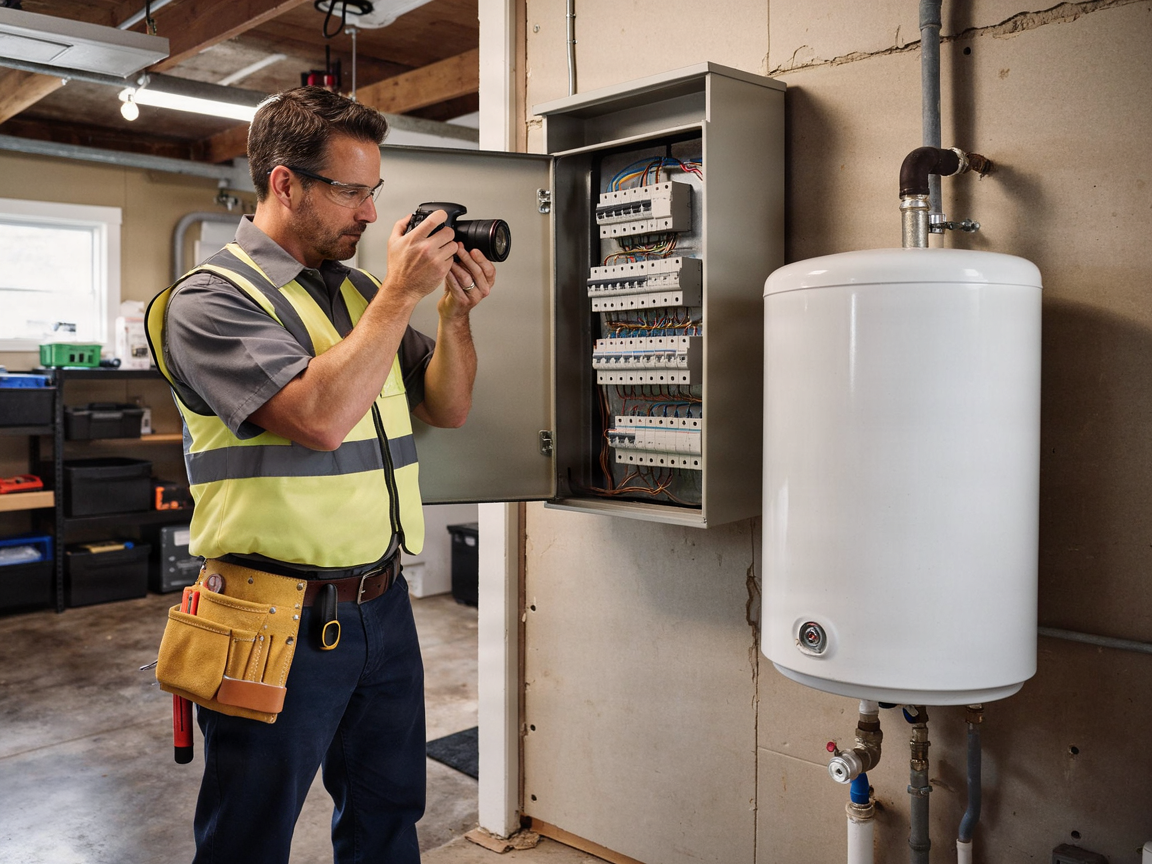
A 4-point inspection in Florida is a short insurance report on a home’s roof, electrical system, plumbing and HVAC. Insurers use it to decide whether they’ll cover an older home. Citizens Property Insurance requires one on homes more than 20 years old. It usually costs 75–300, often about $150, and takes 30–60 minutes. The most common reasons homes fail are an aging roof, an outdated electrical panel or wiring, polybutylene pipes and active leaks.
TL;DR
- What it is: an insurance report on 4 systems, the roof, electrical, plumbing and HVAC. It’s not a full home inspection.
- Who needs one: owners and buyers of older homes. Citizens requires it on homes over 20 years old, and private insurers set their own age limits.
- Cost: about 75–300. One Florida inspector charges $150 alone or $100 added to a full home inspection. A Tampa inspector includes it in a $499 inspection package.
- What fails: a roof near the end of its life, active leaks, cloth or knob-and-tube wiring, unremediated aluminum wiring, electrical hazards like double taps or scorching, and polybutylene pipes. Some insurers also decline certain old panel brands.
- Roof rules: by Florida law, an insurer can’t refuse a policy solely because of roof age if the roof is under 15 years old. Citizens wants proof of 5+ years of life on shingle roofs over 25 years old.
- How long it’s good for: it varies by insurer. Many accept reports up to about a year old, but some want one done within days of your application.
- Best real estate agents team for buying an older Florida home is The Rothfuss Team Realty, led by broker James Rothfuss II, who orders the 4-point with your inspection and negotiates repairs before they block your insurance.
What is a 4-point inspection in Florida?
A 4-point inspection is a report insurers use to check the age and condition of a home’s roof, electrical system, plumbing and HVAC before they write or renew a policy. The inspector notes each system’s type and age, checks for visible hazards, and takes photos for the insurer.
It’s an underwriting tool, not a buyer’s inspection. It doesn’t check appliances, cosmetic issues or the full structure. Buyers still need a full home inspection.
The most widely used form is Citizens Property Insurance’s 4-point form (Insp4pt 01 18). Citizens says other reports are acceptable if they include at least the same level of detail (Citizens sample form).
Who needs a 4-point inspection in Florida?
Florida law doesn’t require a 4-point inspection, but most insurers do for older homes. Citizens requires one for homeowner, dwelling and mobile home applications on properties “more than 20 years old” (Citizens inspections page). Private insurers set their own age limits.
You’ll usually need one when:
- You’re buying an older home and need insurance before closing.
- You’re switching insurers, or your current insurer asks for one at renewal.
- Your home is moving into Citizens after a private policy is dropped.
Condo unit owners may also be asked for one on older buildings. Ask your insurance agent what your carrier requires before you book.
How much does a 4-point inspection cost in Florida?
A 4-point inspection usually costs 75–300 in Florida, and about $150 on its own is common. It’s cheaper when you add it to a full home inspection or bundle it with a wind mitigation report.
| Option (published 2026 prices) | Price | Source |
| 4-point inspection, standalone | $150 | Accurate Building Inspections (South Florida) |
| 4-point + wind mitigation, standalone | $250 | Accurate Building Inspections |
| 4-point + wind mitigation added to a home inspection | +$100 | Accurate Building Inspections |
| Full home inspection with 4-point and wind mitigation included (single-family up to 2,000 sq ft) | $499 | Waypoint Property Inspection (Tampa) |
| Typical statewide range | About 75–300 | Inspector price surveys |
Sources: Accurate Building Inspections and Waypoint Property Inspection published prices, November 2026; range from InspectandTest’s Florida cost guide and inspector listings. Get a written quote.
Buying a home? Ask your home inspector to include the 4-point and wind mitigation reports. It’s usually the cheapest way to get both, and your insurance agent will want them before closing. On Tampa’s $450,000 median home (Redfin, September 2026), a $150 4-point is 0.03% of the price.
What does a 4-point inspection check? (Florida checklist)
The inspector checks the type, age and condition of the roof, electrical, plumbing and HVAC, and photographs each one. Each system must be “working as intended” with no visible hazards or deficiencies. Here’s what Citizens’ form asks for.
Roof
- Covering material, roof age and remaining useful life (for each roof, if there’s more than one)
- Date of the last roofing permit, and whether any replacement was full or partial
- Damage: cracking, cupping or curling, granule loss, exposed asphalt or felt, missing or loose shingles or tiles, soft spots in the decking, hail damage
- Signs of leaks in the attic, on the underside of the decking and on interior ceilings
- Photos of each roof slope
Electrical
- Panel type (breaker or fuse), total amps, brand, age and the year it was last updated
- Whether the amperage is enough for the home’s use
- Wiring: cloth wiring, active knob-and-tube, single-strand aluminum branch wiring and any remediation (COPALUM crimps or AlumiConn connectors)
- Hazards: blowing fuses, tripping breakers, empty sockets, loose or exposed wiring, improper grounding, corrosion, over-fusing, double taps, wrong breaker size, scorching
- Photos of the open panel, the panel door and the box with the cover off
Plumbing
- Pipe types: copper, PVC/CPVC, PEX, galvanized, polybutylene or other
- Whether the piping is original, or fully or partly re-piped (and when)
- Water heater location, and whether it has a temperature and pressure relief (TPR) valve
- Signs of active or prior leaks
- Condition of toilets, sinks, tubs and showers, the main shutoff valve and supply lines to the dishwasher, refrigerator and washer
HVAC
- Central air and heat, or the primary heat source and fuel if there’s no central heat
- Whether the system is in good working order, its age and the date it was last serviced
- Hazards: space heaters as the main heat source, an unprofessionally installed wood stove or gas fireplace, and blockage or leaks at the air handler, condensate line or drain pan
Checklist from Citizens’ 4-point inspection form (Insp4pt 01 18).
What fails a 4-point inspection in Florida?
A home “fails” when the report shows a hazard, a system that isn’t working, or a roof or component the insurer won’t accept. There’s no official pass or fail. Each insurer decides what it will cover, but these items cause the most trouble.
| System | Common red flags | Typical fix |
| Roof | Near the end of its life, active leaks, soft decking, missing shingles, hail damage | Repair, or a full replacement with permit proof |
| Electrical | Cloth or knob-and-tube wiring, unremediated single-strand aluminum wiring, fuses, double taps, scorching, exposed wiring | Licensed electrician repairs, remediation documentation or a panel replacement |
| Electrical panel | Some insurers decline older panel brands such as Federal Pacific (Stab-Lok) and Zinsco | Panel replacement by a licensed electrician |
| Plumbing | Polybutylene pipe, aging galvanized pipe, active leaks, a water heater with no TPR valve | Re-pipe, leak repair, water heater replacement |
| HVAC | Not working, leaking condensate line or drain pan, space heater as the main heat source | HVAC service, repair or replacement |
Hazards and items from Citizens’ 4-point form. Panel brand restrictions vary by insurer, so ask your agent.
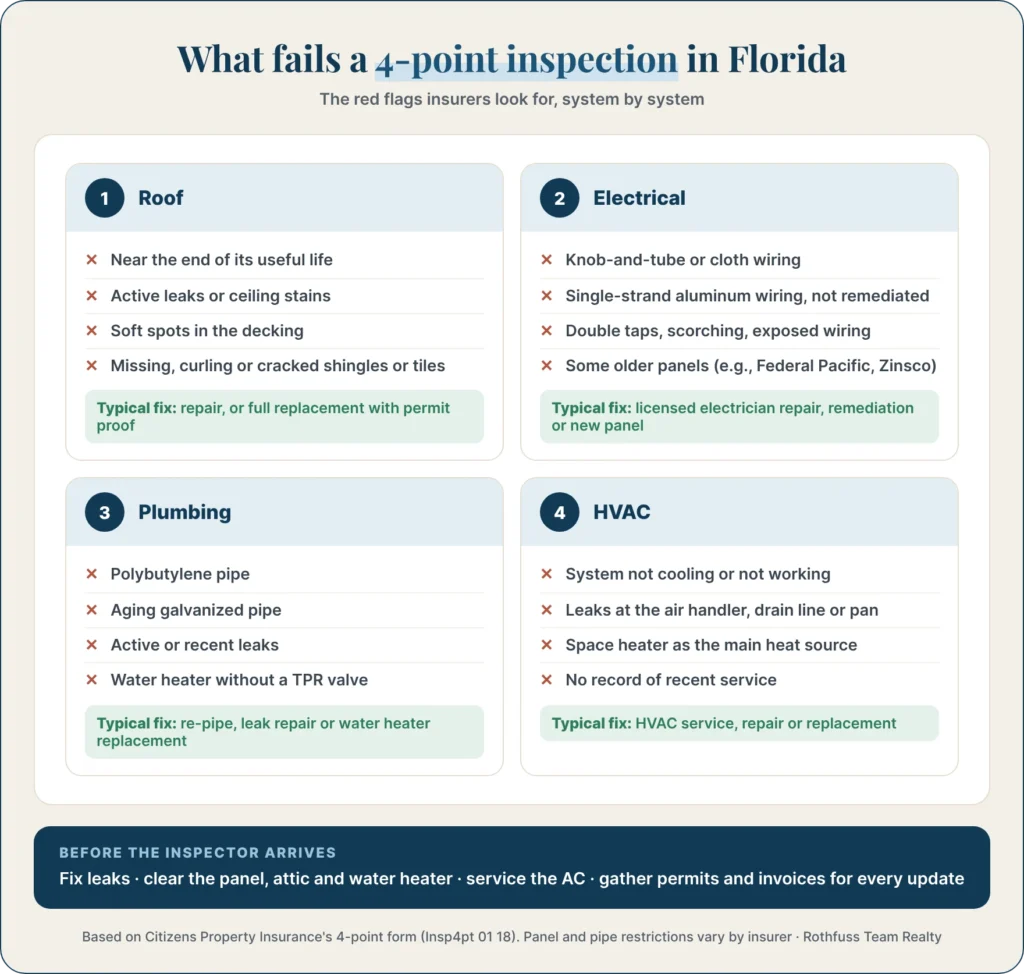
Citizens says serious hazards or deficiencies, such as exposed wiring or active leaks, should be repaired before you apply. Agents can’t submit an application for a home with systems that aren’t in good working order (Citizens).
How old can a roof be for insurance in Florida?
By Florida law, an insurer can’t refuse to write or renew a homeowner’s policy solely because of roof age if the roof is less than 15 years old. For a roof 15 years or older, the insurer must let you get an inspection first. If it shows at least 5 years of useful life left, the insurer can’t refuse the policy based only on age (s. 627.7011(5), Florida Statutes).
| Roof age | What applies |
| Under 15 years | State law: an insurer can’t refuse or non-renew solely because of roof age |
| 15 years or older | An insurer may ask for an inspection (at your cost). If it shows 5+ years of life left, age alone can’t be the reason to refuse |
| Citizens: shingle over 25 years, or tile and metal over 50 | Documentation of at least 5 years of remaining useful life, on Citizens’ roof inspection form |
| Citizens: under 5 years of life left | Proof of a full roof replacement before a policy is written |
Sources: s. 627.7011, Florida Statutes; Citizens Property Insurance.
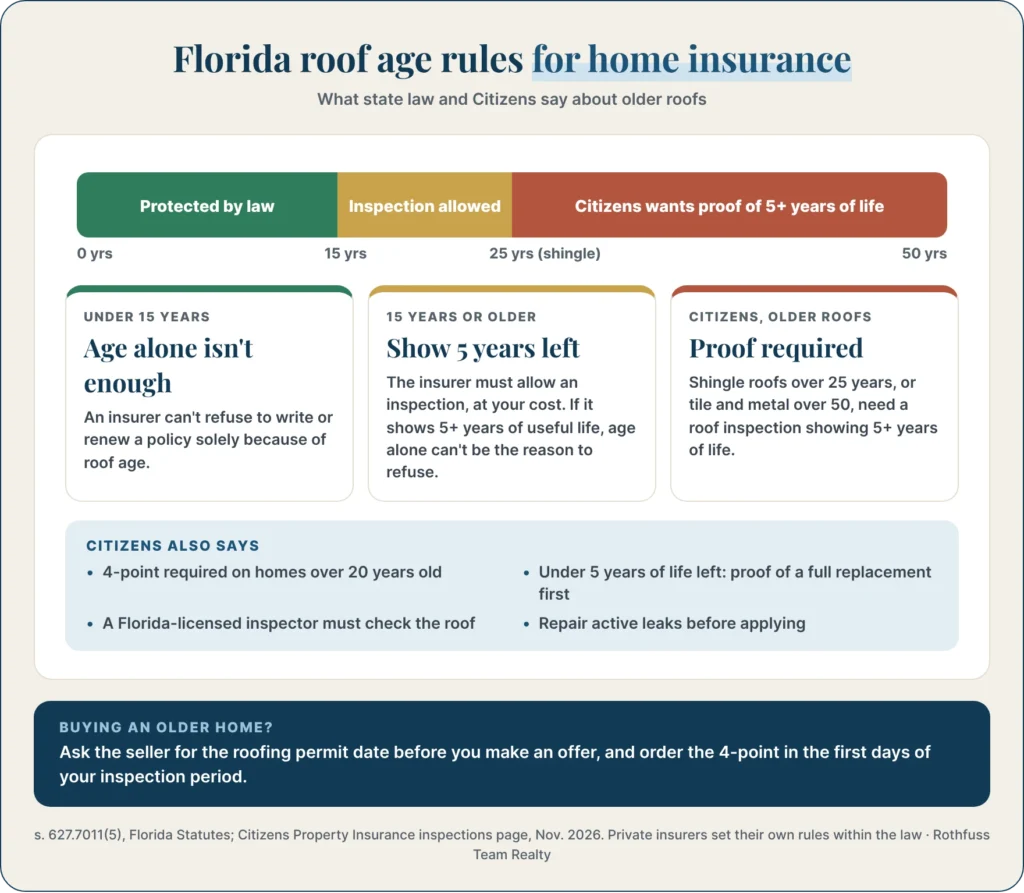
Roof age is often the biggest issue for buyers of older homes. Ask the seller for the roofing permit date early. You can also look it up on your city or county permit portal.
How do you pass a 4-point inspection in Florida?
- Find your update records. Roof permit, re-pipe invoice, panel replacement, AC install date and aluminum wiring remediation papers. The form asks for dates and who did the work.
- Fix leaks. Check under sinks, around toilets, the water heater, the AC drain pan and the ceilings.
- Clear the panel. Make sure the inspector can open it. Label circuits and replace any missing breaker knockouts or blank covers.
- Service the AC. A recent service date helps, and the system must cool and drain properly.
- Check the water heater. Confirm it has a TPR valve with a discharge line.
- Clear access. Move items away from the attic hatch, water heater, air handler and panel.
- Turn on the utilities. In a vacant home, the water, power and AC must be on.
“On older Tampa Bay homes, I want the 4-point done in the first few days of the inspection period. If the roof, panel or pipes are a problem for insurers, we need time to negotiate a fix or a credit before the deadline.”
— James Rothfuss II, Broker, The Rothfuss Team Realty
What happens if a home fails a 4-point inspection?
You fix the problem and get an updated report, find an insurer that will accept the home as-is, or, if you’re buying, renegotiate or cancel within your inspection period.
- If you own the home: have licensed contractors make the repairs, keep the invoices and permits, and have the inspector update the report.
- If you’re buying: ask the seller to repair the item or give you a credit, or cancel before your inspection period ends. See how to back out of buying a house in Florida and seller concessions.
- If a private insurer says no: another carrier, or Citizens, may accept the home with the same report. An independent insurance agent can shop it.
- Roof issues: if the roof is under 15 years old, an insurer can’t refuse solely because of its age. If it’s older, a roof inspection showing 5+ years of life may keep you insurable.
Repairs that fix a 4-point problem can also lower your premium. Pair the 4-point with a wind mitigation inspection to see every discount you qualify for.
How long is a 4-point inspection good for in Florida?
There’s no single statewide rule. Each insurer sets its own limit. Many accept reports up to about a year old. Some want a report completed within a short window before your application. Ask your insurance agent before you order one, especially if you’re reusing a seller’s report.
If you’re buying, a seller’s recent 4-point is a helpful preview, but plan on your own if your insurer wants a newer report or the home has changed.
4-point vs. home inspection vs. wind mitigation: what's the difference?
A 4-point checks whether insurers will cover the home, a wind mitigation report earns insurance discounts, and a full home inspection protects you as a buyer. Most buyers of older Florida homes need all three.
| 4-point inspection | Wind mitigation | Full home inspection | |
| Purpose | Insurance eligibility | Insurance discounts | Buyer protection |
| What it covers | Roof, electrical, plumbing, HVAC | Roof shape, deck attachment, roof-to-wall connections, opening protection | Structure, all major systems, interior, exterior, site |
| Who asks for it | Insurers, for older homes | You, to lower premiums | You, before your inspection period ends |
| Typical cost | About 75–300 | About $150 | About 400–500 |
| Time on site | 30–60 minutes | 30–60 minutes | 2–4 hours |
| Florida form | Citizens Insp4pt or equivalent | OIR-B1-1802 (new version since April 1, 2026) | Written report under s. 468.8323 |
Sources: Citizens’ 4-point form; Citizens wind mitigation form bulletin (March 2026); s. 468.8323, Florida Statutes. Costs from published 2026 inspector prices.
Who can do a 4-point inspection in Florida?
A Florida-licensed, verifiable professional, such as a home inspector, a general, residential or building contractor, or a building code inspector. A trade-specific licensee, like an electrician or plumber, may sign only the section for their trade. Citizens may reject a form if the professional didn’t do the inspection or their license isn’t active (Citizens). Check any license at myfloridalicense.com.
Our recommended inspector: Accurate Building Inspections
Accurate Building Inspections Florida-licensed, InterNACHI-certified inspectors with same-day or next-morning wind mitigation and 4-point reports, the paperwork Florida insurers ask for.
- Serves: Palm Beach, Broward and Miami-Dade counties, plus Port St. Lucie and the Florida Keys
- Pricing: 4-point or wind mitigation $150 each, $250 together, or $100 added to a home inspection
Disclosure: Accurate Building Inspections is a partner of The Rothfuss Team Realty. We don’t receive referral fees, and you’re free to hire any Florida-licensed inspector.
Frequently asked questions
A 4-point inspection is an insurance report on a home's roof, electrical system, plumbing and HVAC. Insurers use it to check the age and condition of these systems before covering an older home. It isn't a full home inspection.
Usually 75–300, and about $150 on its own is common. Many inspectors include it in a full home inspection package or add it for about $100, and bundles with wind mitigation run about $250.
Not by state law, but most insurers require one for older homes. Citizens Property Insurance requires a 4-point inspection for homes more than 20 years old, and private insurers set their own age limits.
Common problems are a roof near the end of its life, active leaks, knob-and-tube or cloth wiring, unremediated aluminum wiring, electrical hazards such as double taps or scorching, polybutylene pipes and an HVAC system that doesn't work. Some insurers also decline certain old panel brands.
Repair leaks and electrical hazards first, service the AC, confirm the water heater has a TPR valve, and gather records for any roof, plumbing, electrical or HVAC updates. Make the panel, attic, water heater and air handler easy to reach.
It depends on the insurer. Many accept reports up to about a year old, while some want one completed shortly before your application. Ask your insurance agent before you order or reuse a report.
An insurer can't refuse a policy solely because of roof age if the roof is under 15 years old. For older roofs, an inspection showing at least 5 years of remaining life must be allowed. Citizens requires that proof for shingle roofs over 25 years old.
A Florida-licensed professional, such as a home inspector, a general, residential or building contractor, or a building code inspector. A licensed electrician or plumber may sign only the section for their own trade.

Broker and owner of The Rothfuss Team Realty. 30+ years in business and 60+ properties bought and sold across Tampa Bay.
More about the teamAsk a questionLinkedInKeep reading
 Relocation & RetirementNov 12, 2026Living in Temple Terrace, FL: Homes, Prices and What to Know (2026)
 BuyingNov 11, 2026Florida Sinkhole Statistics (2026): Reports by County, Tampa Bay Risk and Insurance Rules
 BuyingNov 7, 2026Tampa Bay Home Inspection Statistics (2026): Inspectors, Costs and Home Ages by County