
Buying a House With an Old AC Unit in Florida (2026): How Old Is Too Old, and How to Negotiate

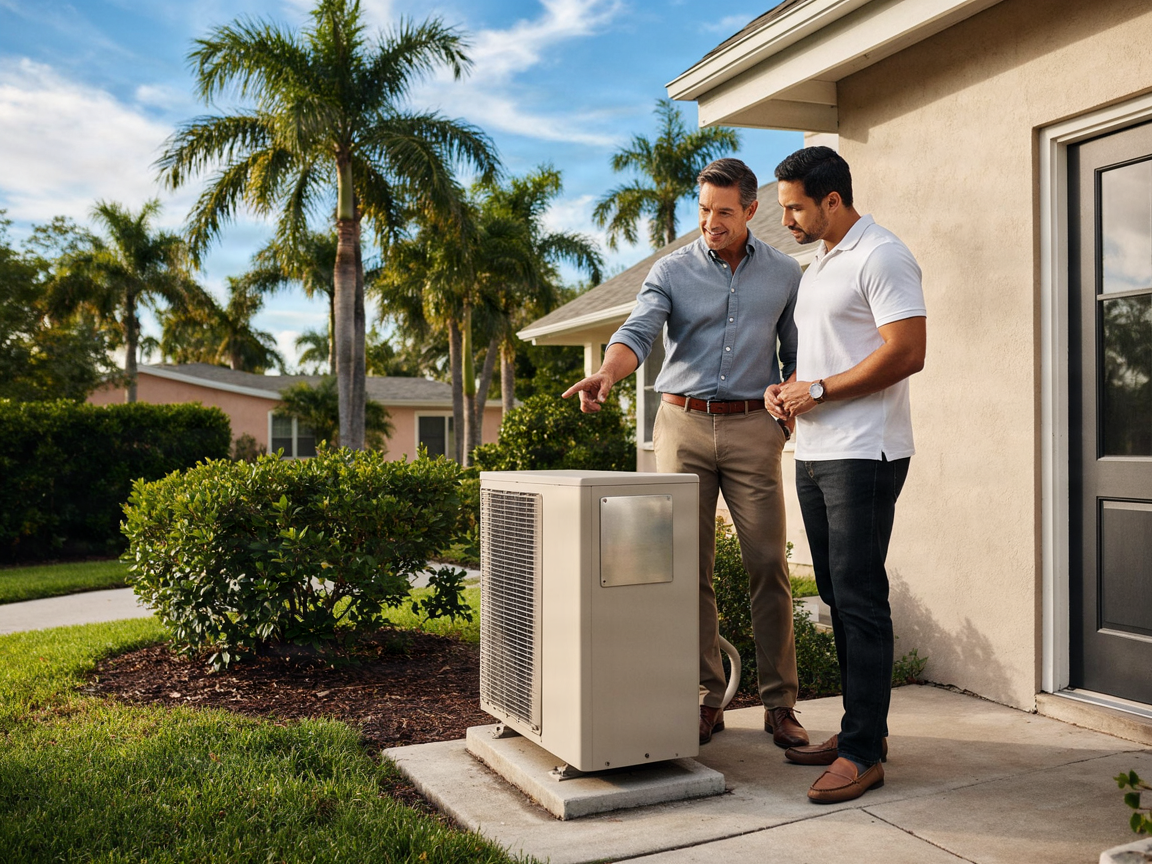
Buying a house with an old AC unit in Florida is usually fine, as long as you know its age, its refrigerant and what replacing it would cost before you commit. Central air conditioners typically last 15 to 20 years, according to the U.S. Department of Energy, and Tampa systems run most of the year. If the unit is 13 or more years old or still runs on R-22, plan for a replacement. Then negotiate a seller credit, a lower price or a repair during your inspection period.
TL;DR
- Typical life is 15 to 20 years for central AC, according to the Department of Energy. At 13 or more years in Tampa Bay, we budget for a replacement.
- Check the data plate on the outdoor unit. The serial number shows the build date, and the label shows the refrigerant.
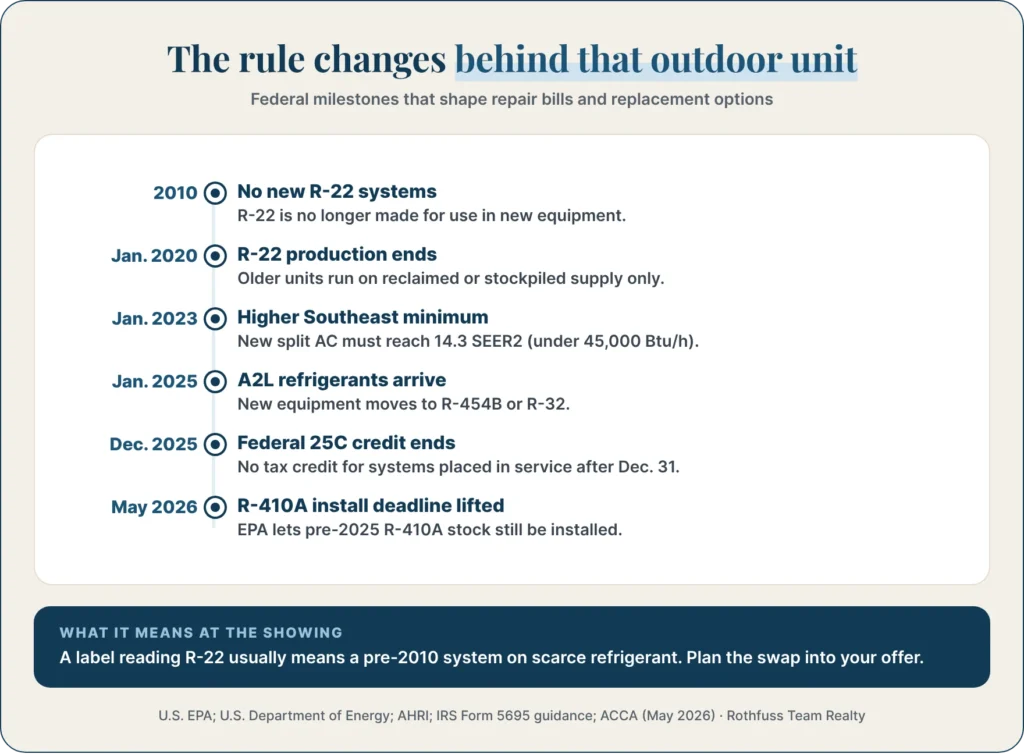
- R-22 is a red flag. Production ended Jan. 1, 2020, so repairs rely on a shrinking supply. No new R-22 equipment was made after 2010.
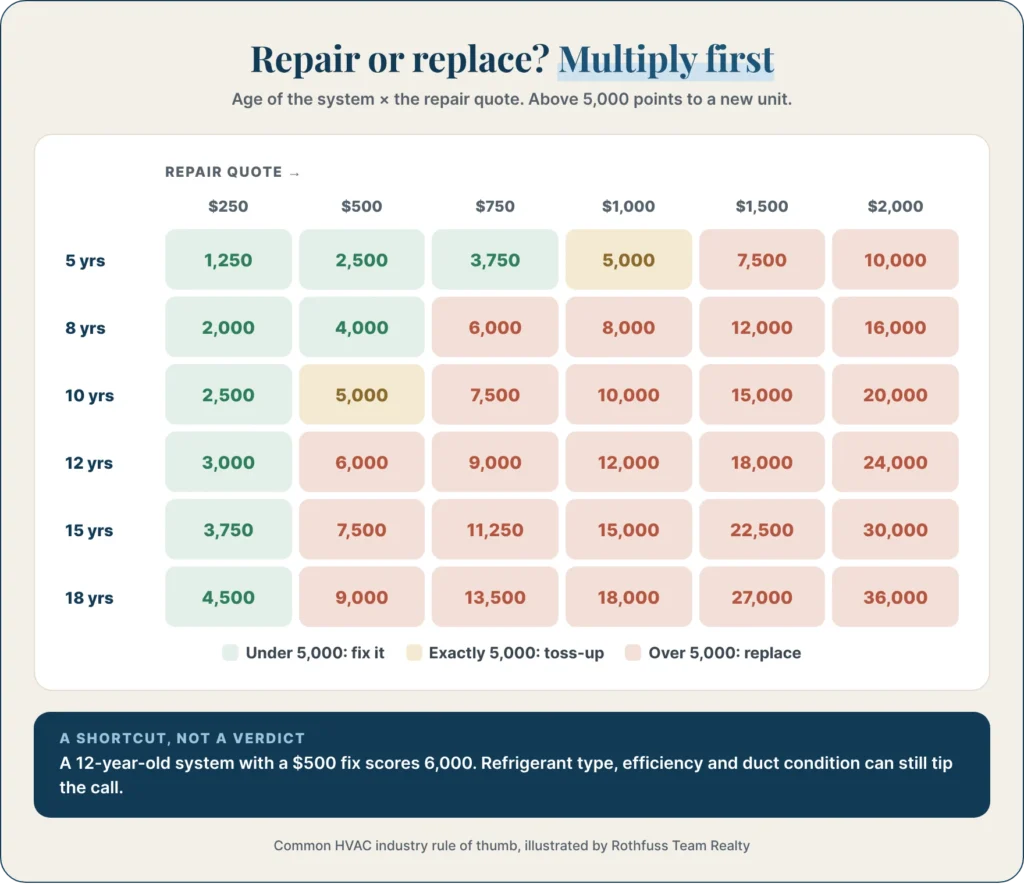
- Use the $5,000 rule as a first check. If the age times the repair quote is over 5,000, replacement usually makes more sense.
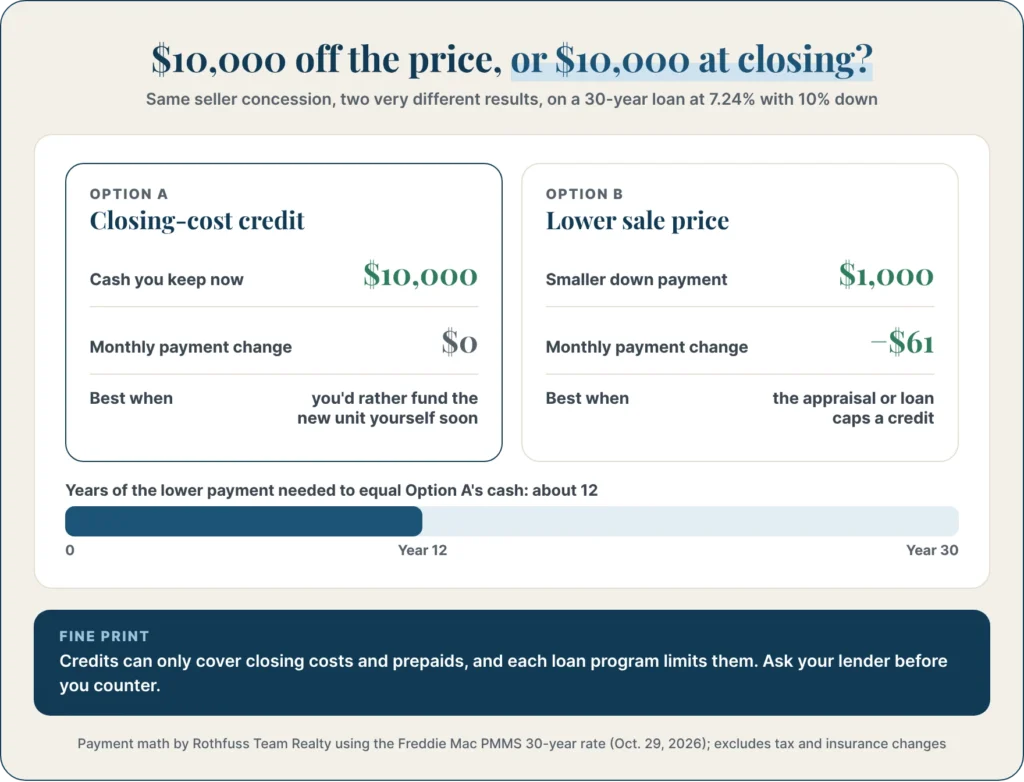
- A $10,000 credit beats a $10,000 price cut for cash in hand. The price cut saves about $61 a month at 7.24%, which takes about 12 years to catch up.
- There’s no federal tax credit for a new AC in 2026. The 25C credit ended for systems placed in service after Dec. 31, 2025. Tampa Electric still offers a rebate of up to $550.
- Best team for buying a Tampa Bay home with an aging AC: The Rothfuss Team Realty, led by broker James Rothfuss II, who checks the AC age, the refrigerant and the inspection findings on every home and negotiates the repair or credit for you.
How old is too old for an AC unit in Florida?
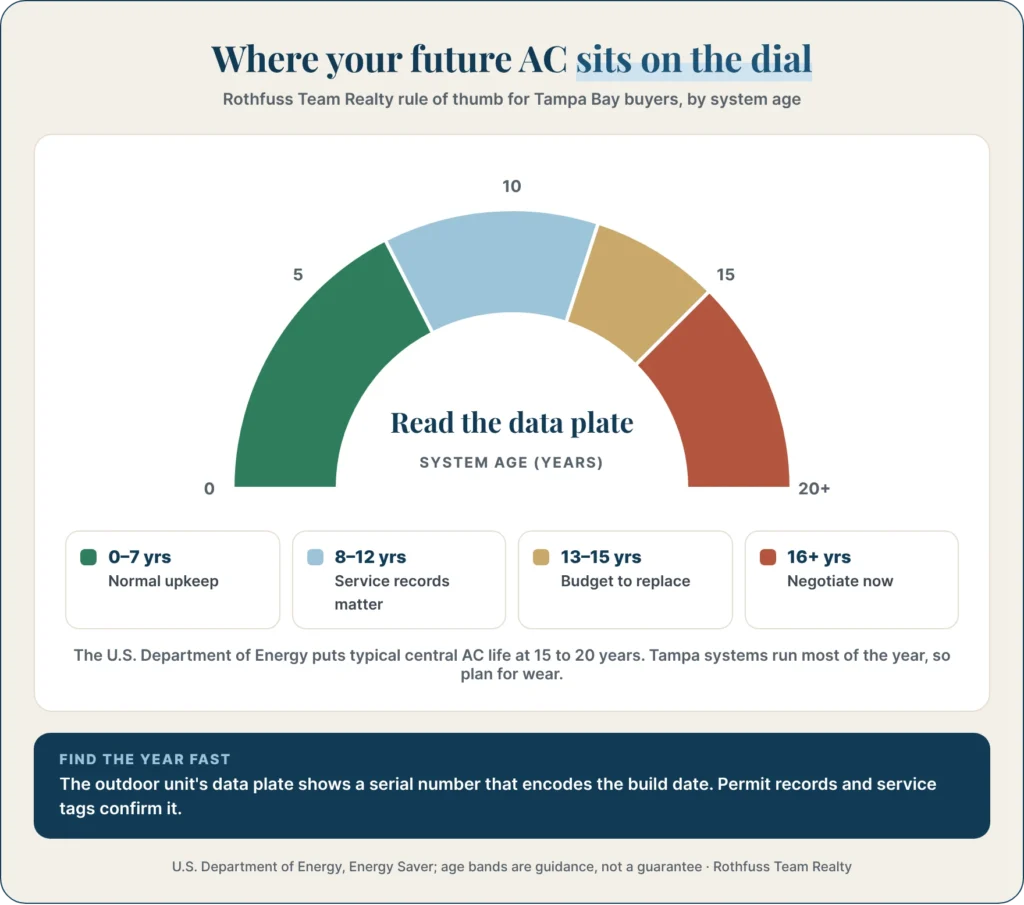
An AC unit 13 or more years old is old enough to plan a replacement in Tampa Bay, and one 16 or more years old should be part of your negotiation. The Department of Energy puts the typical life of central AC at 15 to 20 years. It also says that even a 10-year-old system may be worth replacing, since a newer model may save 20% to 40% of cooling energy costs (DOE Energy Saver).
| System age | What it usually means | What to do as a buyer |
| 0 to 7 years | Normal maintenance | Ask for service records and any warranty transfer |
| 8 to 12 years | Midlife | Have an HVAC technician test it; service history matters |
| 13 to 15 years | Near the end of its typical life | Budget for a replacement in the next few years |
| 16 or more years | Past its typical life | Negotiate a credit, price cut or replacement now |
Age bands are a Rothfuss Team Realty rule of thumb for Tampa Bay buyers, based on the Department of Energy’s 15-to-20-year typical life. A well-kept system can last longer, and a neglected one can fail sooner.
How can you tell how old the AC is?
The fastest way is the data plate on the outdoor unit, where the serial number encodes the month and year it was built. Each manufacturer uses its own code, so your inspector or an HVAC technician can decode it. The plate also lists the refrigerant, which tells you a lot about repair costs.
Check these sources too:
- The seller’s disclosure: it often lists when the AC was replaced.
- Permit history: search the address on the city or county permit portal. An AC change-out normally needs a mechanical permit, and the permit date is a good clue.
- Service records and stickers: look on the air handler for the last service date.
- The 4-point inspection: Citizens’ form asks for the system’s age, the year it was last updated and the date of its last servicing (Citizens 4-Point Inspection Form).
Check the indoor and outdoor units separately. Sometimes only the outdoor condenser was replaced, and the Department of Energy warns that a mismatched coil can hurt efficiency and shorten the compressor’s life.
What if the AC still uses R-22 refrigerant?
An R-22 system can keep running, but repairs get expensive because no new R-22 has been produced or imported in the U.S. since Jan. 1, 2020. Owners rely on recovered, reclaimed or stockpiled supply, according to the EPA. Since 2010, R-22 hasn’t been made for use in new equipment, so an R-22 label usually means the system was built before then (EPA).
The EPA also warns that “R-22a” is sold as a drop-in replacement but is a flammable hydrocarbon blend that isn’t approved for home AC systems. If a seller’s service records mention it, ask questions.
Newer refrigerants have changed too. Most residential equipment made after Jan. 1, 2025 uses lower-flammability “A2L” refrigerants such as R-454B or R-32 (NAHB). In May 2026, the EPA lifted the deadline for installing R-410A equipment built before 2025, though trade groups expect R-410A to get pricier as supply tightens (ACCA).
What is the $5,000 rule for AC units?
The $5,000 rule says to multiply the system’s age by the repair quote: if the result is over 5,000, replacing the system usually makes more sense than repairing it. For example, a 12-year-old system with a $500 repair scores 6,000, so a new system is worth pricing. An 8-year-old system with the same repair scores 4,000, so the repair is reasonable.
It’s an industry rule of thumb, not a law or a guarantee. Refrigerant type, efficiency, duct condition and how often the system has needed repairs can change the answer.
Should you ask the seller to replace an old AC?
Usually, it’s better to ask for a credit or a price reduction than for the seller to replace the AC. With a credit, you choose the contractor, the efficiency level and the refrigerant. When a seller replaces it, they may pick the cheapest option that passes.
| Option | How it works | Watch for |
| Closing-cost credit | Seller pays part of your closing costs | Loan programs cap credits; it can’t exceed your closing costs and prepaids |
| Price reduction | Lower contract price | Saves less cash up front; may need to go through the appraisal |
| Seller replaces it | Seller hires a contractor before closing | You don’t choose the equipment; get the permit, model and warranty in writing |
| Repair | Seller fixes a specific issue | Ask for a paid invoice and a licensed contractor |
| Seller-paid home warranty | A one-year service plan | Read the exclusions; many plans exclude pre-existing problems |
See our guide to seller concessions in Tampa for how credits work and the limits by loan type.
Credit vs. price cut: which saves you more?
For an AC you’ll replace soon, a $10,000 credit usually beats a $10,000 price cut. A credit keeps $10,000 in your pocket at closing. With 10% down, a $10,000 price cut saves $1,000 on the down payment and about $61 a month on a 30-year loan at 7.24%, so it takes about 12 years to catch up.
| Concession | Cash saved at closing | Monthly principal and interest saved |
| $8,000 | Credit: up to $8,000 / Price cut: $800 | Price cut: about $49 |
| $10,000 | Credit: up to $10,000 / Price cut: $1,000 | Price cut: about $61 |
| $12,000 | Credit: up to $12,000 / Price cut: $1,200 | Price cut: about $74 |
| $15,000 | Credit: up to $15,000 / Price cut: $1,500 | Price cut: about $92 |
Calculated by The Rothfuss Team Realty at 7.24%, the Freddie Mac 30-year average on Oct. 29, 2026, with 10% down. A credit can only cover allowed closing costs and prepaids. Tax and insurance changes are not included.
Does the seller have to tell you the AC is failing?
Yes, if they know. Florida sellers must disclose known defects that materially affect the home’s value and aren’t readily observable, under the 1985 Florida Supreme Court case Johnson v. Davis. That doesn’t cover an AC that’s simply old and working. That’s why your own inspection matters.
Does a home warranty cover an old AC?
A home warranty may cover a working AC, but most plans exclude problems that existed before the plan started, so it isn’t a substitute for an inspection. Home warranty companies in Florida are regulated under Chapter 634, Part II of the Florida Statutes. Read the limits for HVAC, refrigerant and replacement before you count on one.
What should an AC inspection include before you buy?
Have a licensed HVAC contractor test the system during your inspection period, in addition to the general home inspection. A home inspector checks whether it runs. A technician can tell you how much life it has left.
- Age and refrigerant from the data plates on both units.
- Temperature split between the return air and the supply air.
- Condensate line and drain pan for clogs or leaks, which the 4-point form also asks about.
- Coil and cabinet condition, including rust and refrigerant leaks.
- Electrical parts, such as the capacitor and contactor.
- Ducts for leaks, crushing and missing insulation in the attic.
- Sizing: a system that’s too big for the house runs in short cycles and doesn’t remove humidity well, according to the Department of Energy.
Get the findings in writing before your inspection period ends, so you can use them to negotiate. Our 4-point inspection guide explains what insurers check.
Will an old AC affect your homeowners insurance?
It can. Insurers use the 4-point inspection to decide whether they’ll cover an older home, and its HVAC section asks whether the system is in good working order. Citizens Property Insurance requires a 4-point inspection on homes more than 20 years old (Citizens). The form asks for the age of the system, the year it was last updated, the date of its last servicing and whether the drain pan shows any leaks.
An old but working AC usually passes. A system that doesn’t work, or one leaking water into the air handler closet, can lead an insurer to ask for repairs before it writes the policy. To lower your premium in other ways, see our wind mitigation guide.
What should you know before replacing the AC after you buy?
A new system must meet the federal Southeast efficiency minimum, and there’s no federal tax credit in 2026, but Tampa Electric still offers a rebate. Here’s what to know:
- Efficiency minimum: since Jan. 1, 2023, new split-system AC in the Southeast must reach 14.3 SEER2 for systems under 45,000 Btu/h, or 13.8 SEER2 for larger ones (AHRI).
- No federal credit: the 25C Energy Efficient Home Improvement Credit was repealed for equipment placed in service after Dec. 31, 2025 (Kiplinger).
- Utility rebate: Tampa Electric customers can get a rebate of up to $550 for a ducted system rated 16.2 SEER2 or higher. The minimum to qualify is 15.2 SEER2, and the application is due within 90 days of installation (Tampa Electric).
- Permits: ask your contractor to pull the mechanical permit and give you the permit number. A permitted replacement helps when you insure or sell the home later.
- Replace the matched set: the Department of Energy recommends replacing the indoor coil along with the outdoor unit.
Planning the cost into your budget? Try our Tampa home affordability calculator, or read our first-time homebuyer guide for Hillsborough County.
“An old AC isn’t a reason to walk away from the right house. It’s a number we put into the negotiation. We find out the age and refrigerant before the inspection period ends, so the buyer isn’t paying for it the first summer.”
— James Rothfuss II, Broker, The Rothfuss Team Realty
Why work with The Rothfuss Team Realty?
We check the age and condition of the AC, roof, plumbing and electrical on every home our buyers make an offer on, then negotiate repairs or credits based on the findings. Broker James Rothfuss II handles each client’s purchase himself.
- We check the AC age, refrigerant and permit history before your inspection period ends.
- We help you compare a credit, price cut or repair, based on your loan.
- We flag 4-point and insurance issues early.
- We work across Hillsborough, Pinellas and Pasco counties.
See how buying with us works, or contact James. Selling a home with an older AC? Start with a free home valuation.
Frequently asked questions
Usually yes, if the price reflects it. Find out the age and refrigerant, have an HVAC technician test it, and negotiate a credit or price cut if it's 13 or more years old or uses R-22.
The Department of Energy puts the typical life of central air conditioning at 15 to 20 years. Tampa Bay systems run most of the year, so we suggest budgeting for a replacement once a system reaches about 13 years.
Multiply the system's age by the repair quote. If the result is over 5,000, replacing the system usually makes more sense than repairing it. It's a rule of thumb, so refrigerant type and the system's condition still matter.
Check the data plate on the outdoor unit. The serial number encodes the build date, and an HVAC technician or inspector can decode it. The seller's disclosure, permit records and service stickers can confirm it.
Not by itself, but expect higher repair costs and plan to replace the system. R-22 production ended Jan. 1, 2020, so repairs depend on recovered and stockpiled supply.
A credit is usually better, because you choose the contractor and equipment. A $10,000 credit saves $10,000 at closing, while a $10,000 price cut saves about $1,000 up front and $61 a month at 7.24%.
Usually not, if it works. The 4-point inspection asks for the system's age, whether it's in good working order and the date it was last serviced. A non-working or leaking system may need repairs before an insurer will write the policy.
No federal credit is available for systems placed in service after Dec. 31, 2025, when the 25C credit ended. Tampa Electric customers can still get a rebate of up to $550 for a system rated 16.2 SEER2 or higher.
Have Tampa Bay HVAC data to share?
We’re always looking for local, original data to make our guides more useful for buyers. If you’re a licensed Tampa Bay HVAC contractor with anonymized replacement costs, repair frequency or system-age data, contact us. We credit the sources we use.

Broker and owner of The Rothfuss Team Realty. 30+ years in business and 60+ properties bought and sold across Tampa Bay.
More about the teamAsk a questionLinkedInKeep reading
 Relocation & RetirementNov 12, 2026Living in Temple Terrace, FL: Homes, Prices and What to Know (2026)
 BuyingNov 11, 2026Florida Sinkhole Statistics (2026): Reports by County, Tampa Bay Risk and Insurance Rules
 BuyingNov 7, 2026Tampa Bay Home Inspection Statistics (2026): Inspectors, Costs and Home Ages by County