
Is a Sewer Scope Inspection Worth It in Florida? (2026): Costs, Odds and What the Camera Finds

A sewer scope inspection is usually worth it in Florida, especially for homes built before about 1975, homes with big trees near the line, and any home with slow drains. A camera inspection often costs a few hundred dollars. A sewer line repair often costs thousands: in St. Petersburg, private line repairs average about $5,000, and many top $7,000. A standard home inspection doesn’t cover the underground sewer line, so a scope is the only way to see it before you buy.
TL;DR
- It’s not part of a home inspection. InterNACHI’s standards say inspectors aren’t required to inspect underground items or utilities.
- Cost: sewer camera inspections run about $125 to $500 when the home has a cleanout, according to Angi. Repairs average about $2,600 nationally, and St. Pete says private line repairs average about $5,000.
- The math: a $300 scope pays for itself if there’s even a 4% to 6% chance it catches a $5,000 to $7,000 problem.
- Real results: in St. Petersburg’s 2019 Pinellas Point pilot, roughly 7 of every 10 inspected private lines ended up repaired.
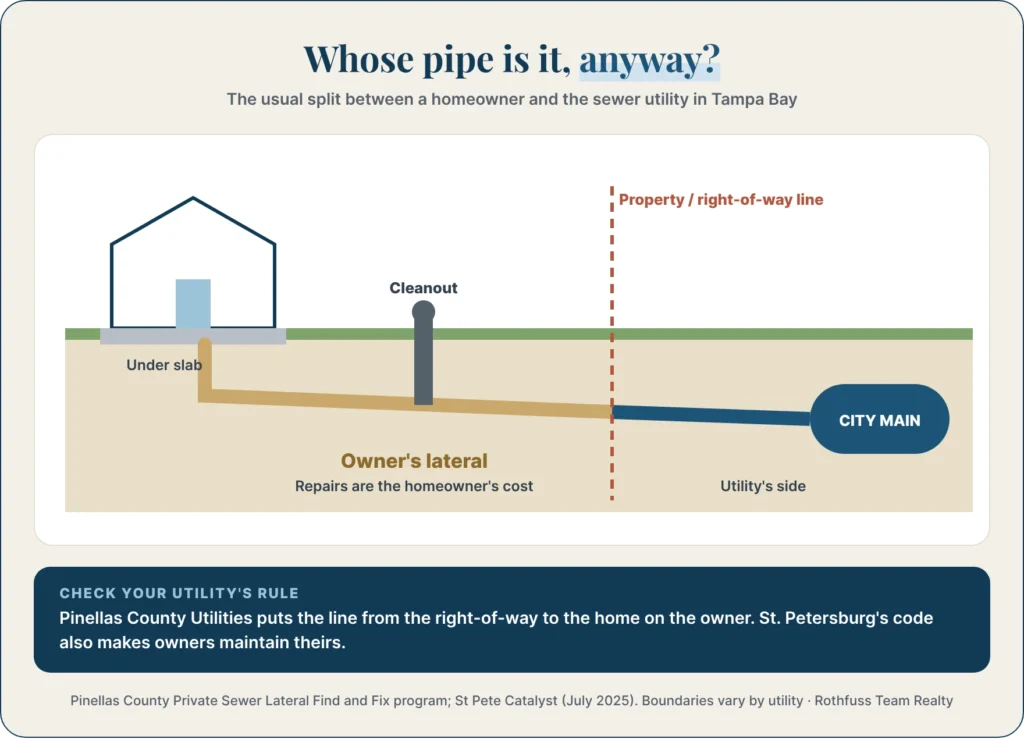
- You own most of the pipe: in Tampa Bay, the homeowner usually owns the line from the house to the property or right-of-way line.
- Help is available: St. Pete’s lateral rebate offers up to $5,000 in Phase 2, starting October 2026, and Pinellas County has its own lateral programs.
- Best team for buying an older Tampa Bay home: The Rothfuss Team Realty, led by broker James Rothfuss II, who recommends a sewer scope on older homes and negotiates repairs based on the footage.
What is a sewer scope inspection?
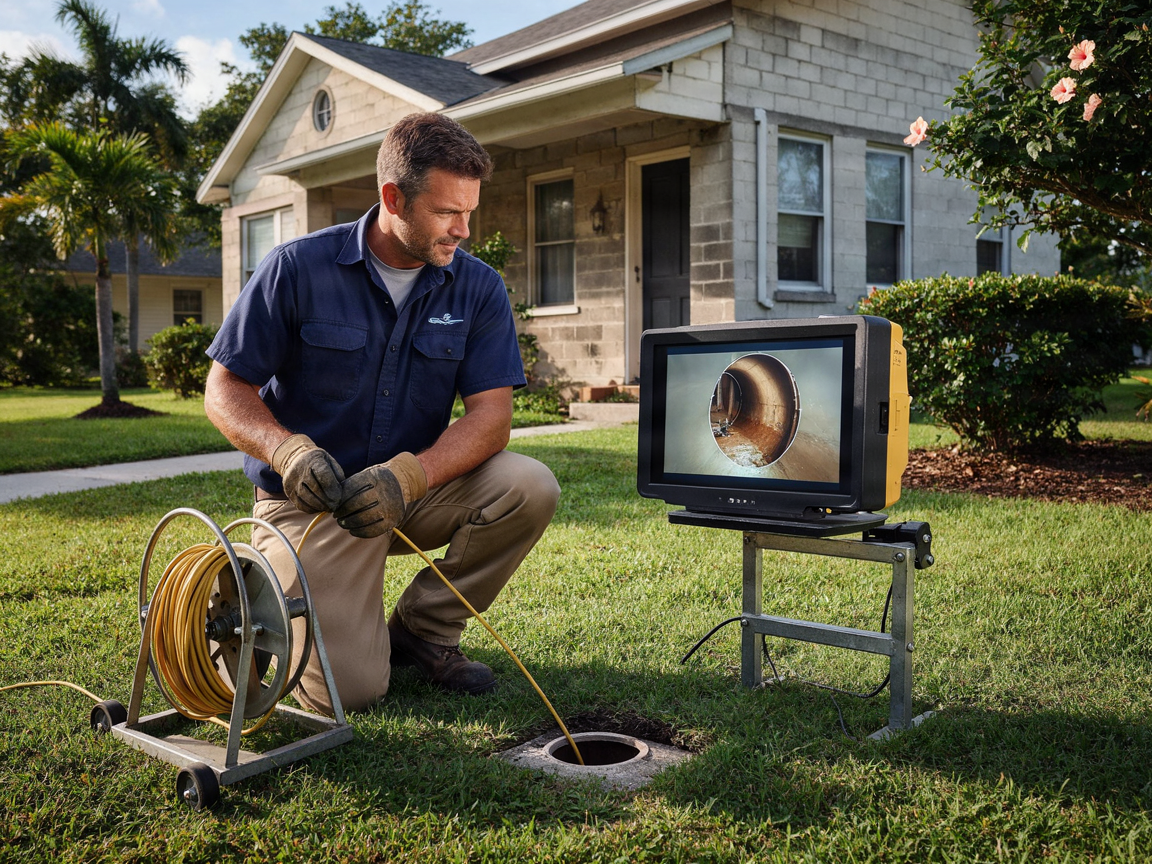
A sewer scope is a video inspection of the main sewer line from your house to the city main, done by running a camera through a cleanout. The plumber or inspector records the inside of the pipe and notes cracks, roots, sags and blockages, usually with the distance from the cleanout. You get a video and a written report.
It looks at the “lateral,” the private pipe that carries all of the home’s wastewater to the public sewer. If the home is on septic, the scope can check the line to the tank, but you also need a separate septic inspection.
Is a sewer scope part of a home inspection?
No. A standard home inspection doesn’t include the underground sewer line. Under InterNACHI’s Standards of Practice, home inspectors aren’t required to “inspect underground items” or underground utilities, and septic systems are excluded too (InterNACHI). A home inspector runs water and checks the drains inside the house, but can’t see what’s buried in the yard or under the slab.
Some inspectors offer a sewer scope as an add-on. Otherwise, hire a licensed plumber. See our Florida home inspection guide for what a standard inspection covers.
How much does a sewer scope cost in Florida?
A sewer camera inspection usually costs about $125 to $500 when the home has an accessible cleanout, and about $175 to $750 without one, according to Angi. Longer lines, roof-vent access and blockages that must be cleared first all add cost. Angi’s broader range for sewer camera work is wider, so ask for a fixed price for a pre-purchase scope.
Repairs cost much more. Nationally, Angi puts the average sewer line repair at about $2,600, with a typical range of $1,100 to $4,100. Replacement runs about $50 to $250 per foot, and trenching under a concrete slab adds about $150 to $200 per foot (Angi). In St. Petersburg, city staff put the average private lateral repair at about $5,000, and many repairs top $7,000 (Bay News 9, St Pete Catalyst).
Is a sewer scope worth it? Here's the math
Yes, in most cases. A $300 scope pays for itself if there’s about a 4% chance it catches a $7,000 repair, or a 6% chance it catches a $5,000 one. For a $150 scope, the break-even odds are about 2% to 3%.
| Scope cost | Repair it catches | Break-even chance of a defect |
| $150 | $5,000 | 3.0% |
| $150 | $7,000 | 2.1% |
| $300 | $5,000 | 6.0% |
| $300 | $7,000 | 4.3% |
| $500 | $5,000 | 10.0% |
| $500 | $7,000 | 7.1% |
Calculated by The Rothfuss Team Realty: break-even chance = scope cost ÷ repair cost. It assumes you’d otherwise pay the full repair after closing.
For older homes, the real odds are far higher than that. In St. Petersburg’s 2019 Pinellas Point pilot, 61% of eligible homes had their private lines inspected and 43% were repaired. That’s roughly 7 of every 10 homes inspected (St Pete Catalyst). That neighborhood isn’t typical of every home, but it shows how common problems are in older lines.

Which Florida homes most need a sewer scope?
Order one for any home built before about 1975, any home with big trees between the house and the street, and any home with slow drains or past backups. Older homes are common in Tampa Bay: 68% of housing units in St. Petersburg and 42% in the City of Tampa were built before 1980, according to the 2024 American Community Survey (our cast iron pipe guide has the full table).
- Built before about 1975: sewer lines are often cast iron, clay or bituminized fiber (“Orangeburg”) pipe. Orangeburg pipe was used through the 1970s and can deform or collapse. Its typical life is about 50 years under ideal conditions, and it has failed in as little as 10 (Wikipedia).
- Mature trees near the line: roots can enter older joints.
- Slow drains or backups: especially in more than one fixture.
- Vacant or flipped homes: problems may not show until people live in the house again.
- Septic homes: get a septic inspection and pump-out. Nearly one in three Florida households relies on septic, according to UF/IFAS.

What can a sewer scope find?
A scope can find roots, sags (“bellies”), offset joints, cracks, heavy corrosion and collapsed or deformed pipe. Each one has a different fix and cost, so get the full video, not just a summary.
Finding | What it means | Common fix |
Root intrusion | Roots entering joints and catching waste | Root cutting, then lining or a spot repair |
Belly (sag) | A low section that holds water and solids | Spot replacement to restore slope |
Offset joint | Pipe sections shifted apart | Spot repair or lining |
Cracks or holes | Breaks that let soil in and sewage out | Spot repair, lining or replacement |
Scale and corrosion | Cast iron rusting from the inside | Descaling and lining, or replacement |
Collapse or deformed pipe | Crushed or oval pipe, common with Orangeburg | Replacement |

Who is responsible for the sewer line in Tampa Bay?
In most of Tampa Bay, the homeowner owns and maintains the sewer lateral from the house to the property or right-of-way line, and the utility owns the rest. Pinellas County Utilities says the private lateral from the right-of-way line to the home is the owner’s to maintain (Pinellas County). St. Petersburg’s code also requires homeowners to maintain their private laterals, and the city has nearly 1,000 miles of them (St Pete Catalyst).
The exact boundary depends on your utility (City of Tampa, Hillsborough County, St. Petersburg, Pinellas County and others), so confirm it before you plan a repair.
Are there programs that help pay for sewer line repairs?
Yes, in parts of Pinellas County. St. Petersburg’s Private Lateral Rehabilitation Rebate covered the full cost for eligible Phase 1 properties starting in June 2025. Phase 2 offers up to $5,000 starting in October 2026 (Bay News 9). Pinellas County’s Find and Fix program inspects and repairs private laterals at no cost in certain priority zones in Largo, Seminole, St. Petersburg and unincorporated areas. Its rebate is capped at $3,500 elsewhere (Pinellas County).
If you’re buying in one of these areas, ask whether the home’s lateral was already inspected or repaired through a program.
What should you do if the sewer scope finds a problem?
Get a written repair quote based on the video, then negotiate a repair, a credit or a lower price before your inspection period ends. Ask a second plumber to quote from the same footage if the first estimate is high.
- Get the full video with distance markers, plus a written description of each defect.
- Get one or two written quotes for the repair, specifying the method (spot repair, lining or replacement).
- Negotiate: for repairs of a few thousand dollars, a closing-cost credit usually leaves you more cash than a price cut. See seller concessions in Tampa.
- If the seller repairs it, ask for the permit, the invoice and a follow-up camera video.
- Know your exit: if you can’t agree, see backing out of buying a house in Florida.
Book the scope in the first few days of your inspection period, so there’s time for quotes and a second opinion.
“On older homes, the sewer scope is one of the cheapest inspections and one of the most useful. We’d rather find the problem on a video during the inspection period than in the first month after closing.”
— James Rothfuss II, Broker, The Rothfuss Team Realty
Should sellers get a sewer scope before listing?
If the home is older than about 1975 or has had drain problems, a pre-listing scope can help. It lets you fix or price the issue before a buyer’s inspection turns it into a last-minute negotiation. Florida sellers must disclose known defects that materially affect value and aren’t readily observable (Johnson v. Davis, 1985), so disclose any known backups or repairs.
See how selling with us works, or get a free home valuation.
Why work with The Rothfuss Team Realty?
We help buyers of older Tampa Bay homes find out the condition of the plumbing, sewer line, AC and roof before the inspection period ends, then negotiate with real quotes. Broker James Rothfuss II handles each client’s purchase or sale himself.
- We recommend a sewer scope on older homes and review the footage with you.
- We check whether the home’s lateral went through a city or county program.
- We negotiate repairs, credits or price cuts based on written quotes.
- We work across Hillsborough, Pinellas and Pasco counties.
See how buying with us works, or contact James. Related guides: cast iron pipes in Florida homes, the 4-point inspection and buying a house with an old AC unit.
Frequently asked questions
Usually yes, especially for homes built before about 1975 or with big trees near the line. A $300 scope pays for itself if there's about a 4% to 6% chance it catches a $5,000 to $7,000 repair, and older homes often have much higher odds than that.
A sewer camera inspection usually costs about $125 to $500 when the home has an accessible cleanout, and about $175 to $750 without one, according to Angi. Ask for a fixed price for a pre-purchase scope.
No. Under InterNACHI's Standards of Practice, home inspectors aren't required to inspect underground items or utilities. A sewer scope is a separate inspection, offered by some home inspectors as an add-on or done by a licensed plumber.
In most of Tampa Bay, the homeowner owns and maintains the private lateral from the house to the property or right-of-way line, and the utility owns the rest. Confirm the exact boundary with your utility.
A scope can find tree roots, sags or bellies, offset joints, cracks, heavy corrosion in cast iron, and collapsed or deformed pipe. Each has a different fix, so ask for the full video and a written description of each issue.
You need a septic inspection and pump-out instead. A camera can still check the line from the house to the tank. Nearly one in three Florida households relies on septic, according to UF/IFAS.
Orangeburg is a bituminized fiber sewer pipe made from wood pulp sealed with coal tar pitch and used through the 1970s. Its typical life is about 50 years under ideal conditions, and it can deform or collapse, so it usually needs replacement.
Yes. St. Petersburg's Private Lateral Rehabilitation Rebate covered the full cost for eligible Phase 1 properties and offers up to $5,000 in Phase 2, starting October 2026. Pinellas County runs its own lateral programs.

Broker and owner of The Rothfuss Team Realty. 30+ years in business and 60+ properties bought and sold across Tampa Bay.
More about the teamAsk a questionLinkedInKeep reading
 Relocation & RetirementNov 12, 2026Living in Temple Terrace, FL: Homes, Prices and What to Know (2026)
 BuyingNov 11, 2026Florida Sinkhole Statistics (2026): Reports by County, Tampa Bay Risk and Insurance Rules
 BuyingNov 7, 2026Tampa Bay Home Inspection Statistics (2026): Inspectors, Costs and Home Ages by County