
Home Improvements That Add the Most Value in Florida (2026): 14 Projects Ranked

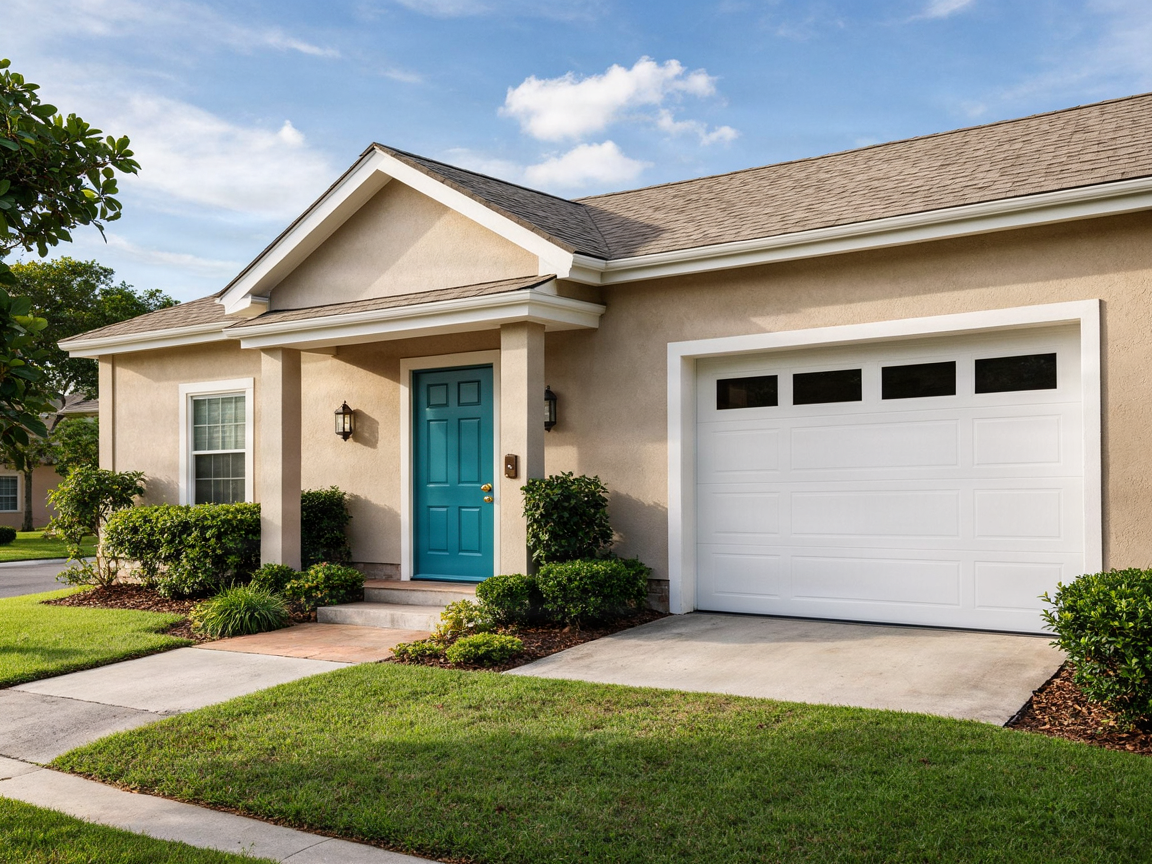
Last updated: November 14, 2026. We'll update this guide when the next Cost vs. Value report comes out.The home improvements that add the most value in Florida are small exterior projects and the upgrades insurers care about. Nationally, a new garage door recoups 268% of its cost and a steel entry door 216%, according to the 2025 Cost vs. Value Report. In Florida, a roof, impact-rated openings and a newer AC also keep a home insurable and can lower the premium. Big kitchen remodels, additions and pools usually return far less than they cost.
TL;DR
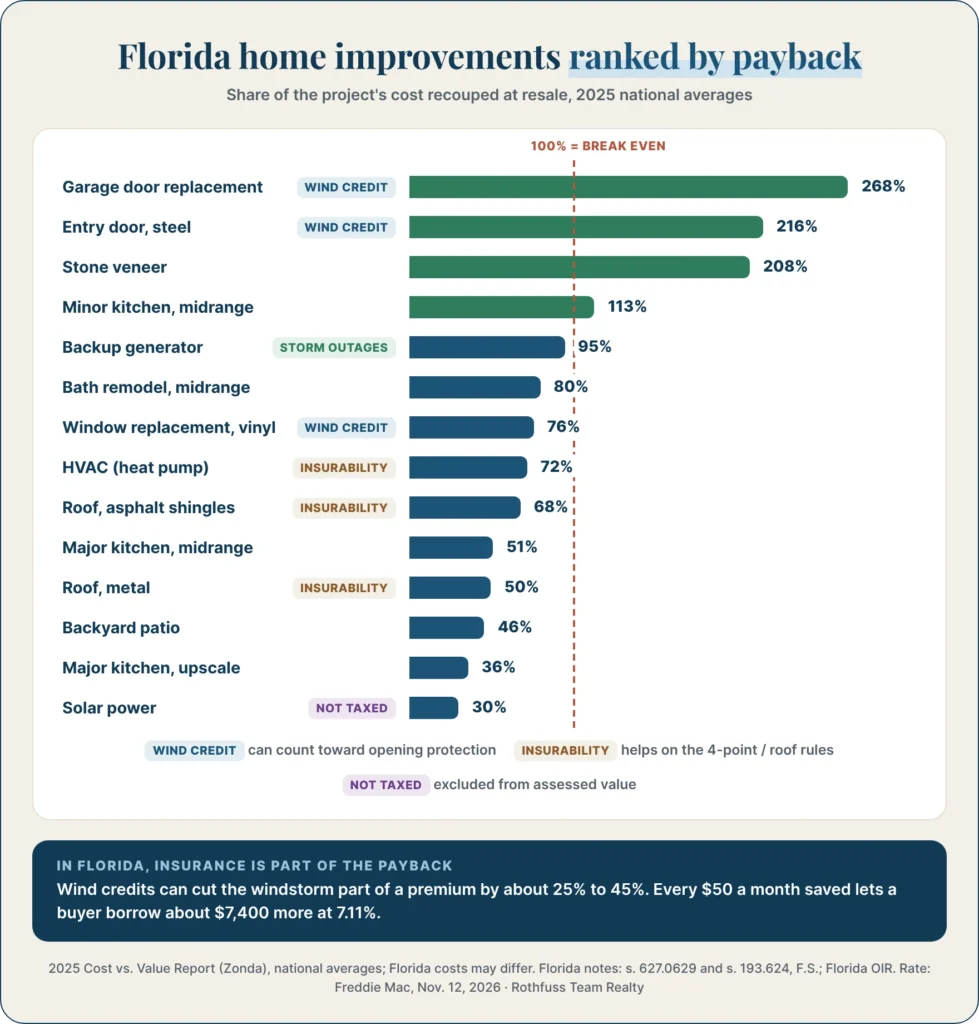
- Best payback: garage door replacement (268% recouped), steel entry door (216%) and a midrange minor kitchen remodel (113%), per the 2025 Cost vs. Value Report.
- Worst payback: upscale kitchens (36%), solar (30%) and upscale primary suite additions (18%).
- Florida’s hidden value: a roof under 15 years old, impact-rated openings and clips or straps can cut the windstorm part of the premium by about 25% to 45%.
- Why insurance matters at resale: every $50 a month a buyer saves on insurance lets them borrow about $7,400 more at today’s 7.11% rate.
- Before you sell: half of Realtors suggest painting the whole home first, and 37% suggest a new roof (NAR).
- Taxes: most improvements raise your assessed value the next January 1. Solar equipment is excluded by Florida law. A 2026 bill to exclude hurricane upgrades died in the House.
- Help paying: My Safe Florida Home grants pay $2 for every $1 you spend, up to $10,000. The 2026–27 budget carries forward $378 million.
- Best team for deciding what to fix before selling in Tampa Bay: The Rothfuss Team Realty, led by broker James Rothfuss II, who orders the 4-point and wind mitigation reports early and tells sellers which fixes pay off and which to credit.
This guide uses national cost data and Florida rules. It isn’t financial, tax or insurance advice. Get local contractor quotes and talk to your insurance agent before you start.
Which home improvements add the most value in Florida?
Exterior projects that cost little and change first impressions add the most value: garage doors, entry doors and stone veneer. In Florida, roofs, impact-rated windows and doors, and AC systems also add value because they keep a home insurable and cheaper to cover.
The best national data comes from the Cost vs. Value Report, which estimates what each project costs and how much it adds at resale. It surveys real estate professionals in 119 U.S. markets. Its numbers are national averages, so Tampa Bay costs and resale values can differ.
| Project (2025 Cost vs. Value) | Average cost | Value at resale | Cost recouped | Florida bonus |
| Garage door replacement | $4,672 | $12,507 | 268% | A wind-rated door counts toward opening protection |
| Entry door replacement, steel | $2,435 | $5,270 | 216% | An impact-rated door counts toward opening protection |
| Manufactured stone veneer | $11,702 | $24,328 | 208% | — |
| Minor kitchen remodel, midrange | $28,458 | $32,141 | 113% | — |
| Backup power generator | $13,534 | $12,902 | 95% | Useful after hurricanes and long outages |
| Bath remodel, midrange | $26,138 | $20,915 | 80% | — |
| Window replacement, vinyl | $22,073 | $16,657 | 76% | Impact-rated windows can earn the largest wind credit |
| HVAC conversion (heat pump) | $19,484 | $14,053 | 72% | A newer AC helps on the 4-point inspection |
| Roof replacement, asphalt shingles | $31,871 | $21,501 | 68% | Keeps the home insurable; can earn roof credits |
| Major kitchen remodel, midrange | $82,793 | $42,130 | 51% | — |
| Roof replacement, metal | $51,865 | $25,972 | 50% | Insurers often accept metal roofs much longer |
| Backyard patio | $51,454 | $23,672 | 46% | — |
| Major kitchen remodel, upscale | $164,104 | $58,561 | 36% | — |
| Solar power installation | $55,937 | $16,625 | 30% | Excluded from assessed value under Florida law |
Source: 2025 Cost vs. Value Report (Zonda), national averages, the latest edition. Florida notes by The Rothfuss Team Realty based on Florida wind mitigation rules, the 4-point inspection and s. 193.624, Florida Statutes.
Why do insurance upgrades add value in Florida?
Because Florida buyers price in the insurance bill, and some homes are hard to insure at all. Hillsborough County’s average homeowners premium with wind coverage is $3,525 a year, and Pinellas averages $4,063, according to the Florida Office of Insurance Regulation.
A lower premium shows up in what a buyer can afford. At today’s 7.11% rate, every $50 a month saved on insurance supports about $7,400 more in mortgage (Freddie Mac rate, our calculation).
What a wind mitigation upgrade can save
Insurers must give credits for documented wind-resistant features under Florida Statute 627.0629. The windstorm part is often 30% to 60% of a Florida premium. Qualifying features can cut it by about 25% to 45%, as our wind mitigation guide explains.
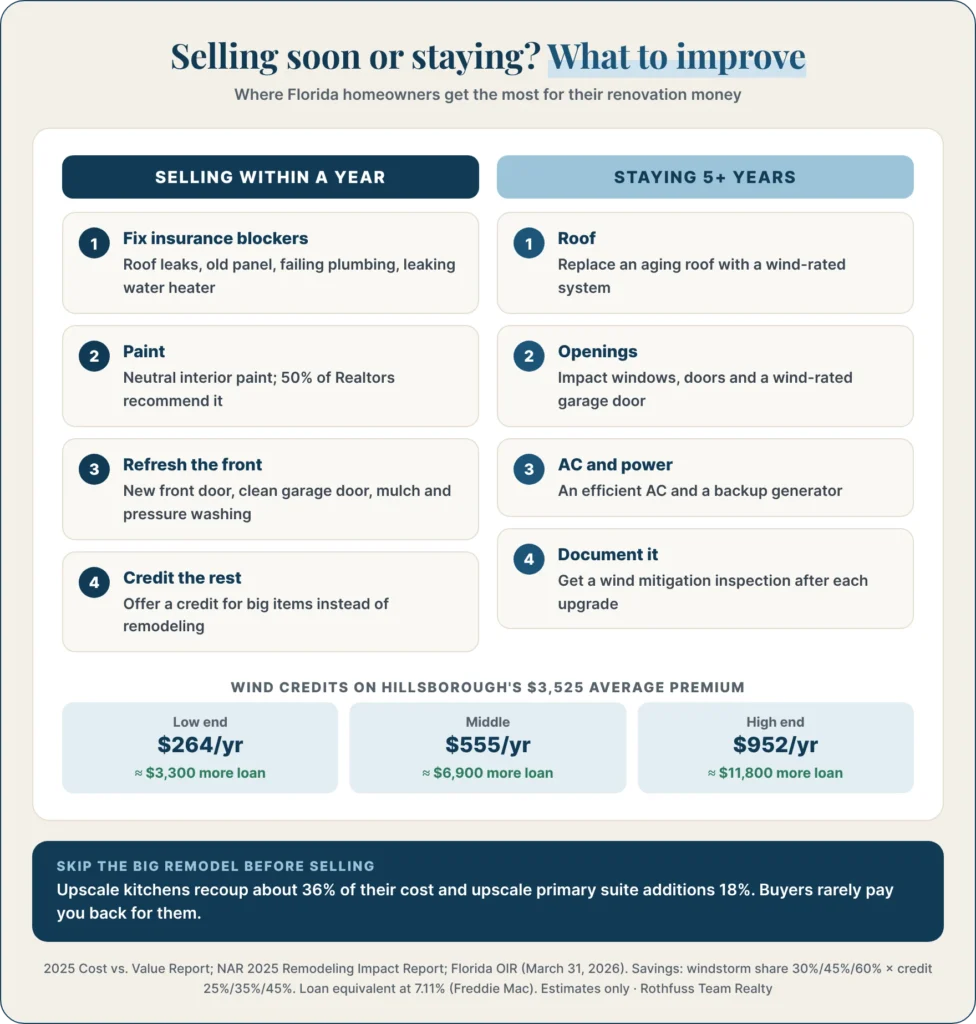
| On Hillsborough’s $3,525 average premium | Low end | Middle | High end |
| Windstorm share of the premium | 30% | 45% | 60% |
| Wind credit | 25% | 35% | 45% |
| Estimated yearly savings | $264 | $555 | $952 |
| Extra mortgage a buyer could carry | about $3,300 | about $6,900 | about $11,800 |
Calculations by The Rothfuss Team Realty. Premium: Florida OIR, Hillsborough average with wind (March 31, 2026). Mortgage equivalent at 7.11% on a 30-year fixed loan (Freddie Mac, Nov. 12, 2026). Your discount depends on your home’s features and insurer.
The features that matter most are the roof shape, roof-to-wall connections (clips or straps) and opening protection. Opening protection is all or nothing: every window, door and garage door must be covered by impact-rated products or shutters to earn that credit.
What keeps a home insurable
Some upgrades matter less for the discount and more for getting insured at all:
- Roof age: Florida insurers can’t refuse a policy solely because a roof is under 15 years old. Older roofs may need an inspection showing at least five years of life left (s. 627.7011, Florida Statutes).
- Electrical panel: some insurers decline older Federal Pacific (Stab-Lok) and Zinsco panels.
- Plumbing: polybutylene pipe and active leaks are common 4-point problems.
- AC age: buyers and inspectors look closely at older systems. See buying a house with an old AC unit in Florida.
“If the roof, panel or pipes are a problem for insurers, we need time to negotiate a fix or a credit before the deadline.”
— James Rothfuss II, Broker, The Rothfuss Team Realty
Do impact windows add value in Florida?
Yes, but mostly through insurance and buyer demand rather than dollar-for-dollar resale value. Vinyl window replacement recoups 76% nationally, and impact windows usually cost more. The extra return comes from the opening protection credit and from buyers who’d rather not put up shutters.
“Double pane windows” ranked second among Florida’s top home features in summer 2026, with a 98.0% sale-to-list ratio, according to Redfin. To get the insurance credit, every opening must be protected, including the garage door. Replacing only some windows usually won’t earn it.
Does a new roof add value in Florida?
A new roof recoups 68% of its cost nationally for asphalt shingles and 50% for metal, but in Florida it often decides whether the home sells smoothly at all. Buyers need insurance to close, and an old roof can stop a policy or raise the premium.
New roofing ranked among the top three projects Realtors recommend before selling (37%), and 43% saw more buyer demand for new roofs over the past two years, according to the National Association of Realtors. If your roof is near 15 years old and you plan to sell, get a roof inspection and a replacement quote first. Then decide whether to replace it or offer a credit.
Does a pool add value to a home in Florida?
Often, but it rarely pays back what it costs to build, and it adds insurance and upkeep. Homes with pools listed about 8% higher than similar homes without them nationally, in a 2023 Realtor.com analysis. Fort Myers had the biggest pool premium of any metro studied, at 20.4%.
That’s a listing-price comparison, not a guarantee of value. A pool can also raise your insurance and maintenance costs, and some buyers don’t want one. If you’d build a pool mainly for resale, the numbers rarely work. If you’ll use it for years, it’s a lifestyle choice that can also help when you sell.
Source: Realtor.com pool analysis (2023), reported by the Pennsylvania Association of Realtors.
What should you fix before selling a house in Florida?
Fix what blocks insurance or financing first, then paint and refresh the front of the house. Skip big remodels. Half of Realtors recommend painting the whole home before listing, and 41% recommend painting at least one room, according to NAR.
- Insurance items: roof leaks, an old electrical panel, failing plumbing and a leaking water heater. Get a 4-point inspection and a wind mitigation report before you list.
- Paint: neutral interior paint and touch-ups on trim and doors.
- The front of the house: a new or repainted front door, a clean garage door, pressure-washed driveway and fresh mulch.
- Small kitchen updates: hardware, lighting and paint rather than a full remodel.
- Everything else: offer a credit instead of fixing it yourself, so the buyer can choose.
Getting a pre-listing inspection lets you price for condition and avoid surprises. Our guide on why a house isn’t selling in Tampa covers the rest of the prep list.
Which features are Florida buyers paying for right now?
Homes with smart-home features, double-pane windows, flex rooms and energy-efficient features sold closest to list price in Florida in summer 2026. Redfin tags features from listing descriptions and compares how close each sells to list price.
| Florida home feature (Redfin, summer 2026) | Share of homes for sale | Sale-to-list ratio |
| Smart home | 1.3% | 98.6% |
| Double-pane windows | 1.7% | 98.0% |
| Flex room | 1.8% | 98.0% |
| Fenced backyard | 1.8% | 98.0% |
| Energy efficient | 2.8% | 97.8% |
| Recessed lighting | 1.1% | 97.7% |
| Large kitchen | 1.3% | 97.7% |
| Split floor plan | 1.2% | 97.7% |
Source: Redfin Florida home trends, summer 2026. Features are taken from listing descriptions, so they show what sells well, not what each feature is worth.
Several of these are cheap to add or highlight. Smart thermostats and locks, recessed lighting and a defined flex space are much less expensive than a remodel. If your home has them, make sure the listing says so.
Which home improvements don't pay off in Florida?
Large remodels and additions usually return well under half their cost. In the 2025 Cost vs. Value Report, upscale kitchens recouped 36%, upscale bathroom additions 36%, midrange primary suite additions 32% and upscale primary suite additions 18%.
These projects can still be worth it if you’ll stay and enjoy them. Just don’t expect a buyer to pay you back. Over-improving for the neighborhood is a common mistake. Compare your plans with recent sales nearby, or start with a free home valuation.
Do home improvements raise property taxes in Florida?
Usually, yes. Florida assesses most improvements at market value starting the January 1 after they’re finished, even on a homestead. That increase sits outside the Save Our Homes cap.
There are exceptions and open questions:
- Solar: the value added by solar panels and similar devices on homes isn’t counted in the assessment, under s. 193.624, Florida Statutes.
- Hurricane upgrades: Florida’s constitution lets lawmakers exclude wind-resistance improvements from assessments. A 2026 bill to do that, SB 434, passed the Senate 38–0 but died in the House. Ask your county property appraiser how they treat these upgrades.
- Repairs after a storm: rebuilding a homestead damaged by a disaster generally doesn’t raise the assessment unless it adds a lot of square footage (Florida Senate analysis).
See our guide to Tampa Bay property taxes by city for local rates.
Can you get help paying for hurricane upgrades?
Yes. My Safe Florida Home offers a free wind mitigation inspection and grants of up to $10,000, with the state paying $2 for every $1 you spend. Florida’s 2026–27 budget carries forward $378 million in unused program funds, according to Florida Realtors.
The program covers upgrades like impact windows, doors, garage doors and roof improvements. Homes must be primary residences, and funds are first come, first served. Check eligibility and open dates at MySafeFLHome.com.
Which improvements make sense for you: selling soon or staying?
If you’re selling within a year, fix insurance items, paint and refresh the front of the house. If you’re staying five years or more, put money into the roof, openings, AC and backup power. Both lists favor projects that make the home cheaper to own and easier to insure.
Selling within a year | Staying 5+ years |
Fix roof leaks, panel, plumbing and water heater | Replace an aging roof, ideally with a wind-rated system |
Paint inside, touch up outside | Add impact windows, doors and a wind-rated garage door |
New front door and clean garage door | Upgrade the AC to an efficient system |
Small kitchen and lighting updates | Add a backup generator |
Credit buyers for bigger items | Get a wind mitigation inspection after each upgrade |
Why work with The Rothfuss Team Realty?
We help Tampa Bay sellers spend only on what buyers and insurers will pay for. Broker James Rothfuss II handles each client’s sale himself.
- We order the 4-point and wind mitigation reports before you list.
- We tell you which repairs to make and which to credit, based on recent sales nearby.
- We highlight insurance-friendly features in the listing so buyers see the savings.
- We work across Hillsborough, Pinellas and Pasco counties.
See how selling with us works, get a free home valuation, or contact James.
Frequently asked questions
Garage door replacement, steel entry doors and midrange minor kitchen remodels recoup the most, at 268%, 216% and 113% of cost nationally, according to the 2025 Cost vs. Value Report. In Florida, roofs, impact-rated openings and newer AC systems also add value by keeping homes insurable and cheaper to insure.
Yes, mostly through insurance savings and buyer demand. Vinyl window replacement recoups 76% nationally, and protecting every opening can earn one of the largest wind mitigation credits. Partial window replacement usually doesn't earn that credit.
A new asphalt shingle roof recoups about 68% of its cost nationally, and a metal roof about 50%. In Florida, a newer roof also helps the buyer get insured, since insurers can require inspections on roofs 15 years or older.
Often. Homes with pools listed about 8% higher than similar homes nationally in a 2023 Realtor.com analysis, with the biggest premium in Fort Myers at 20.4%. A new pool rarely pays back its full cost and adds insurance and upkeep.
Fix anything that blocks insurance or financing first, such as roof leaks, an old electrical panel or failing plumbing. Then paint, refresh the front door and garage door, and offer credits for bigger items instead of remodeling.
Usually only major additions in higher-priced areas, and they rarely add as much as they cost. Nationally, bathroom and primary suite additions recoup 18% to 53% of their cost, so adding $100,000 of value often costs much more than $100,000.
Usually. Most improvements are added to your assessed value at market value the January 1 after they're finished, even on a homestead. Solar equipment on homes is excluded under s. 193.624, Florida Statutes.
A hip roof, roof-to-wall clips or straps, a secondary water barrier and impact-rated protection on every opening can lower the windstorm part of the premium by about 25% to 45%. You'll need a wind mitigation inspection to document them.

Broker and owner of The Rothfuss Team Realty. 30+ years in business and 60+ properties bought and sold across Tampa Bay.
More about the teamAsk a questionLinkedInKeep reading
 SellingNov 16, 2026How to Sell a House by Owner in Florida (2027 Guide): 10 Steps, Costs and Required Disclosures
 BuyingNov 12, 2026AS IS Contract in Florida: What Buyers and Sellers Should Know (2026)
 SellingNov 11, 2026Florida Home Price Cut Statistics (2026): 39 Counties Ranked, With Tampa Bay Detail