
Seawall Replacement Cost in Tampa Bay (2026): Prices per Foot, Permits and What Buyers Should Check

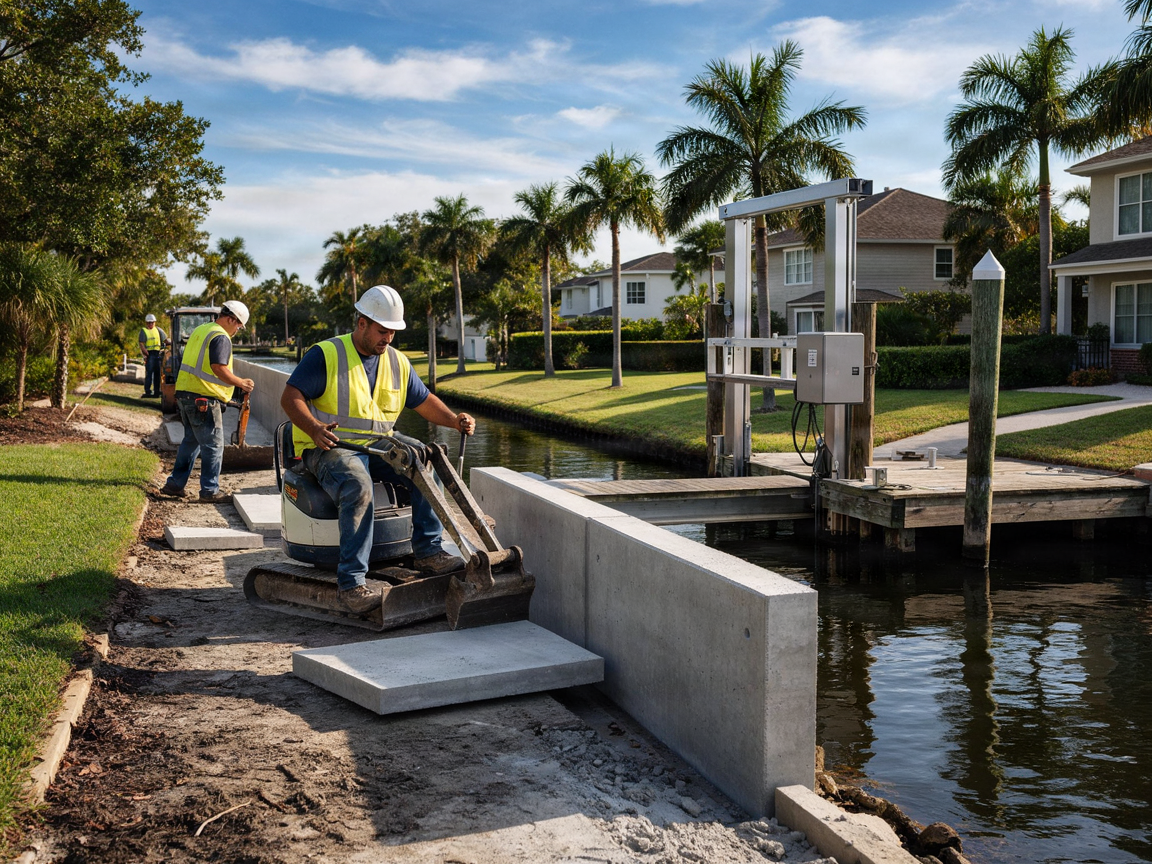
Replacing a residential seawall in Tampa Bay usually costs tens of thousands of dollars. A sample 2026 Tampa Bay estimate for 100 feet of vinyl wall with tiebacks and a concrete cap came to $46,800 to $70,200, or about $585 per foot at the midpoint. The total depends mostly on your waterfront length, wall height, material and access. Flood insurance doesn’t cover seawalls, so buyers should get the wall inspected before closing and price it into the offer.
TL;DR
- Typical range: nationally, seawalls run about $150 to $800 per linear foot depending on material, according to HomeAdvisor. A 2026 Tampa Bay sample estimate for 100 feet came to about $585 per foot.
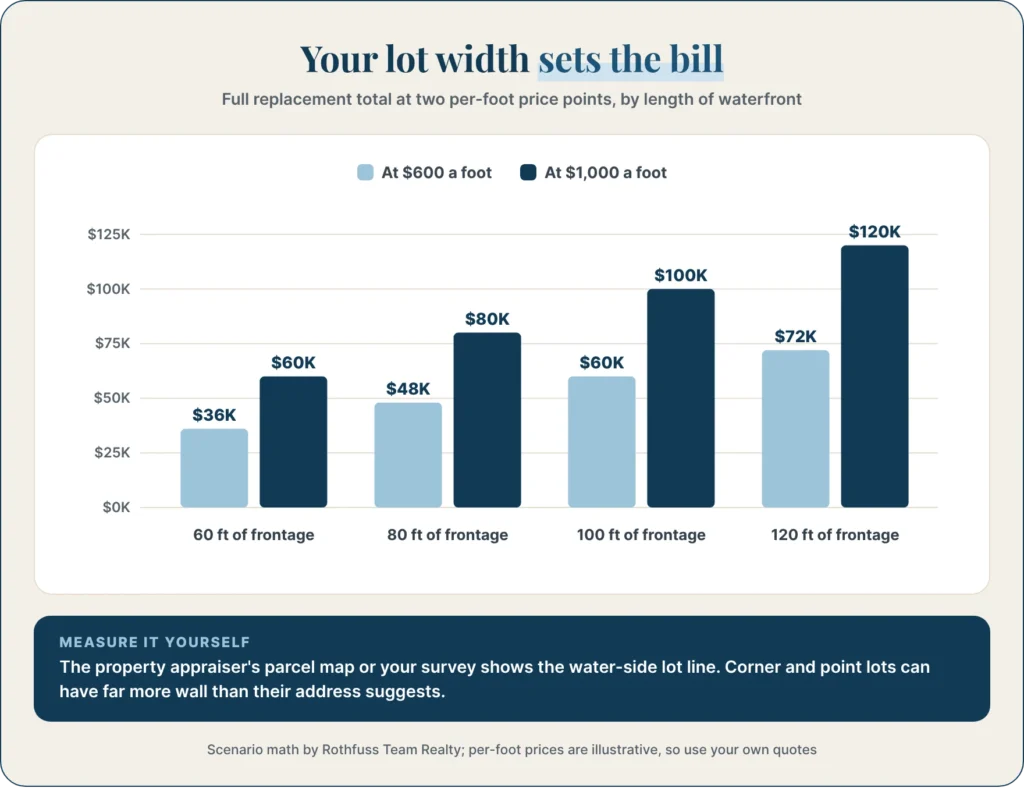
- Your lot sets the total: at $600 a foot, 80 feet of frontage costs about $48,000. At $1,000 a foot, it’s $80,000.
- Materials: vinyl with a concrete cap lasts about 50 to 70 years, poured concrete 50 to 60, steel 30 to 40 and treated wood 10 to 25, according to HomeAdvisor.
- Flood insurance won’t pay: NFIP flood policies exclude seawalls, and many homeowners policies limit them.
- Permits: restoring a wall in place (or up to 18 inches waterward) is exempt from a state DEP permit, but you still need local permits.
- St. Petersburg alone has about 95 miles of private seawall, and the city asked residents in 2026 whether to raise the minimum height for private walls.
- Best team for buying waterfront in Tampa Bay: The Rothfuss Team Realty, led by broker James Rothfuss II, who checks the seawall, flood zone, elevation and insurance on every waterfront home before you make an offer.
How much does seawall replacement cost in Tampa Bay?
A full residential seawall replacement in Tampa Bay often costs $40,000 to $100,000 or more, depending on how many feet of wall you have and how it’s built. One 2026 Tampa Bay estimator sample for 100 feet of vinyl wall with helical tiebacks and a concrete cap came to $46,800 to $70,200, with a midpoint of $58,500, or about $585 per foot (My Dock Guide).
Here’s how that sample breaks down at the midpoint:
| Item (100 feet) | Midpoint cost | Per foot |
| New vinyl wall | $32,000 | $320 |
| Helical tiebacks | $9,500 | $95 |
| Concrete cap | $5,500 | $55 |
| Mobilization | $4,500 | Flat fee |
| Removing the old wall | $4,200 | $42 |
| Permits (Hillsborough) | $2,800 | Flat fee |
| Total | $58,500 | About $585 |
Sample estimate from the My Dock Guide Tampa Bay seawall cost estimator (2026). It excludes surveys, engineered drawings, dewatering and soil borings. Walls taller than about 6 feet add roughly 8% per extra foot, according to the same tool.

What does a seawall cost for your lot?
Multiply your waterfront length by the per-foot price in your quotes. Here’s what that looks like at a range of prices:
| Price per foot | 60 ft of frontage | 80 ft | 100 ft | 120 ft |
| $400 | $24,000 | $32,000 | $40,000 | $48,000 |
| $600 | $36,000 | $48,000 | $60,000 | $72,000 |
| $800 | $48,000 | $64,000 | $80,000 | $96,000 |
| $1,000 | $60,000 | $80,000 | $100,000 | $120,000 |
| $1,200 | $72,000 | $96,000 | $120,000 | $144,000 |
Calculated by The Rothfuss Team Realty, November 2026. Per-foot prices are examples, so use the per-foot figure from your own quotes. Corner and point lots can have much more wall than a standard lot.
What affects the price of a seawall?
Length, wall height, material, tiebacks, access and permits drive most of the cost. Two neighbors with the same frontage can get very different quotes.
- Length: the biggest factor. Measure the water-side lot line on your survey or the property appraiser’s parcel map.
- Height: taller walls need deeper panels and stronger anchoring.
- Tiebacks: anchors that hold the wall against the soil behind it. Taller walls need them.
- Material: see the comparison below.
- Access: work from a barge on the canal or from land through the yard. Tight lots and fences add labor.
- Docks and boat lifts: these often have to be removed and reinstalled, which adds cost.
- Environmental conditions: seagrass beds can require extra mitigation.
- Engineering and permits: surveys, sealed drawings and local permits.
Which seawall material lasts longest?
Vinyl with a concrete cap and poured concrete last the longest, at about 50 to 70 years and 50 to 60 years. Steel lasts about 30 to 40 years, and treated wood 10 to 25, according to HomeAdvisor.
| Material | National price per linear foot | Typical lifespan |
| Vinyl (concrete-capped) | 200–600 | 50–70 years |
| Poured concrete | 200–800 | 50–60 years |
| Steel or aluminum | 250–700 | 30–40 years |
| Treated wood | 150–500 | 10–25 years |
| Riprap (rock) | 70–400 | Not listed |
National residential ranges from HomeAdvisor. Tampa Bay quotes for full replacement with tiebacks and a cap often run above the low end of these ranges.

Should you repair or replace a seawall?
Repair makes sense when the wall is structurally sound and the damage is limited to the cap, a few joints or a small area. Replace it when it’s leaning, losing soil along its length or failing in many places. A marine contractor or engineer can tell you which, and the answer may differ for each section. St. Petersburg’s own seawall study, for example, notes that a deficient section may not need full replacement (St Pete Catalyst).
Common repairs include:
- Replacing or patching a cracked cap.
- Sealing open joints between panels.
- Clearing or adding weep holes.
- Adding new tiebacks.
- Filling small sinkholes behind the wall after the leak is sealed.
If you’re getting a new wall, ask whether it can go just in front of the old one. State rules allow restoring a seawall at its previous location or within 18 inches waterward of it without a state DEP permit (Fla. Stat. 403.813(1)(e)).
What are the signs a seawall is failing?
The most common signs are a cracked or separated cap, sinkholes behind the wall, open joints, rust stains and leaning. Check at low tide, when more of the wall is exposed.
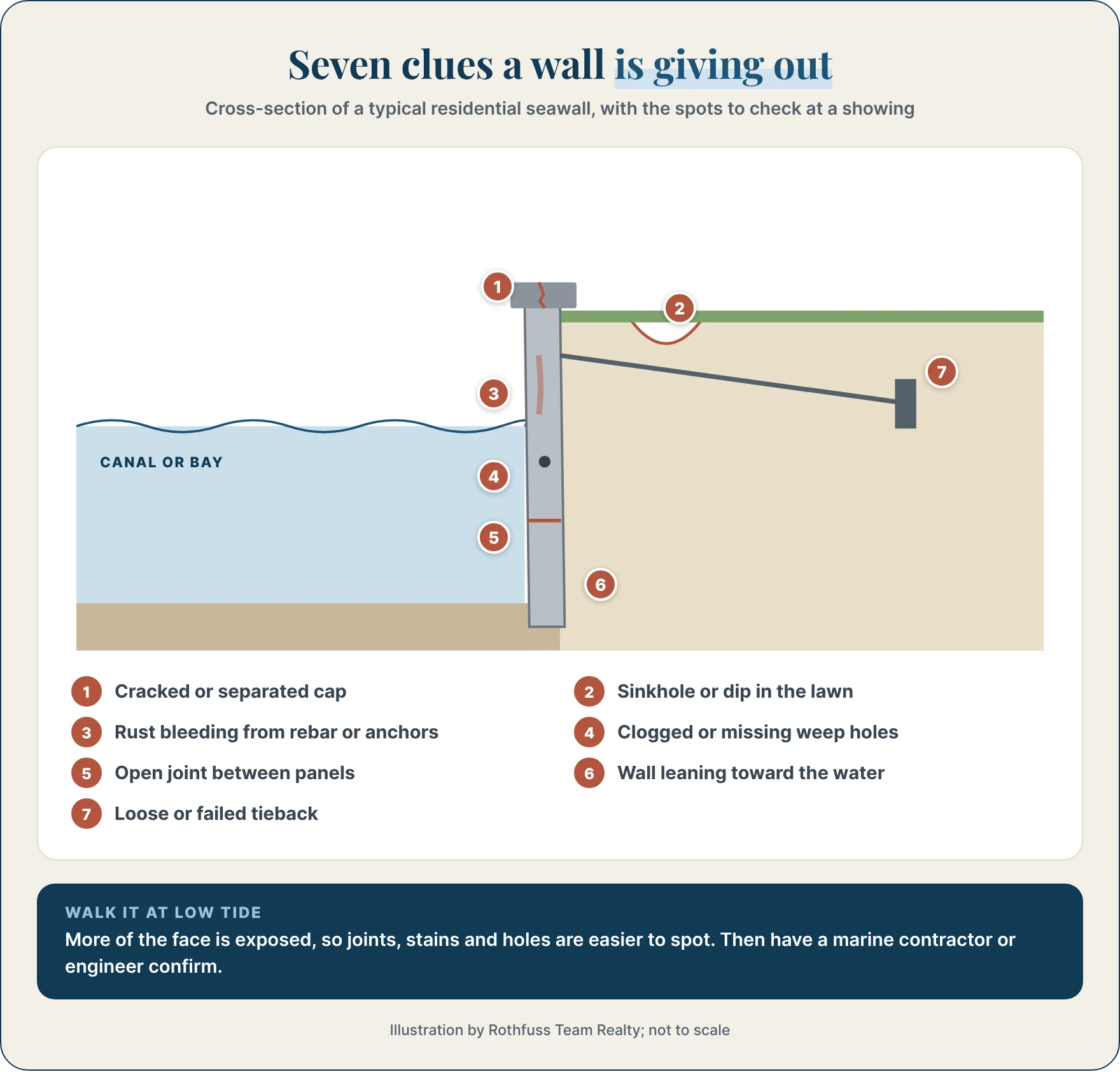
- Cracked or separated cap along the top of the wall.
- Sinkholes or dips in the lawn behind the wall, a sign that soil is washing out.
- Rust stains from rebar or anchors.
- Clogged or missing weep holes, which trap water pressure behind the wall.
- Open joints between panels.
- Leaning toward the water.
- Loose or failed tiebacks.
Do you need a permit to replace a seawall in Florida?
Yes. Seawall replacement needs local permits, even when the work is exempt from a state DEP permit. Under Fla. Stat. 403.813, restoring a seawall at its previous location, or within 18 inches waterward, is exempt from the state permit, and so are some new seawalls in artificially created waterways. You still need the city or county building permit and any local environmental approval.
- Pinellas County: the county’s Water and Navigation section permits seawalls, docks and riprap in unincorporated areas and within city limits (Pinellas County). For dock work in Clearwater, the city must pre-approve plans before the county permit (City of Clearwater).
- Hillsborough County: check with your city or the county building department, and ask your contractor which environmental reviews apply to your site.
Ask the contractor to pull the permits and give you the permit numbers. A permitted wall with final inspections is easier to insure and sell.
Does insurance cover a seawall?
Flood insurance doesn’t. The National Flood Insurance Program lists seawalls among the property outside an insured building that it excludes (FloodSmart). Homeowners policies vary. Many exclude or limit seawalls, docks and other waterfront structures, so read your policy or ask your agent.
That means a seawall that fails in a storm is usually the owner’s cost. Budget for it the way you would a roof. For waterfront insurance more broadly, see our Tampa flood zone map guide and wind mitigation guide.
Are seawall rules changing in Tampa Bay?
Yes, especially in St. Petersburg, where the city is studying its seawalls and asked residents in 2026 whether to raise the minimum required height for private walls. St. Pete has about 15 miles of city-owned seawall and 95 miles of private seawall, Bay News 9 reported in February 2026. In total, the city has more than 600,000 linear feet of seawall, and more than 500,000 feet of it is private (St Pete Catalyst).
Across Pinellas County, nearly half of its 588 miles of coastline is hardened with seawalls. In St. Petersburg, seawall funding such as Penny for Pinellas goes to city-owned walls, not private ones. If you’re buying in St. Petersburg, ask whether the wall meets the current height rules, and watch for changes before you replace one.
What should buyers check on a home with a seawall?
Before your inspection period ends, have the seawall inspected and get a written repair or replacement quote, then negotiate. A general home inspector may not evaluate the wall in detail.
- Hire a marine contractor or engineer to inspect the wall, cap, tiebacks and dock.
- Ask the seller for records: the year the wall was built or replaced, permits, warranties and any storm repairs.
- Measure the frontage and multiply it by your quoted per-foot price.
- Check the flood zone and elevation for the home. See our Tampa flood zone map guide.
- Negotiate the right way: a seawall usually costs more than a seller credit can cover, because credits are limited to your closing costs. Ask for a price reduction, a repair before closing, or a lender-approved escrow holdback. See seller concessions in Tampa.
- Know your exit: if the wall is failing and you can’t agree, see backing out of buying a house in Florida.
On a $60,000 seawall, a $60,000 price reduction with 10% down saves $6,000 on the down payment and about $368 a month at 7.24%. Compare that with paying for the wall yourself after closing.
Calculated by The Rothfuss Team Realty at 7.24%, the Freddie Mac 30-year average on Oct. 29, 2026, with 10% down. Principal and interest only.
Waterfront areas where this comes up often include Apollo Beach, St. Petersburg, Gulfport and South Tampa.
“On a canal home, the seawall can be the most expensive item on the inspection list. We get it inspected and priced before the inspection period ends, so the buyer negotiates with real numbers.”
— James Rothfuss II, Broker, The Rothfuss Team Realty
Should sellers replace the seawall before listing?
Usually not, unless it’s failing. Get it inspected, fix small problems and have the records ready. Buyers of waterfront homes will check the wall, and a recent inspection with photos makes the conversation easier.
- Small repairs: fix the cap, joints and weep holes before listing.
- Failing wall: get a written replacement quote and decide whether to replace it, price for it or offer a concession.
- Disclose known problems: Florida sellers must disclose known defects that materially affect value and aren’t readily observable (Johnson v. Davis, 1985).
See how selling with us works, or get a free home valuation.
Why work with The Rothfuss Team Realty?
We help buyers and sellers of waterfront homes in Tampa Bay price the seawall, flood risk and insurance into the deal, before the inspection period ends. Broker James Rothfuss II handles each client’s purchase or sale himself.
- We check the seawall, flood zone, elevation and insurance on every waterfront home.
- We help you get marine inspections and written quotes in time to negotiate.
- We negotiate price reductions, repairs or holdbacks based on those quotes.
- We work across Hillsborough, Pinellas and Pasco counties.
See how buying with us works, or contact James.
Frequently asked questions
A full replacement often costs $40,000 to $100,000 or more, depending on length, height and material. A 2026 Tampa Bay sample estimate for 100 feet of vinyl wall with tiebacks and a cap came to $46,800 to $70,200, or about $585 per foot at the midpoint.
Nationally, seawalls cost about $150 to $800 per linear foot depending on material, according to HomeAdvisor. Tampa Bay replacements with tiebacks, a cap, removal and permits often land in the mid-hundreds per foot or higher.
According to HomeAdvisor, vinyl seawalls with a concrete cap last about 50 to 70 years and poured concrete about 50 to 60. Steel lasts about 30 to 40 years and treated wood 10 to 25. Storms, soil loss and maintenance can shorten that.
Flood insurance through the NFIP doesn't cover seawalls. Many homeowners policies also exclude or limit seawalls and docks, so check your policy. In most cases, seawall repair or replacement is the owner's cost.
Yes, you need local permits. Restoring a seawall at its previous location, or within 18 inches waterward, is exempt from a state DEP permit under Florida Statute 403.813, but city or county permits still apply.
Look for a cracked or separated cap, sinkholes behind the wall, open joints between panels, rust stains, clogged weep holes, loose tiebacks and leaning. Check at low tide and have a marine contractor or engineer confirm.
It can still be a good buy if the price reflects the repair. Get a marine inspection and a written quote during your inspection period, then negotiate a lower price, a repair before closing or a lender-approved escrow holdback.
St. Petersburg has more than 600,000 linear feet of seawall, including about 95 miles of private seawall and 15 miles owned by the city. In 2026, the city asked residents whether to raise the minimum height for private seawalls.

Broker and owner of The Rothfuss Team Realty. 30+ years in business and 60+ properties bought and sold across Tampa Bay.
More about the teamAsk a questionLinkedInKeep reading
 Costs & TaxesNov 7, 2026Florida Hurricane and Flood Damage Statistics for Homeowners (2026): Claims, Costs and Tampa Bay Data
 BuyingNov 7, 2026Radon and Phosphate Land in Florida (2026): What Tampa Bay Home Buyers Should Check
 Costs & TaxesNov 6, 2026Florida Homeowners Insurance Statistics (2026): Costs by County, Citizens, Rates and Lawsuits