Seller Concessions in Tampa (2026): What Sellers Should Offer — and Buyers Should Ask For

TL;DR
Seller concessions are money the seller credits the buyer at closing — for closing costs, a rate buydown, or repairs — instead of cutting the price. They’re back in a big way in 2026: nearly 44% of U.S. home sales now include them. In Tampa’s more balanced market, offering a concession (especially a rate buydown) can sell your home faster without dropping your list price, and asking for one can save buyers thousands in upfront cash. Loan programs cap them (usually 3–6% for conventional/FHA, 4% for VA). Here’s how to use them smartly on both sides of a Tampa deal.
If you’re buying or selling in Tampa Bay right now, you’ve probably heard the phrase “seller concessions” more than ever — and there’s a reason. So what are seller concessions, exactly? In short, they’re money the seller agrees to put toward the buyer’s costs at closing instead of lowering the price. As the market has shifted from the frenzy of 2021–2022 to a more balanced 2026, concessions have become one of the most powerful tools in a deal. They let sellers close faster without slashing their price, and let buyers cut the cash they need upfront. Here’s exactly how seller concessions work in the Tampa market, and how to use them on either side of the table.
What are seller concessions, and how do they work?
A seller concession is when the seller agrees to pay some of the buyer’s costs at closing, rather than lowering the home’s price. Put another way, the meaning of a seller concession is simple — it’s a credit from the seller that reduces what the buyer owes at the closing table. The money comes out of the seller’s proceeds and shows up as a credit on the final settlement statement.
Here’s how seller concessions work in practice: the amount is negotiated into the purchase contract, capped by the buyer’s loan type, and applied at closing. In 2026, the most common types are:
- Closing cost credits — covering the buyer’s lender, title, and settlement fees.
- Rate buydowns — the seller funds a temporary or permanent reduction in the buyer’s mortgage rate (the popular “2-1 buydown”).
- Repair credits — cash toward issues found in the inspection, so the buyer handles repairs on their own timeline.
- Prepaids — covering things like prepaid property taxes or insurance.
The key idea: a concession keeps the sale price intact on paper while still helping the buyer. That distinction matters more than most people realize (more on why below).
Tampa Bay · 2026 Seller's Toolkit
The 4 Types of Seller Concessions
Ways a seller can help the buyer at closing — without cutting the sale price.
Closing cost credits
The seller covers lender, title, and settlement fees — cutting the cash the buyer needs at the table.
Rate buydown (2-1)
The seller funds a lower interest rate for the first years. $10k here can save a buyer $400+/month in year one.
Repair credits
Cash toward inspection findings, so the buyer handles repairs on their own timeline — no contractors to manage.
Prepaids & escrow
The seller covers prepaid property taxes, insurance, or interest set aside at closing.
Loan programs cap concessions (roughly 3–6% conventional/FHA, 4% VA) and they can't exceed the buyer's actual closing costs or go toward the down payment. Verify current limits with a licensed lender.
Why are seller concessions so common in Tampa right now?
Because the 2026 market has shifted. Tampa Bay has moved from a red-hot seller’s market to a more balanced one — inventory is up (running around 3.5–4 months of supply), homes are taking longer to sell (roughly 35–50 days), and buyers have regained negotiating power they didn’t have in 2021–2022. Nationally, nearly 44% of home sales in early 2026 included a seller concession, close to the record high.
In that environment, a well-placed concession helps a Tampa listing stand out — and helps payment-sensitive buyers (especially first-timers) actually afford the home. With mortgage rates still in the 6.4%–6.8% range, the buyer’s monthly payment and cash-to-close are often the real obstacle, not the sticker price. Concessions target exactly that.
Seller concession vs. price reduction: why the difference matters
Here’s the insight that changes how smart Tampa sellers negotiate: in the seller concession vs. price reduction decision, the two can cost you the same — but they don’t feel the same to a buyer, and they don’t affect your neighborhood the same way.
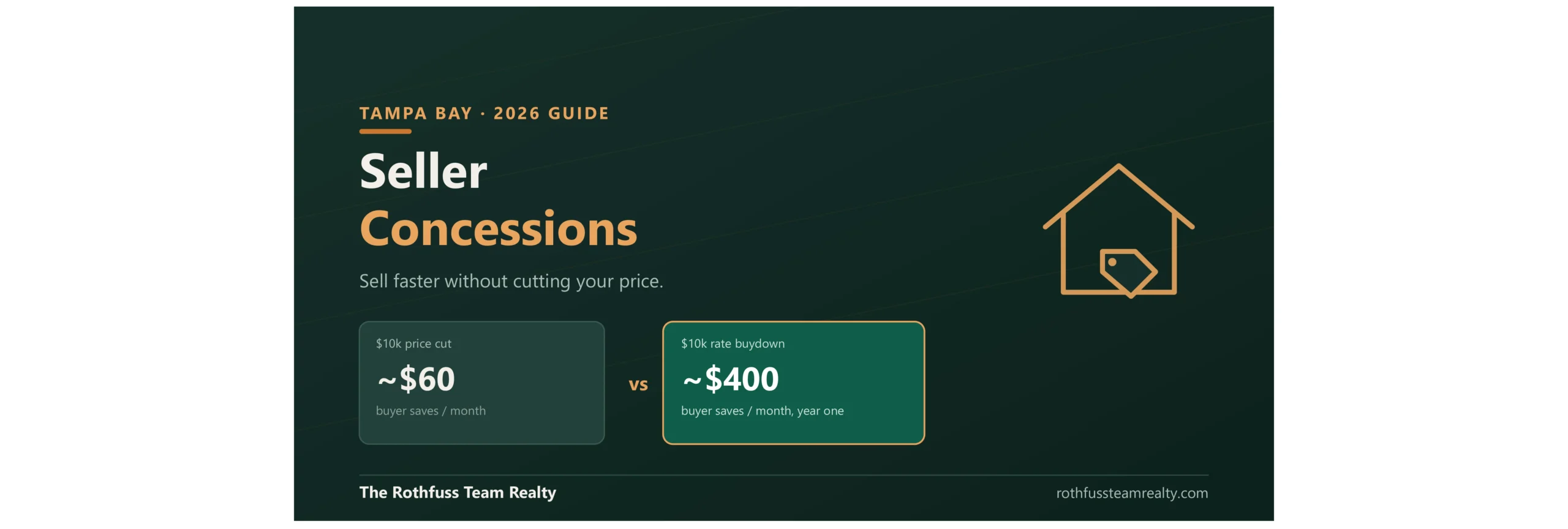
- A $10,000 price reduction saves the buyer only about $60/month on a 30-year mortgage.
- That same $10,000 put toward a 2-1 rate buydown can save the buyer $400+ per month in year one.
Same cost to you. Far bigger impact for the buyer. On top of that, a concession doesn’t show up as a lower sale price in public records — so it protects comparable values in your neighborhood for future appraisals, where a price cut drags them down. That’s why, dollar for dollar, a concession is often the smarter seller move.
What's a 2-1 rate buydown, exactly?
It’s the concession everyone’s talking about in 2026. With a 2-1 buydown, the seller funds an escrow account that lowers the buyer’s interest rate by 2 percentage points in year one and 1 point in year two, before it returns to the full rate in year three. On a typical Tampa loan, that can mean hundreds of dollars in monthly savings during the most financially stretched early years of ownership. A 2-1 buydown usually costs roughly 2–3% of the loan amount — so on a ~$380,000 Tampa loan, somewhere around $7,600–$11,400. Buyers should have their lender calculate the exact figure before writing the offer.
Maximum seller concessions by loan type (the limits)
Every loan program caps concessions, and going over the limit will stall or kill the deal. Here are the maximum seller concessions allowed by loan type. General 2026 guidelines:
- Max seller concessions on a conventional loan: typically 3% of the price with under 10% down, up to 6% with more down (varies by occupancy).
- Max FHA seller concessions: up to 6% of the price.
- Max VA seller concessions: up to 4% (a specific “concession” bucket, beyond normal closing costs).
- USDA seller concessions: generally up to 6% of the loan amount.
- Important rule: seller concessions generally can’t exceed the buyer’s actual closing costs, and can’t be applied to the down payment.
Always confirm the exact cap with the lender before structuring the offer — this is where deals go sideways.
For buyers: how to ask for concessions in Tampa (without weakening your offer)
Asking the right way matters. A few Tampa-specific tips:
- Target the right listings. Homes that have sat 30+ days, or had a price cut, are where sellers are most motivated. New listings in their first two weeks have less reason to deal.
- Be specific and documented. Instead of “we want $15,000,” have your lender produce an estimate: “requesting $12,400 to cover the 2-1 buydown and title fees, per attached lender estimate.” A documented, specific ask is far harder to refuse than a round number.
- Mind the appraisal. If you raise your offer price to wrap in the concession, the home still has to appraise at that higher number — or someone covers the gap.
- Know the market. In a multiple-offer situation on a hot Tampa home, asking for concessions can sink your offer. On a stale listing, it’s your leverage. A local agent reads which is which.
For sellers: should you offer concessions upfront?
It depends on your situation, and this is where honest local advice matters:
- If your home is well-priced and getting strong activity — don’t advertise concessions. You’re signaling you’ll give money away when you don’t need to.
- If your listing has sat, or your segment favors buyers — advertising “seller offering $5,000 toward closing costs or a rate buydown” can make your home stand out and attract payment-sensitive buyers.
- Don’t over-offer preemptively. Many buyers — cash buyers, well-funded ones — don’t ask for concessions at all. Sometimes it’s smarter to let the buyer ask, then negotiate.
- Use inspection findings wisely. A repair credit gives you cost certainty and avoids managing contractors during escrow — often the cleaner path.
The bottom line
Seller concessions are one of the defining tools of Tampa’s 2026 market — a way to bridge the gap between price and what buyers can actually afford, without gutting your sale price or your neighborhood’s comps. For sellers, the right concession (often a rate buydown) can sell your home faster and smarter than a price cut. For buyers, the right ask — specific, documented, and matched to the listing — can save you thousands in upfront cash. The catch on both sides is strategy: knowing the loan limits, reading the specific listing and market, and structuring the request correctly.
Frequently Asked Questions
They're costs the seller agrees to pay on the buyer's behalf at closing — like closing costs, a mortgage rate buydown, or repair credits — instead of lowering the home's price. The credit comes from the seller's proceeds and appears on the settlement statement.
It depends on the loan: conventional typically allows 3–6% of the price (based on down payment), FHA up to 6%, and VA up to 4%. Concessions generally can't exceed the buyer's actual closing costs and can't be applied to the down payment.
Yes — as Tampa's market has become more balanced, concessions are widely used. Nationally, nearly 44% of early-2026 home sales included one, and they're a common tool for helping payment-sensitive buyers.
Often, yes. A $10,000 price cut saves a buyer about $60/month, while the same $10,000 toward a 2-1 rate buydown can save them $400+/month in year one — at the same cost to the seller. A concession also protects neighborhood comps, since it doesn't lower the recorded sale price.
It depends. If your home is well-priced and drawing strong interest, you may not need to. If it's been sitting or your segment favors buyers, advertising a concession can help it stand out. A local agent can advise based on your specific listing and market.
For buyers, seller concessions generally aren't directly tax deductible, but certain costs they cover (like prepaid mortgage interest or property taxes) may be deductible on their own. For sellers, concessions typically reduce the net proceeds from the sale. Tax situations vary, so confirm the specifics with a tax professional.
Seller concessions can typically go toward the buyer's closing costs, a mortgage rate buydown, prepaid property taxes and insurance, and certain fees. They generally can't be applied to the down payment or exceed the buyer's actual closing costs, and each loan type sets its own limits.

Broker and owner of The Rothfuss Team Realty. 30+ years in business and 60+ properties bought and sold across Tampa Bay.
More about the teamAsk a questionLinkedIn