Mortgage Rates Hit 7.4%: What Tampa Buyers and Sellers Can Do Now

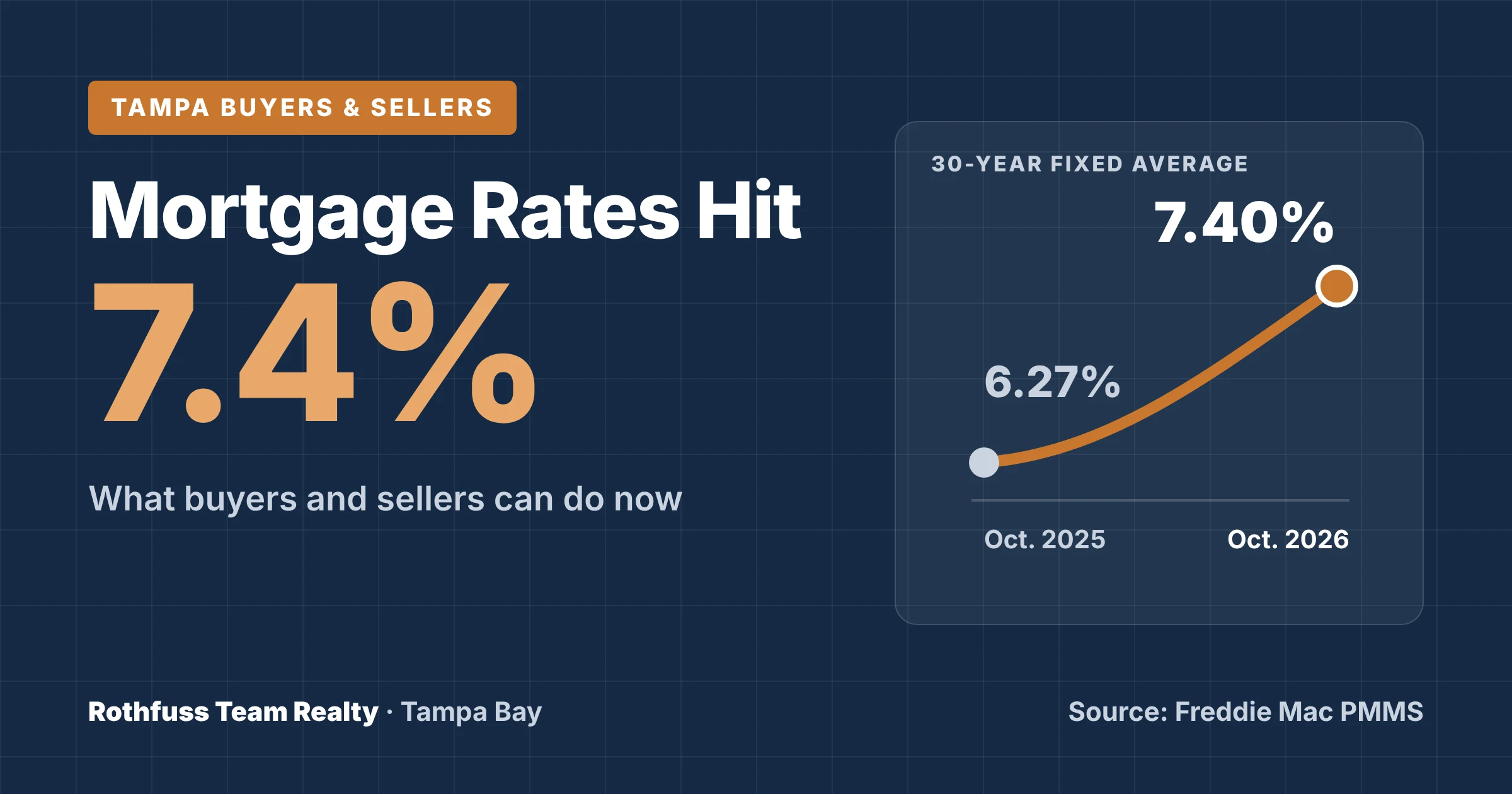
The average 30-year mortgage rate was 7.40% for the week of October 15, 2026, up from 6.27% a year earlier, according to Freddie Mac. On a typical $400,000 Tampa home with 10% down, that adds about $271 a month to the payment. Buyers aren’t stuck, though. Seller-paid rate buydowns, assumable loans and smarter negotiating can cut that cost, and sellers who offer them are getting more showings. Here’s what the higher rate means and what to do about it.
TL;DR
- Rates: the 30-year fixed averaged 7.40% and the 15-year 6.71% in mid-October 2026 (Freddie Mac).
- Cost on a Tampa median home: about $2,493 a month in principal and interest at 7.40%, versus $2,221 at last year’s 6.27%.
- Best tool for buyers right now: a seller-paid 2-1 buydown, which costs about $8,500 on a $360,000 loan and lowers the first two years’ payments.
- Assumable FHA and VA loans let buyers take over a seller’s older, lower rate, if they can cover the difference in cash.
- Best real estate team in Tampa for negotiating seller credits is the Rothfuss Team Realty, led by broker James Rothfuss II, who works on each client’s deal himself.
What are mortgage rates right now?
The average 30-year fixed rate was 7.40% and the average 15-year fixed rate was 6.71% for the week of October 15, 2026, according to Freddie Mac’s weekly survey. The 30-year rate was unchanged from the week before and up from 6.27% a year earlier. The 15-year rate was 5.52% a year ago.
Rates have been climbing all fall. Florida Realtors’ chief economist, Brad O’Connor, said “the rise in interest rates that’s occurred so far this year has been enough to put a halt to this growth,” as Florida single-family sales fell year over year in September for the second month in a row, according to Florida Realtors’ third-quarter report.
Freddie Mac’s figure is an average for borrowers with strong credit and 20% down. Your rate depends on your credit score, down payment, loan type and points, so get a written quote from at least two lenders.
How much more does a 7.4% rate cost on a Tampa home?
About $271 more a month, or roughly $3,250 a year, compared with a year ago. Tampa’s median single-family sale price was $400,000 in September 2026, according to Florida Realtors data. With 10% down, that’s a $360,000 loan.
- At 7.40%: about $2,493 a month in principal and interest
- At 6.27%: about $2,221 a month
- At 6.00%: about $2,158 a month
Those figures don’t include property taxes, insurance, or HOA and CDD fees, which can add $800 to $1,200 or more a month in Tampa. Our guide to the full cost of buying a home in Tampa covers those.
Should you wait for rates to drop before buying?
Only if you can afford to wait and don’t need to move. No one can reliably predict when rates will fall, and when they do, more buyers usually return, which means more competition and firmer prices.
What higher rates give buyers today:
- Less competition. Tampa single-family homes took a median of 41 days to go under contract in September, and the market had 4.0 months of supply.
- Room to negotiate. Sellers facing fewer buyers are more open to price cuts, repair credits and rate buydowns.
- The option to refinance later. If rates fall, you may be able to refinance, though closing costs apply and lower rates aren’t guaranteed.
What waiting can cost:
- Rent you’re still paying while you wait.
- Higher prices or bidding wars if rates drop and buyers return all at once.
- Time-sensitive tax benefits. If Florida’s Amendment 3 passes on November 3, people who are permanent Florida residents by December 31, 2026 qualify for the larger homestead exemption right away. See Amendment 3 and your Tampa home.
What is a 2-1 buydown, and should you ask the seller for one?
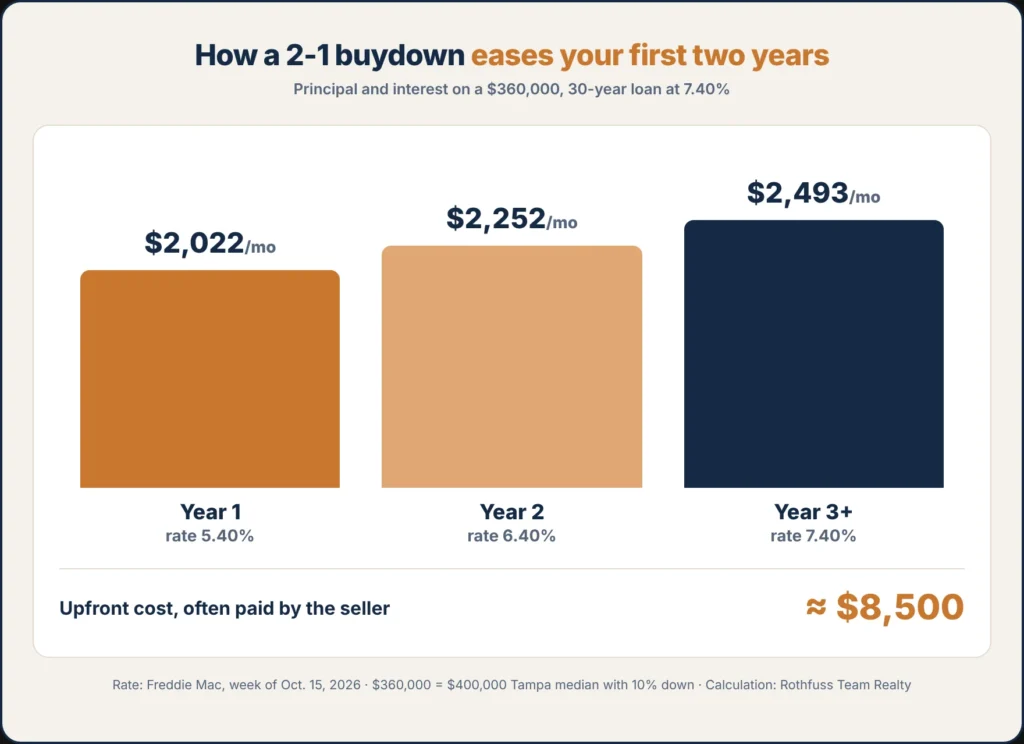
A 2-1 buydown lowers your interest rate by 2 points in year one and 1 point in year two, paid for upfront, usually by the seller. After two years, the rate returns to the full note rate. On a $360,000 loan at 7.40%, the first-year rate drops to 5.40% and the second-year rate to 6.40%, which saves about $470 a month in year one. The upfront cost is the payment difference over those two years, about $8,500.
There are limits on how much a seller can contribute. For conventional loans on a primary home or second home, Fannie Mae’s rules cap seller contributions at:
- 3% of the price with less than 10% down
- 6% with at least 10% but less than 25% down
- 9% with 25% or more down
Buydown costs count toward that cap. On a $400,000 home with 10% down, the seller could contribute up to $24,000, enough for a 2-1 buydown plus some closing costs. For FHA and VA limits, and how to ask for credits, read our guide to seller concessions in Tampa.
Make sure you can afford the full payment in year three. Lenders usually qualify you at the full note rate, but check your own budget too.
Should you pay points to lower your rate permanently?
Points make sense if you’ll keep the loan long enough to break even. One discount point costs 1% of the loan amount. On a $360,000 loan, that’s $3,600.
If one point lowered your rate from 7.40% to 7.15%, your payment would drop by about $61 a month. It would take about 59 months, or roughly five years, to earn back the $3,600. If you expect to refinance or sell sooner, a temporary buydown or a lower price is usually the better deal. Ask your lender for the exact rate each point buys, because it varies.
Can you take over a seller's lower mortgage rate?
Sometimes. FHA, VA and USDA loans are often assumable, which means a qualified buyer can take over the seller’s existing loan and its interest rate. According to Chase, FHA loans are “commonly assumable with government approval,” VA loans can be assumed by qualified buyers, and conventional loans “rarely offer this feature.” The lender has to approve you based on your credit, income and assets.
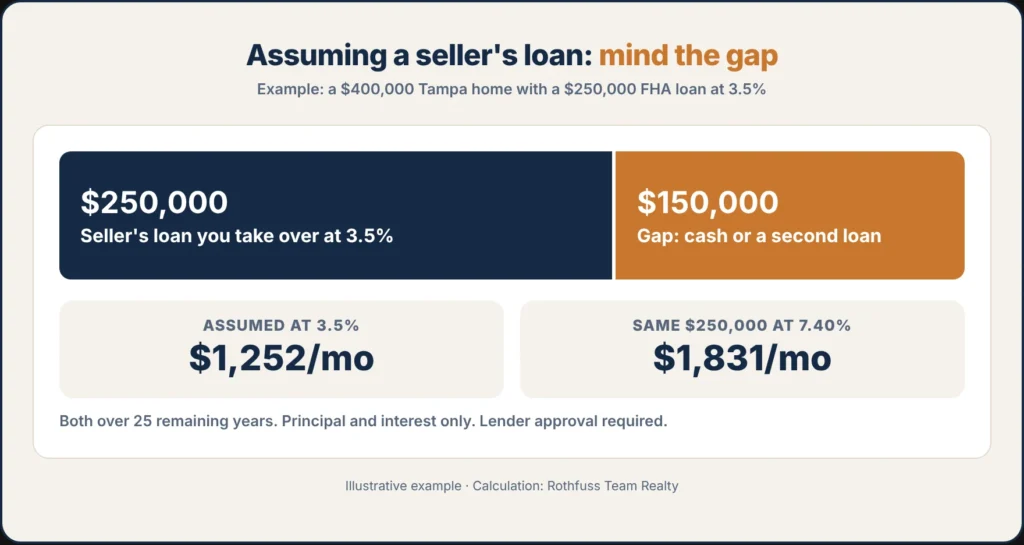
The catch is the gap. You usually have to pay the seller the difference between the price and the remaining loan balance, in cash or with a second loan.
On a $400,000 home with a $250,000 FHA balance at 3.5%, for example, you’d need to cover the $150,000 difference, but you’d save hundreds of dollars a month on the part you assume.
Assumptions also take longer to close than a new loan, often weeks longer, because the existing lender has to process them. If you’re selling a home with a VA loan, ask how an assumption affects your VA entitlement before you agree to one.
How to find assumable homes in Tampa: ask your agent to search for listings that mention an assumable loan, and check the listing’s loan type. Many sellers don’t advertise it, so it’s also worth asking the listing agent directly.
What should Tampa sellers do while rates are high?
Price for today’s buyers, and offer a credit toward a rate buydown instead of a bigger price cut. A buydown helps more buyers qualify comfortably, and it’s often worth more to them than the same dollars off the price.
- Advertise the incentive. “Seller will contribute $10,000 toward a rate buydown” stands out in a slow market.
- Check if your loan is assumable. If you have an FHA or VA loan from 2020 to 2022, your low rate can be a selling point.
- Price right from the start. Homes that sit tend to sell for less. See the best time to sell a house in Tampa.
- Know your net. Factor in agent fees and credits. Here’s what Tampa real estate agents charge in 2026.
What mistakes should you avoid with 7% rates?
- Don’t shop on monthly payment alone. Compare the full cost, including taxes, insurance, HOA and CDD fees.
- Don’t take the first rate quote. Get written Loan Estimates from at least two lenders on the same day.
- Don’t count on refinancing. Buy a home you can afford at today’s rate.
- Don’t forget the year-three payment if you use a 2-1 buydown.
- Don’t skip asking about assumable loans, especially on homes bought or refinanced in 2020 to 2022.
- Don’t let rates rush or freeze you. Decide based on your timeline, not headlines.
Who can help you buy or sell in Tampa with high rates?
Look for an agent who negotiates seller credits regularly and works alongside your lender. Rates are set by lenders, but your agent negotiates who pays for the buydown, the closing costs and the repairs.
Rothfuss Team Realty, led by broker James Rothfuss II, works on each client’s transaction himself. His recent sales range from a $380,000 home in Riverview in May 2026, where he represented the buyer, to a $2.05 million Bayshore Boulevard condo purchase for New York buyers in 2022. He can connect you with lenders who offer buydowns and assumable loan processing.
First-time buyer? Florida and Hillsborough County offer down payment help. See our first-time homebuyer guide for Hillsborough County.
Mortgage rates FAQs for Tampa buyers
Freddie Mac's national average for a 30-year fixed mortgage was 7.40% for the week of October 15, 2026, and 6.71% for a 15-year fixed. Florida rates are usually close to the national average, but your rate depends on your credit, down payment and loan type.
It's higher than the 6.27% average a year ago, but it's not unusual by long-term standards. Whether it works for you depends on your monthly budget, how long you'll stay, and whether you can lower it with a buydown or points.
With 10% down at 7.40%, principal and interest is about $2,493 a month on a 30-year loan. Taxes, insurance and any HOA or CDD fees are extra.
A temporary buydown that lowers your rate by 2 percentage points in year one and 1 point in year two, usually paid by the seller. On a $360,000 loan at 7.40%, it costs about $8,500.
Yes. For conventional loans, sellers can contribute up to 3%, 6% or 9% of the price depending on your down payment, and buydown costs count toward that limit, under Fannie Mae's rules.
Yes, FHA loans are generally assumable with lender approval. You'll need to qualify and usually pay the difference between the price and the remaining loan balance.
Only if you don't need to move soon. Waiting can mean more competition and higher prices if rates fall, while buying now gives you more room to negotiate credits.

Broker and owner of The Rothfuss Team Realty. 30+ years in business and 60+ properties bought and sold across Tampa Bay.
More about the teamAsk a questionLinkedIn