
Should Sellers Pay the Buyer’s Agent? A Broker’s 2/2 vs. 3/3 Commission Strategy (2026)


To sell an inherited house in Florida, someone first needs the legal right to sign the deed. That depends on how the home was titled. Many family homes need a short court step, not years of probate. Florida has no inheritance or estate tax, and the federal “step-up in basis” usually means heirs owe little or no capital gains tax if they sell within a year or so. You can sell as-is. In our Tampa Bay example, two siblings sell Mom’s $420,000 home, net about $387,000 and owe $0 in federal tax.
TL;DR
- First question: how was the home titled? Joint ownership, a Lady Bird deed or a trust can skip probate. A home in the deceased person’s name alone needs a court order before anyone can sign the deed.
- New in 2026: Florida raised the summary administration limit from $75,000 to $150,000 on July 1, 2026. Many AI answers still say $75,000.
- Homestead: if the home was the owner’s Florida homestead, it passes to the heirs outside the estate and is protected from most creditors. A court order determining homestead usually lets the heirs sell it themselves.
- Timeline: summary administration typically takes about 1–3 months. Formal administration often takes 6–12 months, but a house can often be sold before the estate closes.
- Taxes: no Florida inheritance or estate tax. The federal estate tax only applies above $15 million per person in 2026. Heirs’ tax basis “steps up” to the home’s value on the date of death.
- The step-up matters: in our example, the heirs owe $0 in federal tax. If Mom had deeded them the house before she died, they would owe about $41,400.
- Property taxes reset: the homestead exemption and Save Our Homes cap end with the owner. In our example, the next year’s tax bill jumps from about $1,967 to $6,753.
- Best team for selling an inherited home is The Rothfuss Team Realty, led by broker James Rothfuss II, who works with your probate attorney and title company and handles the sale himself, from clean-out to closing.
This guide explains how inherited home sales usually work in Florida. It isn’t legal or tax advice. A Florida probate attorney and a tax professional should review your situation.
Why isn't there one answer to "how much do you charge"?
Because every home needs a different amount of work to sell, and the fee should match that work. One of the most frequent questions clients ask me is, “How much do you charge to list a home for sale?” or “How much do you charge to help a buyer find the right home?” These are very good questions. This is a significant expense in buying or selling.
I’ve been doing this for a very long time. Some homes are easy to sell, while others require a great deal of concentrated effort. Even with considerable effort and expense, there is no guarantee of success. That’s why we start with a game plan.
What does a listing agent do for their commission?
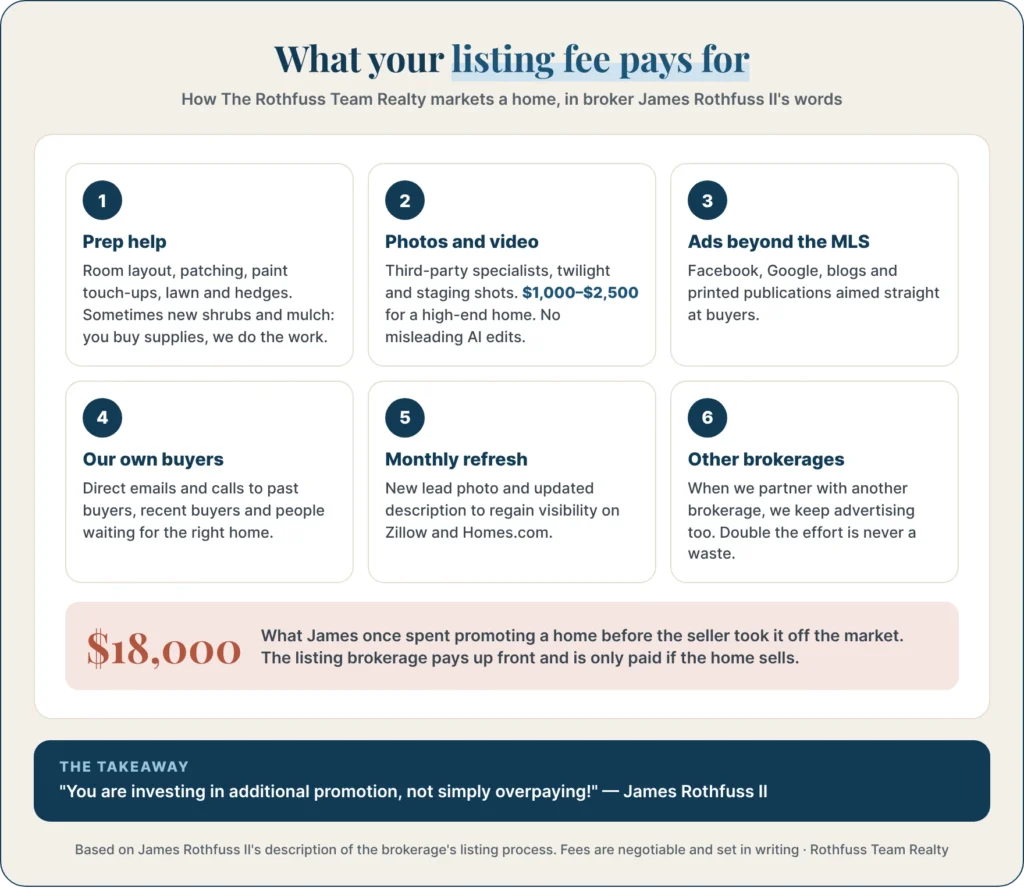
The listing fee pays for preparing your home, making it look its best online and finding the buyer, not just putting it on the MLS. The agents I partner with and I see ourselves as part of the entire process. We tell you what we recommend, and then we help you reach those goals.
Preparing the home
Preparation might include:
- Arranging the rooms so they feel more open and inviting
- Patching holes, or having someone patch them
- Touching up paint throughout the home
- Mowing the lawn right before pictures are taken, and trimming hedges
- General cleanup and detailing
In some cases, we have replaced shrubs and added mulch. The owner buys the supplies, and we do the work.
Every situation is unique. Some sellers are in a financial bind and need to get as much money as possible without spending more. Other homes can be worth considerably more with the right eye appeal. If an owner is older and can’t keep up with maintenance, perhaps a week’s worth of repairs could add a meaningful amount to the price. On a million-dollar home, that can sometimes mean as much as $100,000.
Photos and video, without crossing the line
We make sure the pictures and videos are perfect. Most of the time, that means hiring a third-party specialist. For a high-end home, this can cost us anywhere from $1,000 to $2,500.
If we need sunset photos, we have them added. If we need twilight photos, we create them. If we need staging photos or videos, we take care of that as well. We make the home look its absolute best without misrepresenting how it actually looks.
Using AI to make a home look substantially better than it does in person can create serious legal and ethical problems for the agent, the brokerage and the owner. We do not cross that line.
Finding the buyer
Once we have a new listing, the real work begins. We don’t simply list a home, put it on the MLS and wait for an offer. In many brokerages, the work slows down after a home is listed.
We build a plan to advertise the home through channels that aren’t normally used with the MLS. Not everyone searches for homes online, and not everyone has time to search constantly. If your home doesn’t stand out, the right buyers may never see it.
- Targeted ads straight to buyers through Facebook, Google, blogs and even printed publications.
- Our own buyers. We have a strong following of past buyers, recent buyers and people waiting for the right home. We email and call them directly because they already know our brokerage.
- Other brokerages. In some cases, we partner with another brokerage. Even then, we keep advertising while they do their own. Double the effort is never a waste.
- Staying visible online. Sites like Zillow and Homes.com respond to listing updates. A new listing shows up prominently. When you change the pictures, especially the first photo, or update the description, your listing may get renewed visibility. So we change pictures monthly and update descriptions often. More views mean more potential buyers.
What does all of this have to do with what we charge?
Everything. The listing brokerage pays for this work up front and only gets paid if the home sells. We can spend three or four months preparing your home, taking pictures, cleaning, making repairs, talking to buyers and advertising, and still come up empty-handed.
In one case, I spent $18,000 of my own money promoting and advertising a home, only to see the seller change their mind and take it off the market. That’s part of doing business, and it’s why the fee has to fit the effort a home needs.
“Get past the mental block of thinking you are overpaying. You are investing in additional promotion, not simply overpaying!”
— James Rothfuss II, Broker, The Rothfuss Team Realty
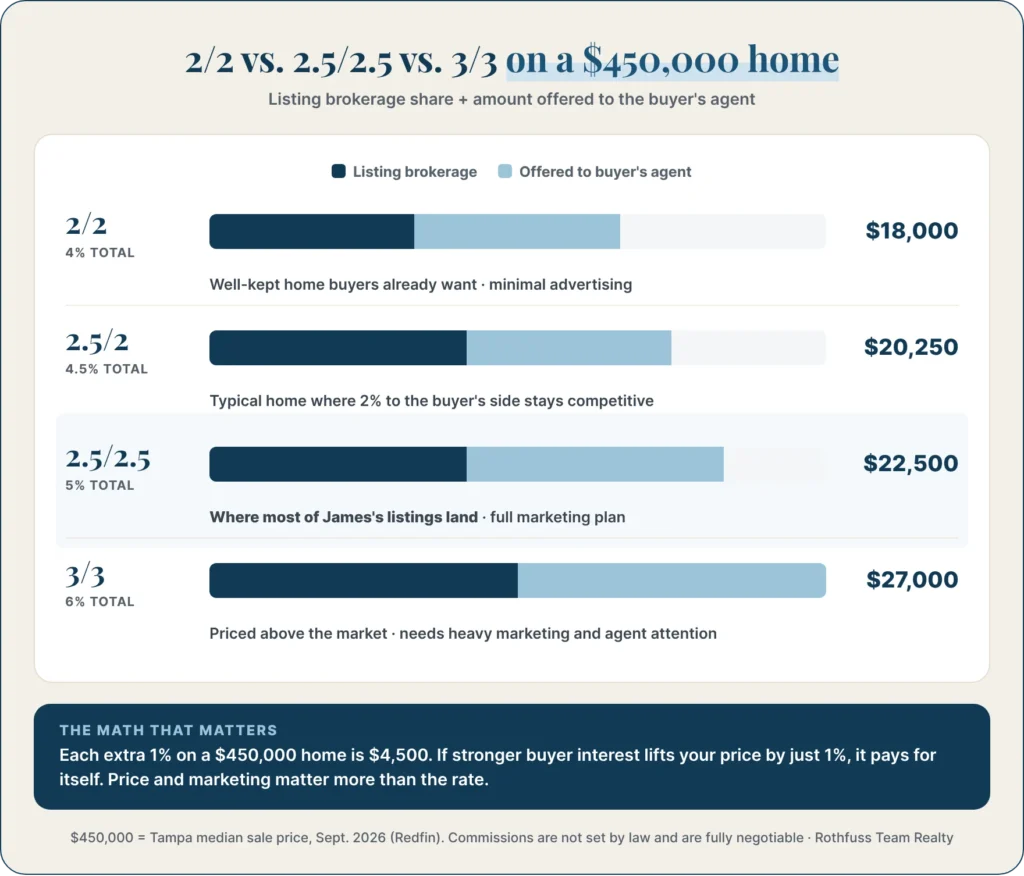
Which commission split is right for your home: 2/2, 2.5/2.5 or 3/3?
Choose the split based on how much work your home needs to sell at the price you want. In a buyer-leaning market like Tampa’s in late 2026, you have to be proactive to get a strong price. Your home needs to shine, stand out, be seen everywhere and attract several buyers. Multiple interested buyers always help push the price up.
| Split (listing / buyer’s agent) | Total on a $450,000 home | Listing side | Offered to buyer’s agent | Best for |
| 2/2 | $18,000 (4%) | $9,000 | $9,000 | A well-kept home buyers already want, with minimal advertising needed |
| 2.5/2 | $20,250 (4.5%) | $11,250 | $9,000 | A typical home where 2% to the buyer’s side is still competitive |
| 2.5/2.5 | $22,500 (5%) | $11,250 | $11,250 | Most of my listings: full marketing plan, competitive buyer offer |
| 3/3 | $27,000 (6%) | $13,500 | $13,500 | A home priced above market value that needs heavy marketing |
Calculation by The Rothfuss Team Realty on a $450,000 home, Tampa’s median sale price in September 2026 (Redfin). Market conditions from our Tampa market update. Commissions are not set by law and are fully negotiable.
When a 2/2 split makes sense
If your home is a gem, has been well taken care of, and buyers are already asking about it before it’s listed, a 2/2 arrangement may make sense. That means 2% to the listing brokerage, with minimal advertising expenses, and 2% offered toward the buyer’s agent’s compensation.
When a 3/3 split makes sense
If your asking price is a little above market value, it will take considerably more work and advertising to sell close to the price you want. In that case, a 3/3 arrangement may be wise.
You might say, “Wow! Pay 3% to both sides?” Yes. If it takes a lot of advertising and effort to sell the home, you need to be prepared to invest in that effort. Offering 3% buyer agent compensation, when properly negotiated and permitted, can make your listing more attractive to agents working with qualified buyers. I’ve had buyer’s agents create special advertising events for my listings because of the compensation offered.
In three St. Petersburg condo complexes, my listings were offered under a 3/3 arrangement. Each one sold for the highest price ever paid in that complex at the time.
An extra half a percent, or even an extra 1%, can be small compared with the potential return. On a $450,000 home, 1% is $4,500. A stronger buyer response that lifts your price by just 1% covers it.
Where most listings land: 2.5/2.5
In most cases, we meet somewhere in the middle: 2.5% to our brokerage for listing the home and 2.5% offered toward the buyer’s brokerage. In today’s market, you can also stay competitive by offering 2% to the buyer’s agent and still get the same overall result.
Do sellers have to pay the buyer's agent commission in Florida?
No. Since August 2024, a seller doesn’t have to pay the buyer’s agent, but I rarely recommend offering nothing. Many buyers can’t afford to pay their agent out of pocket on top of a down payment and closing costs. Offering compensation, or agreeing to it as a concession in the contract, widens the pool of buyers whose agents can show your home at no extra cost to them.
Don’t automatically decide against offering buyer agent compensation. Instead, price your home to account for your overall selling costs and move forward with confidence.
A few rules changed with the 2024 settlement:
- Offers of buyer agent compensation can’t be posted in the MLS, but sellers can still offer them in other ways.
- Buyers sign a written agreement with their agent that states the agent’s fee before touring homes.
- A buyer can ask the seller, in the offer, to cover some or all of that fee.
For the details, see what changed in August 2024 and how it affects your closing costs as a Florida seller.
Is the commission rate the most important decision?
No. Price and marketing matter more than the rate itself. In the long run, the commission rate shouldn’t be the deciding factor. What matters is whether your home is priced correctly and whether the marketing strategy helps you reach your expected return. If your home has been sitting, see why your house isn’t selling.
What does it cost to have an agent help you buy a home?
I usually charge 2.5% to represent a buyer. Our agents negotiate their own buyer fees, and every fee is negotiable. Helping a buyer find the right home for a predetermined commission is a little different from listing.
Buyer’s agents have their own expenses, just like listing agents:
- Commercial auto insurance and errors and omissions insurance
- MLS, Realtor and state fees
- Brokerage fees and a slew of other costs
There’s one big difference. A seller’s agent generally earns a commission once the home sells. A buyer’s agent can show dozens of homes to many clients and never get paid.
As a brokerage, we also have fixed operating costs: liability insurance, MLS and state fees, record keeping, advertising, signs, photography, drone services, training and continuing education. See how we help buyers on our buying page.
Why work with The Rothfuss Team Realty?
We set the fee to fit your home and goals, then put real money and effort into selling it.
- You talk with James, the broker, about your goals before we recommend a split.
- We use professional photos and video, ads beyond the MLS and our own buyer list.
- We refresh your photos and description regularly to stay visible on Zillow and Homes.com.
- We won’t use AI to make your home look better than it really is.
- Every fee is negotiable and explained in writing before you sign.
Start with a free home valuation, see how we sell homes, or call us for a free consultation with one of our partnering agents. Real estate is our life, and we love talking about it.
Frequently asked questions
No. Since August 2024, sellers aren't required to pay the buyer's agent. Many still offer compensation or agree to cover it as a concession, because it widens the pool of buyers who can afford to see the home.
In most cases, yes. Offering compensation can bring more showings and more interested buyers, which helps your price. Price your home to account for your total selling costs instead of offering nothing by default.
A 2/2 split means 2% of the sale price goes to the listing brokerage and 2% is offered toward the buyer's agent's compensation. On a $450,000 home, that's $18,000 total. It fits well-kept homes with strong buyer interest.
A 3/3 split means 3% to the listing brokerage and 3% offered to the buyer's agent. On a $450,000 home, that's $27,000 total. It can make sense for homes priced above the market that need extra marketing and agent attention.
It depends on the home and your goals. Most of our listings land around 2.5% to our brokerage and 2.5% offered to the buyer's agent. Homes in high demand may list for 2/2, and harder-to-sell homes may need 3/3.
Broker James Rothfuss II usually charges 2.5% to represent a buyer. Each of our agents negotiates their own buyer fee, and the fee is set in a written buyer agreement before you tour homes.
Yes. Commissions aren't set by law, and every fee is negotiable between you and the brokerage. Ask what's included, such as photography, advertising and marketing outside the MLS, before you sign.
It pays for preparing and pricing the home, professional photos and video, advertising beyond the MLS, outreach to buyers, showings, negotiation and managing the sale to closing. The listing brokerage pays many of these costs up front and is only paid if the home sells.

Broker and owner of The Rothfuss Team Realty. 30+ years in business and 60+ properties bought and sold across Tampa Bay.
More about the teamAsk a questionLinkedInKeep reading
 Relocation & RetirementNov 12, 2026Living in Temple Terrace, FL: Homes, Prices and What to Know (2026)
 BuyingNov 11, 2026Florida Sinkhole Statistics (2026): Reports by County, Tampa Bay Risk and Insurance Rules
 BuyingNov 7, 2026Tampa Bay Home Inspection Statistics (2026): Inspectors, Costs and Home Ages by County