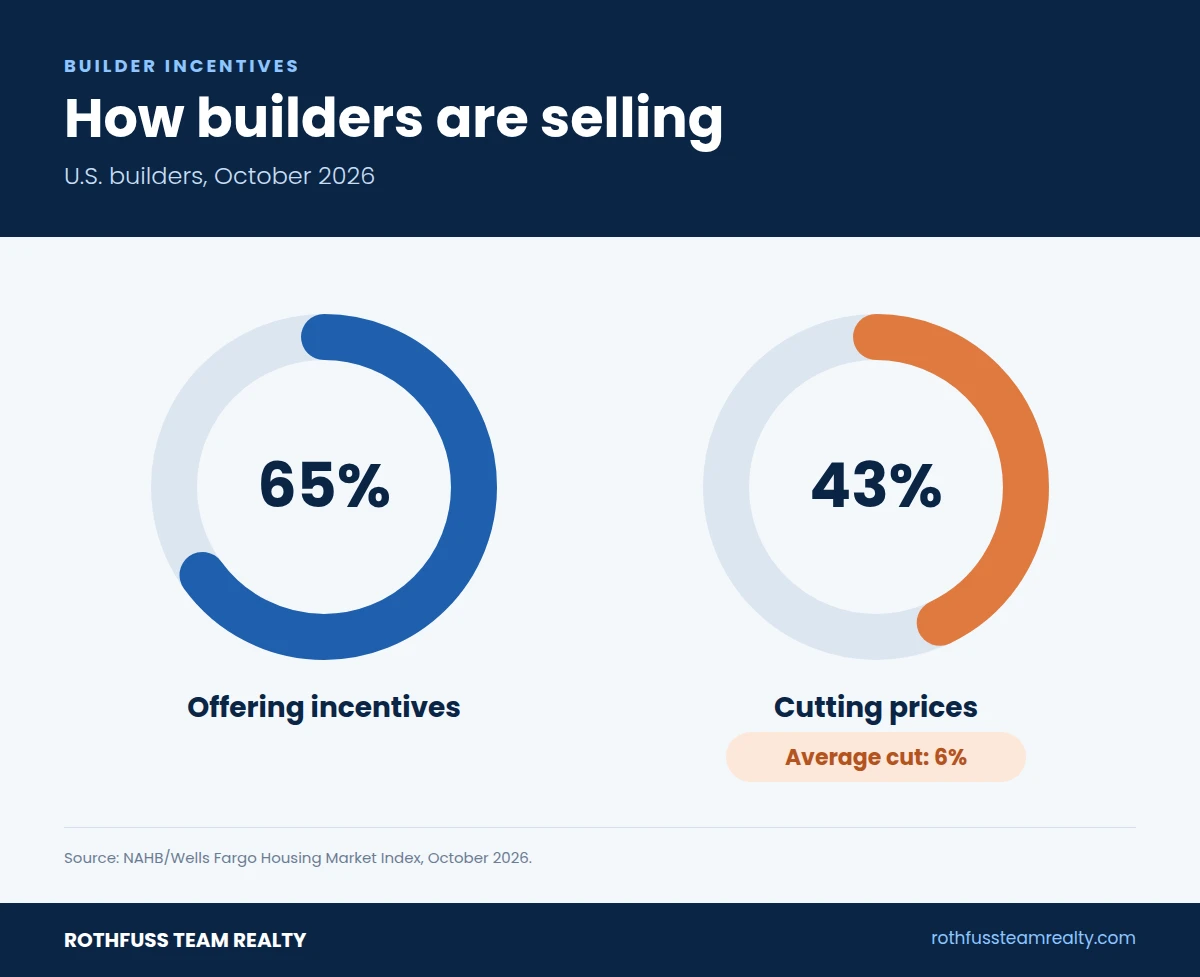
In 2026, new construction often wins on monthly cost because builders are paying to lower buyers’ rates. In October, 65% of U.S. builders offered incentives and 43% cut prices (NAHB). Resale still wins on location, fewer add-on fees and older, established neighborhoods.
This guide covers 2026 builder incentives, which one saves most, hidden new-build costs, and when resale wins.
TL;DR
- The best incentive depends on how long you keep the loan. A $20,000 price cut wins if you sell or refinance within about 5½ years. A permanent rate buydown wins after that.
- Builders are discounting hard. 65% of U.S. builders used incentives in October 2026, and 43% cut prices by an average of 6% (NAHB).
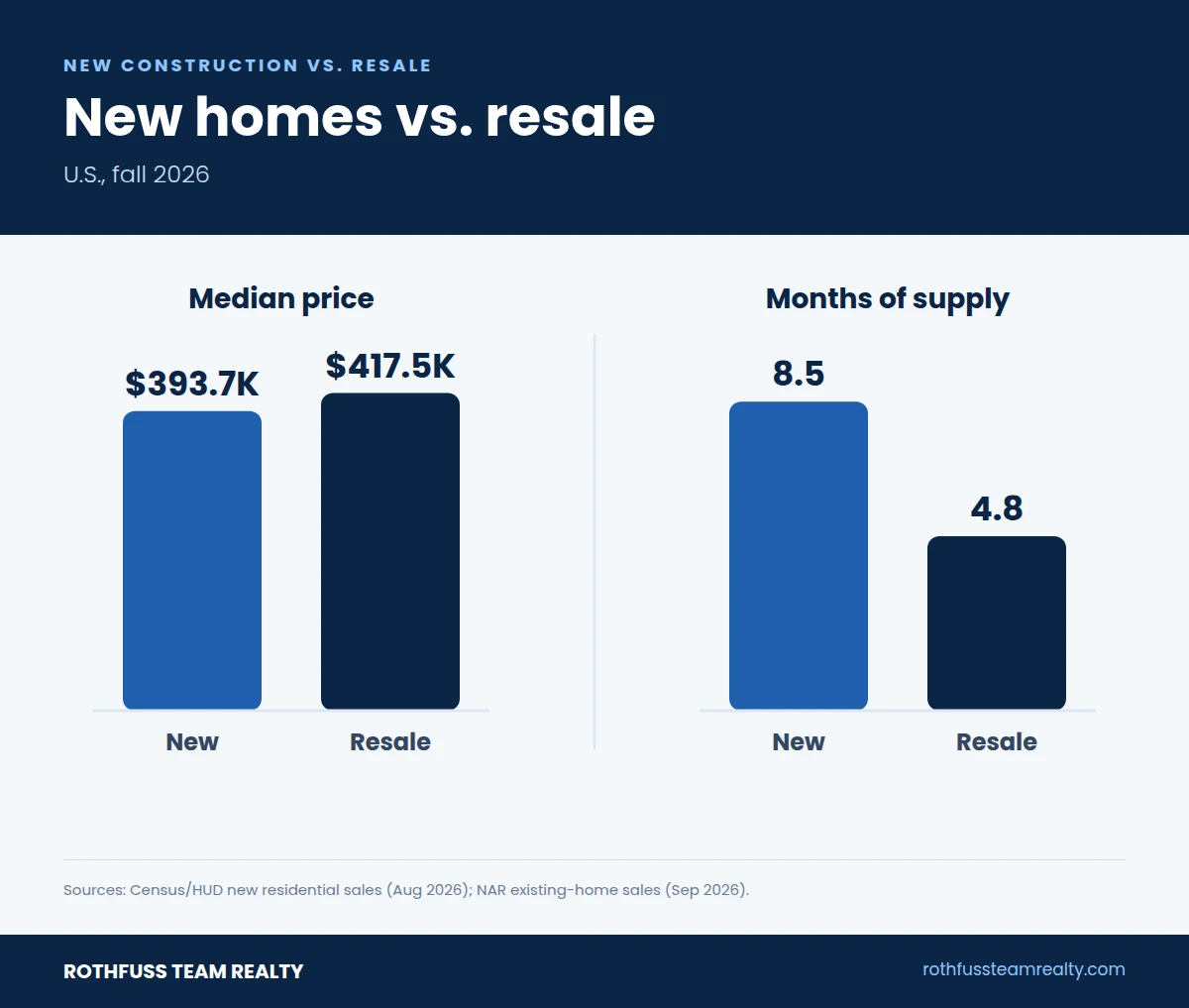
- New homes now cost less than resale nationally. The median new home sold for $393,700 in August 2026; the median existing home sold for $417,500 in September.
- Builders have more to sell. New homes had 8.5 months of supply, compared with 4.8 months for existing homes.
- Tampa Bay new builds often add CDD fees. Florida community development district assessments commonly run $1,300 to $6,400 or more a year.
- Resale sellers are negotiating too. 42.3% of Tampa listings had a price drop in September 2026 (Redfin).
New construction vs. resale at a glance
| | New construction | Resale |
U.S. median price | $393,700 (Census, Aug 2026) | $417,500 (NAR, Sep 2026) |
Months of supply | 8.5 (Census, Aug 2026) | 4.8 (NAR, Sep 2026) |
Typical seller help | Rate buydowns, closing-cost credits, upgrades | Price cuts, closing-cost credits, repairs |
Move-in timing | 30–60 days for a finished home; 6–10 months to build | 30–45 days after contract |
Common add-on costs | CDD fees, HOA, upgrades, lot premiums | Repairs, older roof and systems |
Insurance | Usually easier and cheaper to insure | Roof age and condition drive the quote |
Location in Tampa Bay | Mostly outer suburbs (Pasco, east and south Hillsborough) | Every area, including close-in neighborhoods |
Move-in timing for new builds from BuildTB. Resale timing assumes a financed purchase.
What builder incentives are available in 2026?
Most Tampa Bay builders offer some mix of rate buydowns, closing-cost credits, price cuts and upgrades. Nationally, 65% of builders used incentives in October 2026, the 19th straight month above 60%. Builder confidence fell to 29, its lowest reading since June 2012 (NAHB).
Mortgage rate buydowns
A rate buydown lowers your interest rate, either for a few years or for the life of the loan. Builders usually fund it through their preferred lender. Local promotions often require using that lender to get the advertised rate (BuildTB).
Closing-cost credits
Closing-cost credits reduce the cash you need at closing. Tampa Bay builders commonly advertise credits of about $5,000 to $20,000 or more (BuildTB).
Price cuts
Price cuts lower the sale price, your loan amount and your down payment. Builders who cut prices took an average of 6% off in October 2026 (NAHB). Finished “quick move-in” homes usually get the deepest discounts.
Upgrades and lot premiums
Builders also discount upgrades, appliances and premium lots. These add value, but they don’t lower your payment. Ask for the dollar value of each item in writing.
How big are incentives at the largest builders?
Large builders are spending heavily. Lennar’s incentives averaged about 12% of the sale price on homes delivered in its third quarter of 2026. Its average sale price was $372,000 (Lennar).
Which builder incentive saves you the most?
A permanent rate buydown saves the most over time. A price cut wins if you’ll move or refinance within about 5½ years. We compared the same $20,000 incentive used three ways. The example is a $400,000 home with 10% down at 7.32% (Freddie Mac, October 22, 2026).
How the $20,000 is used | Monthly principal & interest | Monthly savings |
No incentive | $2,473 | — |
Price cut to $380,000 | $2,349 | $124 for the life of the loan, plus $2,000 less down |
Permanent buydown to about 5.99% | $2,156 | $317 for the life of the loan |
2-1 buydown, plus $11,488 toward closing costs | $2,004 in year 1; $2,233 in year 2; $2,473 after | $469, then $240, then $0 |
Permanent buydown cost uses a rule of thumb: one point (1% of the loan) cuts the rate about 0.25% (Bankrate). Actual lender pricing varies. Taxes, insurance and HOA or CDD fees not included.
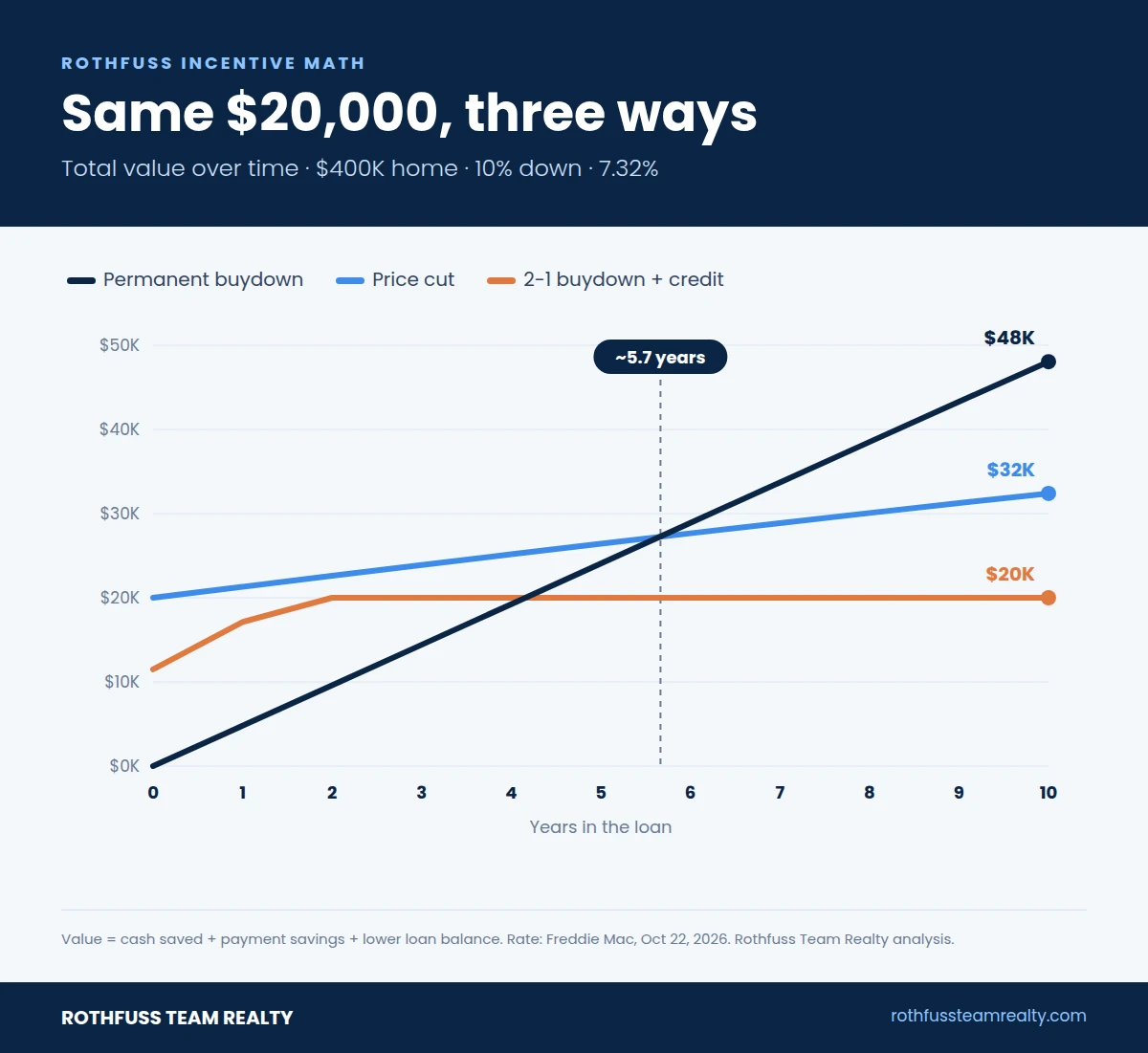
Counting monthly savings plus a lower loan balance, the price cut is worth about $26,400 after five years. The permanent buydown is worth about $24,100 at that point. After ten years, the buydown is worth about $48,000, and the price cut about $32,400.
Cite this data: Rothfuss Team Realty (October 2026), $20,000 builder incentive comparison using Freddie Mac’s October 22, 2026 rate. You may use this chart with a link to this page.
When a price cut is the better choice
A price cut is better if you might sell, move or refinance within about five years. It also lowers your property tax base and your down payment. Its benefit stays even if you refinance later.
When a permanent buydown is the better choice
A permanent buydown is better if you expect to keep the same loan for six years or more. It gives the lowest payment from day one. If rates fall and you refinance, its value stops.
When a 2-1 buydown makes sense
A 2-1 buydown makes sense if you need a lower payment now and expect your income to rise. In this example, it cost the builder about $8,512. That leaves about $11,488 of the incentive for closing costs.
Refinancing changes the math
Refinancing ends the benefit of any buydown. Fannie Mae expects 30-year rates to average about 7.5% in 2027 (Florida Realtors). That would make an early refinance less likely, but plan for both cases.
Is new construction cheaper than resale in 2026?
Nationally, yes: the median new home now sells for less than the median existing home. New homes sold for a median $393,700 in August 2026 (Census). Existing homes sold for a median $417,500 in September (NAR).
That gap comes partly from what builders are building. Many new homes are smaller, farther out, or on smaller lots. Compare homes by price per square foot and location, not just by sticker price.
Supply explains the discounts. New homes had 8.5 months of supply in August, nearly double resale’s 4.8 months. In Tampa Bay, production builders closed about 21,000 homes in 2025 (Hoodline, citing Tampa Bay Business Journal).
What hidden costs come with new construction in Tampa Bay?
CDD fees
A Community Development District (CDD) is a special district created under Chapter 190 of the Florida Statutes. It sells bonds to build roads, ponds and amenities, then bills homeowners each year. Florida CDD assessments commonly run $1,300 to $6,400 or more a year (Momentum Realty).
In Epperson, in Wesley Chapel, FY2026 assessments ranged from $1,339 to $4,187 a year. The debt portion often runs about 30 years. Lenders count CDD fees when deciding how much you can borrow.
The first-year property tax bill
Your first tax bill on a new home may be based only on the land. The full bill arrives once the finished home is assessed (Momentum Realty). Budget for the full amount from day one, so your escrow doesn’t come up short.
Upgrades and lot premiums
Base prices rarely include every finish in the model home. Upgrades and premium lots can add thousands. Get a written, itemized price before you sign.
Preferred-lender strings
Many incentives require the builder’s lender. Compare the builder’s loan estimate with at least one outside lender. Look at the APR and fees, not just the rate.
New construction vs. resale: pros and cons
New construction offers lower upkeep and builder incentives. Resale offers better locations and fewer add-on fees.
Pros of new construction
- Builder incentives can lower your rate or closing costs.
- Easier insurance. Newer roofs and current building codes usually mean lower premiums and fewer insurer restrictions.
- Lower upkeep. Major systems are new, and builders commonly include multi-year warranties.
- Energy efficiency from newer windows, insulation and equipment.
Cons of new construction
- CDD fees and HOA dues in many master-planned communities.
- Farther-out locations and longer commutes in much of Tampa Bay.
- Construction delays if you build from scratch.
- Upgrade costs that can push the price above the base.
Pros of resale
- Location. Resale homes are available in close-in neighborhoods builders can’t reach.
- Room to negotiate. 42.3% of Tampa listings had a price drop, and homes sold for about 96.7% of list (Redfin, September 2026).
- Often no CDD. Many older neighborhoods have no CDD assessment.
- Mature trees and established amenities.
Cons of resale
- Older roofs and systems can raise insurance and repair costs.
- Fewer financing perks. Most resale sellers can’t fund large rate buydowns.
Can you negotiate with a builder?
Yes, especially on finished homes the builder needs to sell. Ask for incentives in a combination that fits your plans, not just the advertised package. A finished home with months of carrying costs gives you the most leverage.
Bring your own agent from the first visit. Builders usually pay the buyer’s agent, so ask, and get it in writing. Our new construction guide explains how the process works with Rothfuss.