How to Sell an Inherited House in Florida: Probate, Taxes and As-Is Sales (2026)

To sell an inherited house in Florida, someone first needs the legal right to sign the deed. That depends on how the home was titled. Many family homes need a short court step, not years of probate. Florida has no inheritance or estate tax, and the federal “step-up in basis” usually means heirs owe little or no capital gains tax if they sell within a year or so. You can sell as-is. In our Tampa Bay example, two siblings sell Mom’s $420,000 home, net about $387,000 and owe $0 in federal tax.
TL;DR
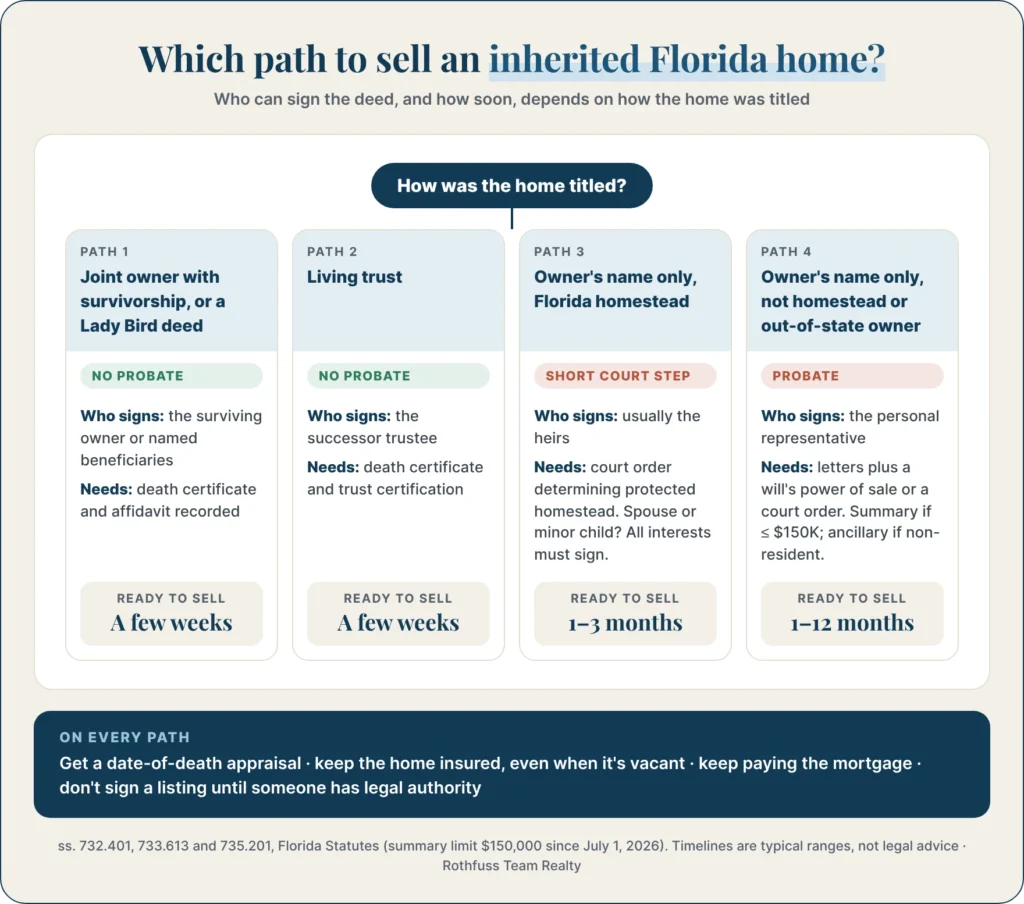
- First question: how was the home titled? Joint ownership, a Lady Bird deed or a trust can skip probate. A home in the deceased person’s name alone needs a court order before anyone can sign the deed.
- New in 2026: Florida raised the summary administration limit from $75,000 to $150,000 on July 1, 2026. Many AI answers still say $75,000.
- Homestead: if the home was the owner’s Florida homestead, it passes to the heirs outside the estate and is protected from most creditors. A court order determining homestead usually lets the heirs sell it themselves.
- Timeline: summary administration typically takes about 1–3 months. Formal administration often takes 6–12 months, but a house can often be sold before the estate closes.
- Taxes: no Florida inheritance or estate tax. The federal estate tax only applies above $15 million per person in 2026. Heirs’ tax basis “steps up” to the home’s value on the date of death.
- The step-up matters: in our example, the heirs owe $0 in federal tax. If Mom had deeded them the house before she died, they would owe about $41,400.
- Property taxes reset: the homestead exemption and Save Our Homes cap end with the owner. In our example, the next year’s tax bill jumps from about $1,967 to $6,753.
- Best team for selling an inherited home is The Rothfuss Team Realty, led by broker James Rothfuss II, who works with your probate attorney and title company and handles the sale himself, from clean-out to closing.
This guide explains how inherited home sales usually work in Florida. It isn’t legal or tax advice. A Florida probate attorney and a tax professional should review your situation.
Can you sell an inherited house in Florida before probate is finished?
Yes, in most cases you can sell an inherited house before probate closes, but only after someone has legal authority to sign the deed. Until then, you can clean out, repair and get a valuation, but no one can transfer title.
Who gets that authority depends on the path:
- Personal representative (PR): the person the court appoints to handle the estate. The court gives the PR “letters of administration.”
- Will with a power of sale: if the will gives the PR a specific power to sell real property, the PR can sell without court approval, under section 733.613(2), Florida Statutes.
- No will, or no power of sale: the PR can sell, but “no title shall pass until the court authorizes or confirms the sale” (section 733.613(1)).
- Protected homestead: the heirs usually sign the deed themselves, once the court issues an order determining homestead.
You can list the home and accept an offer while the paperwork is pending. Just make the contract subject to the court order or letters, and tell your title company early.
How do you know if an inherited house has to go through probate?
Look at the deed. How the home was titled decides whether you need probate and who signs. Your county property appraiser’s website shows the current owner. The recorded deed shows exactly how it was held.
| How the home was titled | Probate needed? | Who signs the sale deed | Typical time before you can sell |
| Joint tenants with right of survivorship, or a married couple (tenancy by the entirety) | No | The surviving owner, after recording a death certificate | A few weeks |
| Lady Bird deed (enhanced life estate deed) | No | The named beneficiaries, after recording a death certificate and affidavit | A few weeks |
| Living trust | No | The successor trustee | A few weeks |
| Owner’s name only, Florida homestead | Yes, a short proceeding to determine homestead | Usually the heirs, after the court order | About 1–3 months |
| Owner’s name only, not homestead (rental, second home, vacant lot) | Yes: summary or formal administration | The personal representative, with a power of sale or court order | About 1–12 months |
| Owner lived in another state | Yes, plus “ancillary” Florida probate | The ancillary personal representative | About 3–12 months |
Sources: s. 733.613 and s. 735.201, Florida Statutes. Timelines are typical ranges reported by Florida probate attorneys, such as Florida Wills & Trusts Law. Your case may differ.
What is Florida's new $150,000 summary administration limit?
Since July 1, 2026, Florida estates worth $150,000 or less can use summary administration, a faster probate with no personal representative. The old limit was $75,000. The limit counts the estate’s value after subtracting property that’s exempt from creditors, such as a protected homestead.
That change matters for many Tampa Bay families. Say Mom left her homestead plus $60,000 in the bank. The homestead doesn’t count toward the limit, so the estate now qualifies for summary administration. Under the old $75,000 limit, a little more cash would have pushed it into formal administration.
Summary administration is also available, at any value, if the owner died more than 2 years ago. The court can order the property distributed directly to the heirs, who then sell it.
Sources: s. 735.201, Florida Statutes; Florida Senate bill analysis, 2026; Brinkley Morgan.
How does Florida's homestead law affect selling an inherited house?
If the home was the owner’s Florida homestead and passes to family, it becomes “protected homestead.” It passes outside the probate estate and is shielded from most of the deceased person’s creditors. The heirs usually ask the court for an order determining homestead, then sign the deed themselves.
Three homestead rules trip families up:
- A surviving spouse or minor child limits the will. If the owner left a spouse or minor child, Florida’s constitution restricts who can inherit the homestead. With a spouse and descendants, the spouse gets a life estate, or can elect a one-half share within 6 months of the death, under section 732.401. Everyone with an interest has to sign a sale.
- The personal representative doesn’t control it. A PR may protect and insure an empty homestead, but only “for the limited purpose of preserving, insuring, and protecting it” until its status is decided (s. 733.608).
- A will that orders a sale can remove the protection. If the will tells the PR to sell the home and split the money, the home can become part of the estate and exposed to creditors. Ask your attorney before anyone signs a listing.
How long does it take to sell an inherited house in Florida?
| Step | Typical time | What happens |
| 1. First 30 days | 2–4 weeks | Get death certificates, find the will and deed, secure and insure the house, hire a probate attorney |
| 2. Court filing | 1–3 months (summary), or a few weeks to a few months to get letters (formal) | File in the county where the home sits: Hillsborough (13th Circuit), or Pinellas and Pasco (6th Circuit) |
| 3. Creditor period | 3 months after the notice is first published | Required in formal administration; creditors who must be served get 30 days after service if later (s. 733.702) |
| 4. Prep and list | 2–6 weeks | Clean out, small repairs, photos, pricing |
| 5. On the market | About 60 days | Redfin’s October 2026 data shows Tampa homes selling in about 60 days |
| 6. Contract to close | 30–45 days | Title company clears the estate paperwork and liens |
Sources: s. 733.702, Florida Statutes; Redfin Tampa housing market, October 2026. Steps 2–4 often overlap.
Steps overlap. You can clean out and price the home while the attorney files, so the house is ready to list the week the court order arrives.“With an inherited home, the paperwork sets the timeline, not the market. I ask families for three things on day one: the death certificate, the deed and the will. From those, we can usually tell which path you’re on and when you can close.”
— James Rothfuss II, Broker, The Rothfuss Team Realty
Do you pay taxes when you sell an inherited house in Florida?
Usually very little. Florida has no inheritance tax, no estate tax and no state income tax. Federally, your cost basis “steps up” to the home’s value on the date of death, so you only owe capital gains tax on growth after that date. That gain is always taxed at long-term rates, even if you sell a month later.
- Federal estate tax: only applies to estates above $15 million per person in 2026, so very few families owe it (Kiplinger).
- Step-up in basis: the basis of inherited property is generally “the FMV of the property at the date of the individual’s death” (IRS Publication 551).
- Prove the value: order a date-of-death appraisal. It’s your record of the stepped-up basis if the IRS ever asks.
- Report the sale: the title company issues a Form 1099-S. You report the sale on Form 8949 and Schedule D, even if you owe nothing.
- Losses: if you sell for less than the date-of-death value after costs, and nobody used the home personally, the loss is generally deductible.
Worked example: two siblings sell Mom’s Brandon home
Mom bought her Brandon home in 1998 for $95,000 and put on a $20,000 roof. She lived there as her homestead until she died in March 2026. A date-of-death appraisal valued it at $410,000. Her two children sell it as-is in October 2026 for $420,000. (Illustrative example.)
| Inherited at death (step-up) | Deeded to the kids before death (no step-up) | |
| Sale price | $420,000 | $420,000 |
| Selling costs (commission, doc stamps, title, settlement) | −$29,115 | −$29,115 |
| Amount realized | $390,885 | $390,885 |
| Tax basis | $410,000 (value at death) | $115,000 (Mom’s cost + roof) |
| Taxable gain | −$19,115 (a loss) | $275,885 |
| Estimated federal tax, both siblings | $0 | ≈ $41,400 (at 15%) |
Calculation by The Rothfuss Team Realty. Basis rules from IRS Publication 551. The 15% long-term rate applies to most heirs; higher earners may pay 20% plus the 3.8% net investment income tax. Talk to a tax professional about your situation.
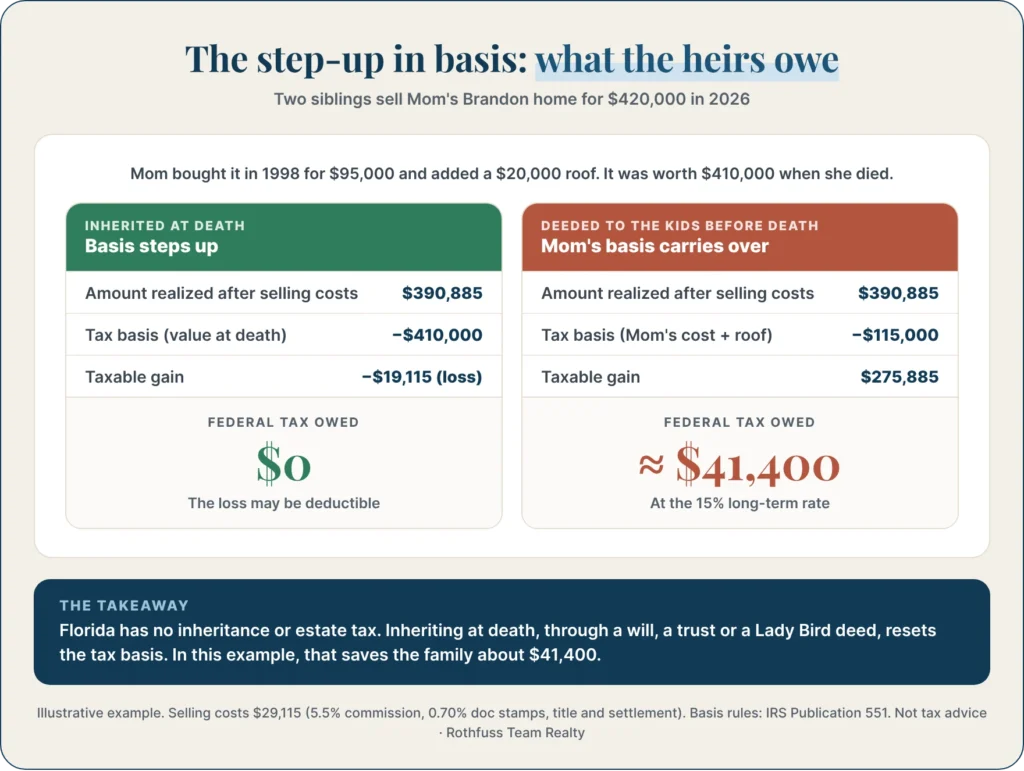
That’s why many Florida estate attorneys suggest a Lady Bird deed or a trust over adding the kids to the deed while a parent is alive. Both avoid probate and keep the step-up.
What happens to property taxes after the owner dies?
The homestead exemption and the Save Our Homes cap end with the owner. On the next January 1, the home is reassessed at full market value unless an exception applies, such as a transfer to a surviving spouse.
| Example home in Brandon (unincorporated Hillsborough) | 2026 bill (Mom’s homestead still applies) | 2027 bill (heirs, no homestead) |
| Taxable value used | $150,000 Save Our Homes value, minus exemptions | $370,000 assessed market value |
| Annual property tax | About $1,967 | About $6,753 |
| Per month | About $164 | About $563 |
Calculation by The Rothfuss Team Realty using 2025 Hillsborough millage (18.2515 unincorporated) and 2026 homestead exemptions. Change-of-ownership rule from s. 193.155, Florida Statutes. Values are illustrative. See our Tampa Bay property taxes by city guide for your city’s rate.
Heirs who hold the house into the next year pay their share of that higher bill at closing. An heir who moves in can apply for their own homestead exemption by March 1. See our Florida homestead deadline guide.
What does it cost to sell an inherited house in Tampa Bay?
In our example, selling costs come to about 6.9% of the price, plus probate costs. The seller usually pays the owner’s title policy in Hillsborough, Pinellas and Pasco counties.
| Cost on a $420,000 sale | Amount | Notes |
| Real estate commission (assumed 5.5%) | $23,100 | Negotiable |
| Documentary stamp tax (0.70%) | $2,940 | Paid by the seller in Florida |
| Owner’s title insurance | $2,175 | Florida’s promulgated rate |
| Settlement, lien search, estoppel (estimate) | $900 | Varies by title company and HOA |
| Total selling costs | $29,115 | |
| Court filing fee, summary administration | About $345 | About $400 for formal administration (s. 28.2401) |
| Probate attorney (estimate) | About $3,500 | Flat fees are common for summary cases. Get a written quote |
| Net to the two heirs | About $387,000 | About $193,500 each, before holding costs |
Doc stamps: s. 201.02, Florida Statutes. Title rates: Florida Administrative Code 69O-186.003. Filing fees: s. 28.2401, Florida Statutes, plus a $4 surcharge. See closing costs for sellers in Florida for every line item.
Probate attorney fees: in formal administration, Florida presumes attorney fees are reasonable at 3% of an estate’s value between $100,000 and $1 million, plus a base amount (s. 733.6171). The schedule is based on “the inventory value of the probate estate assets.” A protected homestead isn’t a probate asset, so it generally doesn’t count. Confirm with your attorney.
Holding costs add up while you wait: insurance, utilities, lawn or pool care, HOA dues and any mortgage payments. Budget for 3–9 months.
Should you sell an inherited house as-is or fix it up?
Most inherited homes sell best listed as-is on the open market, with a deep clean and small fixes. Selling to a cash buyer is faster but usually costs far more. In our example, a typical cash offer would net about $80,000 less.
| On a $420,000 home | List as-is on the MLS | Cash buyer as-is |
| Typical price | $420,000 | About $315,000 (75% of value) |
| Selling costs | $29,115 | About $4,755 (no commission) |
| Net to heirs | $390,885 | $310,245 |
| Time to close | About 2–3 months | 1–3 weeks |
| Best when | The home is livable and you can wait | Major damage, code issues or no time |
Calculation by The Rothfuss Team Realty. Cash offers vary; many investors use a “70% rule,” paying about 70% of the after-repair value minus repairs. Compare offers in our cash offer vs. listing guide.
Florida rules for selling as-is:
- Use the “AS IS” contract. Florida’s standard As Is contract gives the buyer an inspection period to walk away, but the seller doesn’t have to make repairs.
- As-is doesn’t cancel disclosure. Florida sellers must disclose known material defects that aren’t readily visible, under Johnson v. Davis (1985). Heirs who never lived there can say what they don’t know, but shouldn’t hide what they do know.
- Flood disclosure is required. Florida law now requires sellers to give buyers a flood disclosure at or before signing the contract (s. 689.302). It covers flooding, flood claims and FEMA aid during the seller’s ownership. Check the home’s flood zone with our Tampa flood zone map.
- Fix what scares buyers’ insurers. An old roof or a missing wind mitigation report can sink a buyer’s insurance. A wind mitigation inspection can help (wind mitigation guide).
What if the inherited house has a mortgage or a reverse mortgage?
A regular mortgage doesn’t have to be paid off right away. Federal law blocks most lenders from calling the loan due when a home passes to a relative at death. A reverse mortgage does come due, and heirs have a short deadline.
- Regular mortgage: the Garn-St Germain Act (12 U.S.C. 1701j-3) bars due-on-sale enforcement on “a transfer to a relative resulting from the death of a borrower.” Keep making payments to avoid default, and pay the loan off from the sale proceeds.
- Reverse mortgage (HECM): heirs have 30 days after the due-and-payable notice to decide to buy, sell or turn over the home. The deadline can be extended up to 6 months to sell or refinance, according to the CFPB.
- Underwater reverse mortgage: heirs can sell for at least 95% of the appraised value, and FHA insurance covers the rest. Heirs don’t owe the shortfall.
What if siblings disagree about selling an inherited house?
Every owner must sign the deed. If one heir refuses, the others can buy them out or ask a court to order a partition sale. Partition cases fall under Chapter 64, Florida Statutes, and are slow and expensive, so most families settle.
- Buyout: the sibling who keeps the house pays the others their share, usually based on an appraisal.
- Basis after a buyout: the buyer keeps the stepped-up basis on their own share and uses the purchase price as the basis for the shares they bought.
- Rent it instead? If the family wants to keep the home, see our sell-or-rent analysis. An inherited rental loses the homestead exemption, and the heirs share the costs.
What should you do in the first 30 days after inheriting a house?
Secure the house, keep it insured and get it valued, but don’t sign a listing or move valuables until someone has legal authority. Use this checklist:
- Order 5–10 certified death certificates.
- Find the will, the deed, the mortgage statement and the insurance policy.
- Change the locks, and keep the power and water on.
- Call the insurer. Many policies limit coverage once a home has been vacant for a set period, often 30 or 60 days, so you may need a vacant-home policy.
- Keep paying the mortgage, HOA dues and property taxes.
- Order a date-of-death appraisal, or ask us for a free home valuation as a starting point.
- Hire a Florida probate attorney, and tell them if the home was a homestead.
- Forward the owner’s mail and cancel unneeded services.
- Ask us for a sale estimate so the house is ready to list when the court order arrives.
Why work with The Rothfuss Team Realty?
Selling an inherited home means coordinating an attorney, a title company and family members, often from out of state. Broker James Rothfuss II handles that coordination himself.
- We price the home with a free home valuation and a net sheet for each heir.
- We list as-is, or arrange clean-out and repair vendors if they pay off.
- We work with your probate attorney and title company so the contract matches the court order.
- We handle showings and keep out-of-town heirs updated by phone and email.
- If the family decides to keep the house as a rental, our property management team can manage it.
See how we sell homes in Tampa Bay, or contact James to talk through your inherited home.
Frequently asked questions
Yes. Once a personal representative has letters of administration and either a power of sale in the will or a court order, the home can be sold before probate closes. For a protected homestead, the heirs can usually sell after the court determines homestead status.
There's no legal deadline, but costs push most families to sell within a year. The homestead exemption ends after the owner's death, so the next year's property tax can jump. Reverse mortgage heirs have 30 days to respond and up to 6 months to sell.
Usually very little. Florida has no inheritance, estate or state income tax. Your federal basis steps up to the home's value at death, so you only owe capital gains tax on any increase after that date, taxed at long-term rates.
No. Florida has no inheritance tax and no estate tax. The federal estate tax only applies to estates above $15 million per person in 2026.
Yes. Every owner must sign the deed. If one heir refuses, the others can buy out that share or file a partition action under Chapter 64, Florida Statutes, asking a court to order a sale.
Yes. Most estates use Florida's "AS IS" contract, which lets the buyer inspect and cancel but doesn't require the seller to make repairs. Sellers must still disclose known hidden defects and give the buyer Florida's flood disclosure.
$150,000. Since July 1, 2026, Florida estates worth $150,000 or less, after subtracting exempt property such as a protected homestead, can use summary administration. Estates of any size qualify if the person died more than 2 years ago.
It depends on the path. A personal representative signs a personal representative's deed. Heirs sign for a protected homestead after a court order. A successor trustee signs for a trust, and a surviving joint owner or Lady Bird beneficiary signs after recording the death certificate.

Broker and owner of The Rothfuss Team Realty. 30+ years in business and 60+ properties bought and sold across Tampa Bay.
More about the teamAsk a questionLinkedIn